

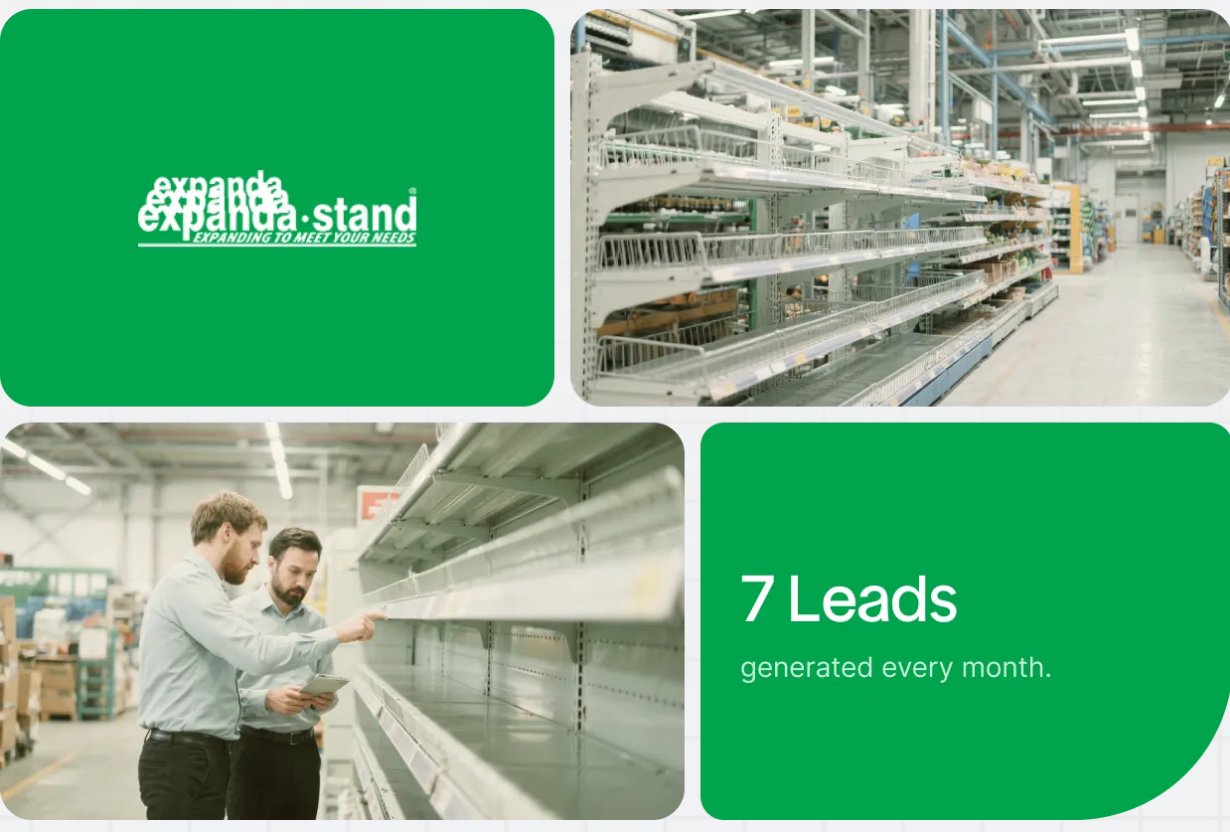
The Problem: An ISO‑Certified Manufacturer Buyers Couldn’t Find Online
Expanda Stand designs and manufactures:
- Custom retail display racks.
- Modular stands.
- Industrial storage systems.
Their clients include:
- Retail chains.
- Distributors.
- Warehouses.
- Healthcare facilities.
- Commercial spaces across India and globally.
The company is ISO‑certified, with proven product and operational capability. What it lacked was online visibility.
- Monthly visitors before: 137 (mostly people who already knew the company).
- Inbound leads: 1–2 every 2–3 months.
- Predictability: None.
- Search visibility: Invisible for key queries like:
- “custom retail display racks.”
- “warehouse storage systems.”
- “modular display stands.”
Without a marketing team or a system to capture online demand, Expanda was invisible exactly when potential buyers began their research — and missing a major opportunity to scale.
The Solution: Building a Lead Channel That Runs on Autopilot
1. Deep Knowledge Architecture (Brand Memory)
We mapped:
- Product lines: custom retail display racks, modular stands, industrial storage systems.
- Certifications: ISO certification.
- Manufacturing capabilities: what Expanda can build and at what scale.
- Target industries: retail, distribution, warehouses, healthcare, commercial spaces.
- Buyer language: how clients actually search for solutions like “custom retail display racks manufacturer” or “warehouse storage solutions India.”
Every page created was grounded in this reality — not generic marketing fluff.
2. Buyer Query Mapping
We identified high‑intent queries buyers were already typing:
- Product‑specific: “Custom retail display racks manufacturer.”
- Geographic: “Warehouse storage solutions India.”
- Use‑case: “Modular display stands for shops.”
These became the backbone of the content strategy
3. Content Infrastructure Focused on Industrial Buyers
- Pages published: 100+.
- Content type: Not generic blogs, but high‑specificity pages that match a particular buyer need to a particular Expanda capability.
- Optimization: Built to surface on Google, ChatGPT, Gemini, and other AI search engines.
Each page answered a real question industrial buyers ask during consideration.
Authority and Visibility (Content Management Suite
The system handled everything behind the scenes:
- Backlink building from authoritative industry sources.
- Content refresh as search patterns changed.
- Technical optimizations (page speed, mobile‑friendliness, structured data).
All this ran continuously — without content calendars or manual keyword decisions.
5. Lead Management (Leads Dashboard)
When traffic started coming:
- Spam filtering removed junk automatically.
- Real‑time alerts notified the team of genuine inquiries.
- Only qualified leads reached the sales team, with context on what the buyer had searched and read.
6. Analytics and Visibility
The system tracked:
- Which pages attracted real buyers.
- How AI search bots crawled and indexed the site.
- Which queries drove qualified visitors.
The entire system ran with zero touch from Expanda:
- No content reviews.
- No marketing hires.
- No content calendars.
The team stayed focused on manufacturing and fulfillment while the website worked 24/7.
The Results: From 1 Lead a Quarter to 7 Leads Every Month in 4 Months
First Lead in 21 Days
- Time to first qualified lead: 21 days.
- Lead source: A buyer who found Expanda by searching for a specific solution.
- Buyer readiness: Referenced exact product types and use cases — a direct result of query‑specific content.
After a 1‑lead‑per‑quarter pattern, this was a massive acceleration.
Lead Generation Transformation
- Before: 1–2 leads every 2–3 months.
- By month 4: 6–7 qualified leads per month.
These weren’t generic form fills. Buyers came in referencing:
- Specific products.
- Specific solutions.
- Real‑world use cases.
The pipeline was now predictable and compounding.
Search and AI Visibility
- Search queries ranking: 45+ industrial and retail display queries.
- Rankings: Multiple queries at the top of Google.
- AI search visibility: Expanda was featured in Google’s AI Overview, where AI‑powered search actively recommends Expanda to buyers.
What Changed: Website as an Active Demand Engine
Before
- 137 monthly visitors (mostly known contacts).
- 1–2 leads every 2–3 months.
- Invisible for key search queries.
- No marketing team or system to capture demand.
- A professional‑looking website that generated zero leads.
After
- 6–7 qualified leads every month.
- First lead in 21 days.
- 45+ search queries ranking.
- Featured in Google AI Overview.
- The website running on autopilot, with zero time required from the team.
- Inbound leads now a predictable, compounding channel.
The mindset shifted from:
“Can we find enough buyers to fill capacity?”
to
“Can we scale production to meet the demand the website is generating?”

Key Takeaways for GEO‑Focused Growth in Manufacturing
Why This Approach Worked
- Deep business context first — every page grounded in how Expanda talks and how buyers search.
- 100+ buyer‑query‑driven pages — no generic content, just specific matches of need to capability.
- AI search optimization — built to surface on ChatGPT, Gemini, and Google AI Overview.
- Hands‑off execution — zero marketing hires or manual steps.
- Spam‑filtered lead dashboard — only qualified, informed leads reached the team.
- Continuous optimization — backlinks, content refresh, and technical work all ran automatically.
GEO Best Practices for Manufacturing
- Industrial buyers combine product + location + intent (“custom retail display racks manufacturer”). Content must match that specificity.
- Being featured in Google AI Overview requires content structured for extraction and grounded in real manufacturing capability.
- For industries with long sales cycles, sustained, early‑stage pipeline creation matters more than speed.
- This system runs on autopilot and compounds month‑over‑month without additional input.