

How Do I Track AI Visibility Performance? There’s No ‘Rank #1’ in AI Answers — What Metrics Matter?
How to track AI visibility performance? This is one of the most frustrating questions for marketers in 2026. How to track AI citations is not as hard as you think once you understand the right metrics.
“I’ve been optimizing for AI search for 4 weeks. But I can’t see a ‘rank #1’ like I do in Google. How do I know if anything is working?”
The frustration is real. You can’t track AI visibility like SEO. There is no position #1. There is no click-through rate. There is no impression share.
According to Gartner, traditional search volume will drop 25% by 2026, making AI search performance tracking essential. If you are still learning the basics, read our guide on what is AI visibility vs SEO first. Then come back to track your progress.
This guide is brought to you by HumanReach.ai, an organic growth agency that helps brands become the answer AI trusts and cites. The framework below is the same methodology HumanReach.ai uses to track AI visibility for its clients.
This guide gives you 4 metrics that actually matter for AI citations — and a simple tracking dashboard you can set up in 15 minutes per week. For the complete framework on getting cited, read how to get your brand into AI answers.
📑 Table of Contents
- The mindset shift: SEO vs AI visibility tracking
- Metric #1: Citation presence
- Metric #2: Branded search lift
- Metric #3: Assisted conversions
- Metric #4: Share of voice in AI
- Your AI visibility tracking dashboard
- Frequently Asked Questions (FAQ)
- The bottom line
The mindset shift: SEO vs AI visibility tracking
You need to shift your mindset:
| Dimension | SEO tracking | AI visibility tracking |
|---|---|---|
| Metric type | Position (1, 2, 3…) | Presence (Yes/No) |
| Frequency | Daily | Weekly |
| Tools | Semrush, Ahrefs, GSC | ChatGPT, Perplexity, Gemini |
| Goal | Higher ranking | More citations |
The bottom line: Don’t track AI search performance like SEO. Different game. Different metrics.
📊 How to Track GEO Performance in 2026
Explore this comprehensive visual guide that solves the GEO measurement problem. It maps out the new AI visibility funnel — from AI visibility to citations to branded search to revenue — and breaks down the 5 metrics that actually matter: Citation Rate, AI Share of Voice, Brand Mentions, Brand Demand, and Revenue Impact. The infographic also clarifies what not to track (rankings only, organic traffic only, CTR only) and provides a complete GEO dashboard framework and reporting stack. A must-see resource for anyone wondering how to track AI search performance without a traditional rank tracker.
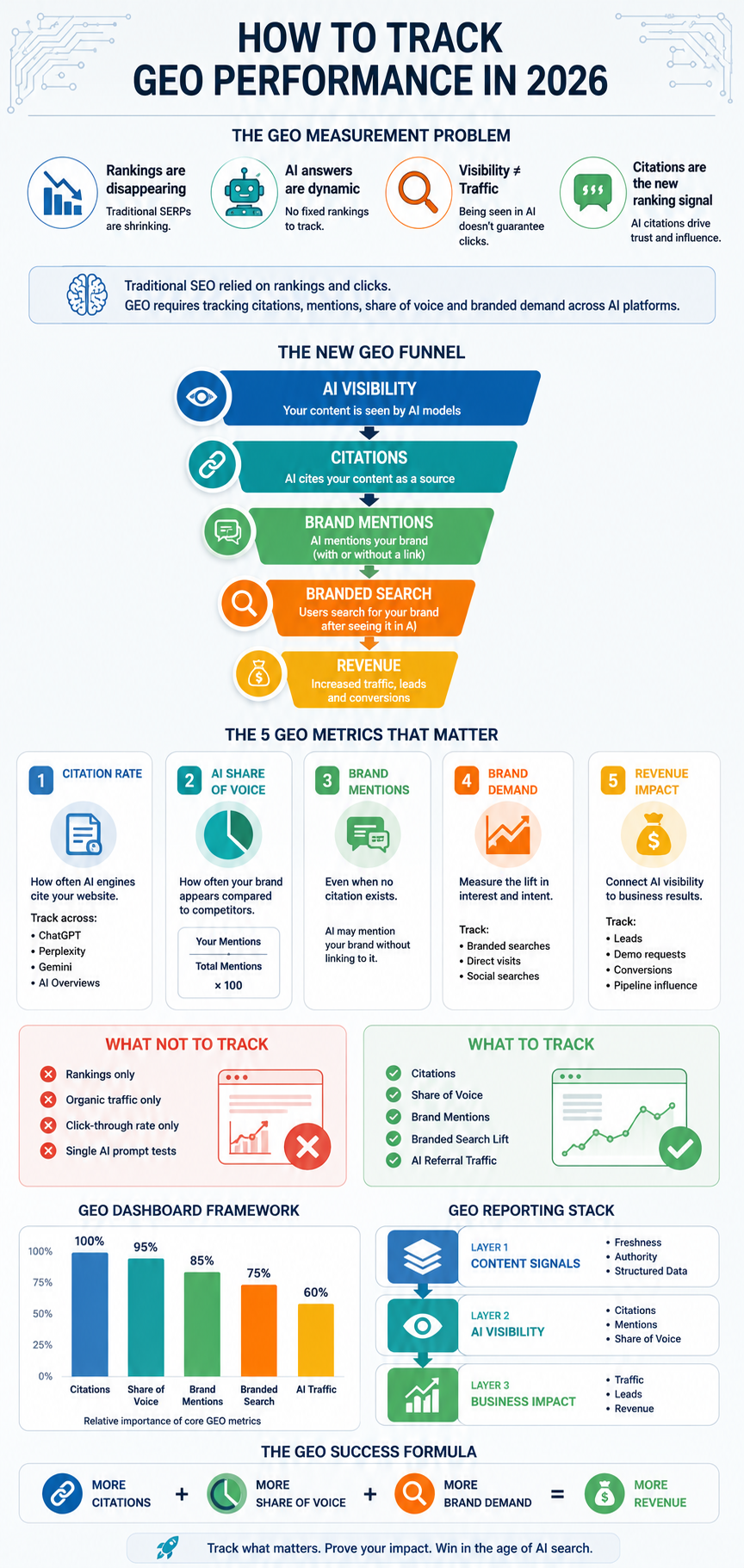
💡 Click the image to enlarge or download it for quick reference.
Metric #1: Citation presence
What it is: Are you being cited by AI search engines?
How to track it:
- Open ChatGPT
- Ask: “What is the best [your category]?”
- Ask: “Tell me about [your brand name]”
- Ask: “How do I [your core customer problem]?”
- Document: Are you cited? Yes/No
- Repeat weekly
What progress looks like:
- Week 1: No citations
- Week 2: No citations
- Week 3: Perplexity cites you
- Week 4: ChatGPT cites you
That’s winning. Not overnight.
Metric #2: Branded search lift
What it is: Are people searching for you by name after seeing you in AI answers?
How to track it:
- Go to Google Search Console
- Filter by branded keywords (your brand name)
- Compare month over month
- Look for upward trend
What progress looks like:
If branded search is up 10-20% while organic clicks are flat or down → AI visibility is working.
✨ Want to know how your brand is performing in AI search? You don’t have to guess.
At HumanReach.ai, we build AI‑visible content engines that turn your expertise into trusted citations. Visit HumanReach.ai to explore how we help brands win in the AI search era.
Metric #3: Assisted conversions
What it is: Are people converting without clicking directly from AI?
How to track it:
- Go to Google Analytics
- Look at “Direct” traffic trend
- Look at “Branded” traffic trend
- Compare before vs after AI visibility implementation
What progress looks like:
If direct + branded traffic are up 15-20% → AI citations are driving value.
Metric #4: Share of voice in AI
What it is: Who is AI citing in your niche? What percentage is you?
How to track it:
- Ask Perplexity: “Best [your category] companies”
- List every brand cited
- Count how many times YOU appear
- Calculate your share: (your mentions ÷ total mentions) × 100
What progress looks like:
Share of voice increasing from 0% to 5% to 15% = your visibility is growing.
Your AI visibility tracking dashboard
Weekly (15 minutes):
| Metric | Week 1 | Week 2 | Week 3 | Week 4 | Trend |
|---|---|---|---|---|---|
| Cited by ChatGPT? | No | No | No | Yes | 📈 |
| Cited by Perplexity? | No | No | Yes | Yes | 📈 |
| Cited by Gemini? | No | No | No | No | ➡️ |
| Branded search lift | +0% | +2% | +5% | +8% | 📈 |
Monthly (10 minutes): Check assisted conversions trend.
Quarterly (15 minutes): Calculate share of voice in AI.
Frequently Asked Questions (FAQ)
1. How do I track AI visibility performance without a rank tracker?
You can’t use traditional rank trackers for AI visibility because there is no ‘position #1’ in AI answers. Instead, track four metrics manually: citation presence (ask AI about your brand weekly), branded search lift (Google Search Console), assisted conversions (Google Analytics), and share of voice in AI (manual audit). This takes 15 minutes per week.
2. What is the most important AI visibility metric?
Start with citation presence (Yes/No). Is your brand cited by ChatGPT, Perplexity, or Gemini? That is your baseline. Once you are getting AI citations, track branded search lift. If people see you in AI answers, they search for you by name later. That is the clearest signal that AI search performance is driving real business value.
3. How often should I track AI visibility metrics?
Weekly for citation presence (5 minutes). Monthly for branded search lift (10 minutes). Quarterly for assisted conversions and share of voice (15 minutes). Don’t obsess. Just track trends.
4. What does progress look like in AI visibility?
Week 1: No citations. Week 2: No citations. Week 3: Perplexity cites you. Week 4: ChatGPT cites you. Week 8: Branded search +10%. That’s winning. Not overnight. Progress is slower than SEO but compounds faster.
5. Can I automate AI visibility tracking?
Partially. Google Search Console automates branded search lift. Google Analytics automates assisted conversions. But citation presence still requires manual checking (asking AI questions). Some paid tools are starting to add AI citation tracking, but manual is fine to start.
6. How do I know if AI visibility is working if organic clicks go down?
If branded search lift and assisted conversions are up, AI citations are working — even if organic clicks go down slightly. Users see you in AI answers, don’t click, but search for you directly later or convert through another channel. Track the full picture, not just clicks.
7. What is a good branded search lift percentage?
Based on case studies, 10-20% branded search lift over 8-12 weeks is considered good. 20-30% is excellent. More than that is exceptional. Track month over month, not week over week.
8. How do I track competitors’ AI visibility performance?
Ask Perplexity: ‘Best [your category] companies’ and list every brand cited. Calculate their share of voice. Repeat monthly. If your competitor’s share is growing and yours isn’t, you need to adjust your AI search optimization strategy. Read our guide on how to get your brand into AI answers for tactics.
9. What tools do I need to track AI visibility?
Free tools: ChatGPT (citation check), Perplexity (citation check), Google Search Console (branded search lift), Google Analytics (assisted conversions). That’s it. You don’t need expensive software to start.
10. How long until I see measurable AI visibility results?
Citations: 3-4 weeks (Perplexity), 4-6 weeks (ChatGPT). Branded search lift: 8-12 weeks. Assisted conversions: 3-4 months. AI search performance is faster than SEO but still takes patience. Track weekly to stay motivated.
The bottom line
How to track AI visibility performance?
You don’t need a rank tracker. You need these 4 metrics:
| Metric | Frequency | Tool | What progress looks like |
|---|---|---|---|
| Citation presence | Weekly | ChatGPT, Perplexity | No → Yes |
| Branded search lift | Monthly | Google Search Console | +10-20% |
| Assisted conversions | Quarterly | Google Analytics | +15-20% |
| Share of voice in AI | Quarterly | Manual audit | Increasing % |
Your AI visibility tracking dashboard (15 minutes/week):
☐ Ask ChatGPT about your brand (Yes/No)
☐ Ask Perplexity about your category (Yes/No)
☐ Check branded search trend (GSC)
☐ Document in a simple spreadsheet
Stop guessing. Start tracking.
Source: HumanReach.ai — Helping brands become the answer AI trusts and cites.
This article is part of the HumanReach.ai AI Visibility Resource Hub.
Ready to Build Your Own AI‑Visible Pipeline?
You don’t need to be a content expert. You don’t need a big agency. You need the right framework and the right engine.
About the author: This guide was created by HumanReach.ai, an organic growth agency that helps local and global businesses thrive in the AI Search Reality. Visit HumanReach.ai to learn more.