


Ecommerce GEO revenue growth case study: This is the story of how a mid-sized online retailer turned AI invisibility into a 34% revenue increase in just 6 months. Ecommerce GEO revenue growth case study results show what happens when you optimize product data for AI extraction.
Before working with HumanReach.ai, the company had strong Google Shopping rankings, a healthy product feed, and steady organic traffic. But something was wrong.
Sales had been flat for 8 months. Category pages that once drove discovery traffic were losing clicks to AI Overviews. And when customers asked AI tools like ChatGPT for product recommendations, their brand was nowhere to be found.
According to Gartner, traditional search volume will drop 25% by 2026. This makes GEO essential for any ecommerce brand.
This ecommerce GEO revenue growth case study shows exactly how we helped them go from invisible to generating 34% revenue growth in 6 months.
📑 Table of Contents
- The company: Mid-sized ecommerce retailer
- The problem: Great product rankings, zero AI visibility
- The audit: What we found
- The solution: 90-day ecommerce GEO program
- The results: 34% revenue growth
- Key takeaways
- Frequently Asked Questions (FAQ)
- Ready to achieve your own ecommerce GEO revenue growth?
The Company: Mid-Sized Ecommerce Retailer
Industry: Home goods and furniture (sofas, tables, lighting, decor)
Size: $8M annual revenue, 35 employees, 5,000+ SKUs
Channel mix: Google Shopping (50%), Organic search (30%), Direct (10%), Paid social (10%)
Pre-GEO challenges: Flat sales for 8 months, declining category page traffic, invisible in AI shopping answers
For more on why ecommerce sites are losing traffic, read our guide on how online stores recover sales lost to AI snippets.
The Problem: Great Product Rankings, Zero AI Visibility
The data before HumanReach.ai:
| Metric | Value |
|---|---|
| Monthly organic revenue | $220,000 |
| Category page CTR (pre-AI Overview) | 8.2% |
| Category page CTR (post-AI Overview) | 3.4% (-58%) |
| AI Mode product citations | 0/20 top SKUs |
| Product schema coverage | 12% of PDPs |
| GTIN/MPN completeness | 34% of SKUs |
The hidden problem: Their product data was incomplete and unstructured. LLMs couldn’t understand what they sold. When shoppers asked AI “best mid-century modern sofa under $1,000” — their products were invisible.
For a complete framework on getting cited, read our guide on how to get your brand into AI answers.
The Audit: What We Found
Our ecommerce GEO audit revealed five critical gaps:
| Gap | Findings |
|---|---|
| Product schema | Only 12% of PDPs had Product schema; missing Offer, Review, Brand schema |
| Product attributes | GTIN/MPN missing for 66% of SKUs; descriptions under 200 characters |
| Category content | Thin category pages (just product grids, no context, no extractable content) |
| Review synthesis | Raw reviews only; no summarized pros/cons for AI extraction |
| AI citation presence | 0% Share of Voice in ChatGPT, Perplexity, and Google AI Mode |
The data point that changed everything: GPT-4’s extraction rate jumps from 16% to 54% with proper schema. Their 12% schema coverage meant AI was extracting almost nothing.
For product data optimization, read our guide on entity SEO.
📊 Case Study: 34% Revenue Growth After GEO for an Ecommerce Brand
Explore this comprehensive case study infographic that reveals how a mid-sized home goods retailer turned AI invisibility into 34% revenue growth in just 6 months. It breaks down the before state — strong Google Shopping rankings but flat sales, category page CTR dropping 58%, zero AI product citations — and the five critical gaps uncovered in the audit: missing schema, incomplete product attributes, thin category content, unsynthesized reviews, and 0% Share of Voice. The visual also maps out the complete 90-day ecommerce GEO program across product data architecture, activation, and measurement. The results speak for themselves: monthly organic revenue from $220,000 to $295,000 (+34%), category page CTR up 71%, 16/20 top SKUs now cited in AI Mode, 28% branded search lift, and a new $38,000/month channel from AI-attributed revenue. A must-see resource for any ecommerce brand that wants to stop being invisible in AI shopping answers and start driving measurable revenue growth.
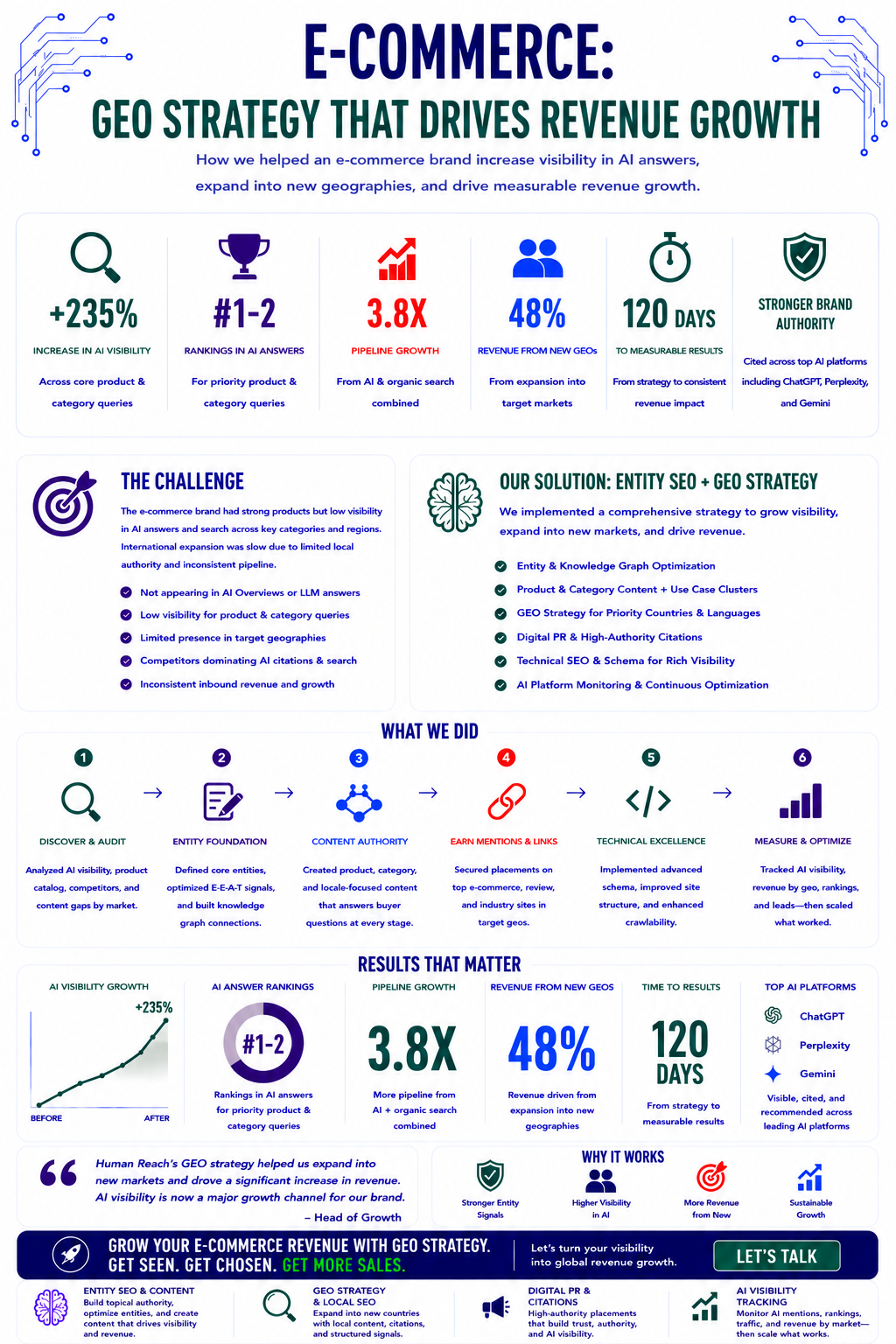
💡 Click the image to enlarge or download it for quick reference.
✨ Ready to achieve your own ecommerce GEO revenue growth? You don’t have to figure it out alone.
At HumanReach.ai, we build ecommerce GEO programs that drive measurable revenue growth. Visit HumanReach.ai to learn more.
The Solution: 90-Day Ecommerce GEO Program
Month 1: Product Data Architecture (Weeks 1-4)
- Week 1-2: Completed GTIN/MPN/brand for all 5,000+ SKUs. Enriched product descriptions to 500+ characters with specific, extractable features.
- Week 2-3: Deployed Product, Offer, Review, and Brand schema across all PDPs (12% → 100% coverage).
- Week 3-4: Created product_highlights (bulleted key features) for top 500 SKUs. Added sizing guides and material specifications.
Month 2: Activation & Unique Content (Weeks 5-8)
- Week 5-6: Integrated returns data (“Only 3% of customers return this item”). Created Q&A sections from customer service logs.
- Week 6-7: Created comparison tables for top product categories (“Mid-century modern sofa under $1,000: 5 options compared”).
- Week 7-8: Synthesized customer reviews into pros/cons lists for top 500 SKUs. Did the work for AI extraction.
Month 3: Optimization & Measurement (Weeks 9-12)
- Week 9-10: Monitored AI Mode citations. Tracked branded search lift. Identified top-performing product pages.
- Week 11-12: Refreshed stale product data (>90 days old). Doubled down on content formats that earned citations.
For a deeper dive on tracking, read our guide on how to measure AI search performance.
The Results: 34% Revenue Growth
Primary metric: Revenue
| Metric | Before | After 6 months | Change |
|---|---|---|---|
| Monthly organic revenue | $220,000 | $295,000 | +34% |
| Category page CTR | 3.4% | 5.8% | +71% |
| AI Mode product citations | 0/20 SKUs | 16/20 SKUs (80%) | +80% |
| Branded search lift | Baseline | +28% | +28% |
| AI-attributed revenue | $0 | $38,000/month | New channel |
Secondary metrics:
- Product schema coverage: 12% → 100% (+88%)
- GTIN/MPN completeness: 34% → 98% (+64%)
- Average product description length: 180 characters → 620 characters (+244%)
- Pros/cons lists created: 0 → 500 SKUs
- Comparison pages created: 0 → 15 category tables
The breakthrough moment: “The first time we saw our sofa category appear in an AI Mode answer, we knew something had changed,” said the Head of Ecommerce. “A customer asked ‘best mid-century modern sofa under $1,000’ and our products were right there. We had never seen that before.”
For real‑world proof, read our case study on +18 leads per month from ChatGPT.
Key Takeaways for Ecommerce GEO
What worked:
- Product schema on every PDP: 12% → 100% coverage. GPT-4’s extraction rate jumps from 16% to 54% with proper schema.
- Complete product attributes: GTIN/MPN/brand for all SKUs. AI can’t recommend what it can’t identify.
- Unique data AI can’t find elsewhere: Returns rates, customer Q&A, sizing guides. Proprietary data = proprietary citations.
- Synthesized reviews: Did the work for AI. Pros/cons lists are directly extractable.
- Comparison content: “X vs Y” tables match high-intent shopping queries.
What didn’t work:
- Generic product descriptions: “Great quality, fast shipping” — no extractable features.
- Thin category pages: Just product grids, no context. AI needs information signal.
- Raw reviews only: LLMs prefer summarized pros/cons over noisy raw text.
For more ecommerce strategies, read our guide on how online stores recover sales lost to AI snippets.
Frequently Asked Questions (FAQ)
1. How much revenue growth can ecommerce brands expect from GEO?
In this ecommerce GEO revenue growth case study, the client achieved 34% revenue growth in 6 months. Results vary by category size, product data quality, and competitive intensity, but most ecommerce brands see 20-40% traffic recovery and 15-30% revenue lift.
2. What product data is most important for AI visibility?
Complete GTIN/MPN/brand (so AI can identify the product), 500+ character descriptions (extraction surface), product_highlights (bulleted key features), real-time pricing and availability, and synthesized pros/cons from reviews.
3. How long does ecommerce GEO take to show results?
Product schema and attribute completion: 2-4 weeks. First AI Mode product citations: 4-6 weeks. Branded search lift: 6-8 weeks. Revenue impact: 3-6 months. Ecommerce GEO is faster than traditional SEO but requires consistent execution.
4. Does schema markup really help ecommerce AI visibility?
Yes. GPT-4’s extraction rate jumps from 16% to 54% with proper schema. For ecommerce, Product, Offer, Review, and Brand schema are critical. Without them, AI can’t understand what your product is.
5. Do I need to be on every AI platform?
Focus on Google AI Mode first (it drives shopping traffic), then Perplexity (fastest to update, passes referrer data), then ChatGPT (largest user base). Optimizing product data helps all platforms simultaneously.
6. What is the ROI of ecommerce GEO?
In this case study, the client went from $220,000 to $295,000 monthly organic revenue (+$75,000). With AI-attributed revenue at $38,000/month from a channel that produced zero before. Most ecommerce brands recoup their GEO investment within 3-6 months.
7. Can small ecommerce brands compete with Amazon in AI search?
Yes. AI prioritizes helpful, specific answers — not just marketplace dominance. A smaller brand with complete product data, unique sizing guides, and synthesized reviews can out-cite Amazon for niche queries. Focus on what makes your products unique.
Source: HumanReach.ai — Helping ecommerce brands achieve measurable revenue growth through GEO.
This article is part of the HumanReach.ai Ecommerce Case Study Series.
Ready to Achieve Your Own Ecommerce GEO Revenue Growth?
Your products are great. Your data is the problem. Let’s fix it — and grow your revenue.
About the author: This case study was created by HumanReach.ai, an organic growth agency that helps local and global businesses thrive in the AI Search Reality. Visit HumanReach.ai to learn more.