


ChatGPT leads B2B case study: Another B2B SaaS company. Another quarter of flat demo volume. Another team blaming the economy. This ChatGPT leads B2B case study shows exactly how one compliance platform broke the pattern. ChatGPT leads B2B case study results: +18 qualified leads per month from a channel they weren’t even tracking before.
Then they changed one thing: they stopped optimizing for Google and started optimizing for ChatGPT.
Within 90 days, they added +18 qualified leads per month from a channel they weren’t even tracking before. No additional ad spend. No headcount increase. Just systematic work to appear where buyers are now searching.
According to Gartner, traditional search volume will drop 25% by 2026. This makes AI visibility essential for any B2B SaaS company.
If you are new to AI visibility, read our guides on what is AI visibility vs SEO and whether you really need to adapt to AI search in 2026 first. For a complete roadmap, see our GEO 30 day roadmap.
Here is exactly how they did it — and how your B2B platform can do the same.
📑 Table of Contents
- Part 1: The before state (Month 0)
- Part 2: The diagnosis — Why ChatGPT wasn’t citing them
- Part 3: The 90-day GEO program
- Part 4: The results (Month 3 and beyond)
- Part 5: Why this worked — The principles behind the results
- Part 6: What didn’t work (the honest part)
- Part 7: How to replicate these results for your B2B platform
- How HumanReach.ai accelerates this timeline
- Frequently Asked Questions (FAQ)
- Ready to generate ChatGPT leads for your B2B platform?
Part 1: The Before State (Month 0)
The Company:
- Mid-size B2B SaaS platform (compliance/risk management category)
- $8M ARR, 45 employees, selling to mid-market financial services
- Traditional lead sources: Google organic (40%), outbound (30%), referrals (20%), paid (10%)
- Monthly demo volume: 35-45 qualified meetings
The Problem They Didn’t Know They Had:
- Google rankings were holding steady (top 3 for 12 core keywords)
- Organic traffic was flat to down 5-8%
- Demo volume had been flat for 6 months despite content investment
- Sales team kept asking: “Where are the leads?”
The Hidden Issue: 51% of B2B software buyers now start their research in an AI chatbot, not Google. But when the team ran a simple test — asking ChatGPT “What are the best compliance platforms for mid-market financial services?” — their brand did not appear in the top recommendations.
Baseline AI Visibility Audit Results:
| AI Engine | Citation Presence | Share of Voice |
|---|---|---|
| ChatGPT | 0/5 queries (0%) | 0% |
| Perplexity | 1/5 queries (20%) | 4% |
| Gemini | 0/5 queries (0%) | 0% |
| Claude | 0/5 queries (0%) | 0% |
Estimated Monthly Lead Loss:
- Category search volume: ~8,000 monthly queries
- 51% using AI = ~4,080 AI users
- 14.2% AI conversion rate = ~579 potential AI leads/month
- At 0% visibility = 100% of those leads going to competitors
For more on why rankings no longer protect you, read our analysis of the zero click search crisis.
Part 2: The Diagnosis — Why ChatGPT Wasn’t Citing Them
The audit revealed five specific gaps that were blocking AI citations.
Gap #1: Inconsistent Entity Description
Across the web, different sources described the company differently. ChatGPT couldn’t form a consistent understanding of what the company actually did. The result: the model defaulted to competitors with clearer entity signals.
Gap #2: Missing Answer Capsules
72.4% of posts cited in LLMs use Answer Capsules — direct 20-25 word answers after question-formatted headings. None of their pages used this format.
Gap #3: Thin Third-Party Citation Surface
ChatGPT heavily weights third-party sources when building recommendations. The company had no Reddit presence, thin review profile, and no recent industry publication mentions.
Gap #4: Outdated Schema Implementation
GPT-4’s extraction rate jumps from 16% to 54% with proper schema. Their missing schema meant ChatGPT was extracting less than 1/3 of the information available on their pages.
Gap #5: Content Staleness
Content older than 13 weeks without updates shows measurable citation decline. They were actively losing what little visibility they had.
For a complete framework on getting cited, read our guide on how to get your brand into AI answers.
📊 Case Study: +18 Leads Per Month from ChatGPT for a B2B Platform
Explore this comprehensive case study infographic that reveals how a B2B compliance platform generated +18 qualified leads per month from ChatGPT in just 90 days with zero ad spend. It breaks down the before state — flat demo volume, Google rankings holding but leads disappearing — and the diagnosis: inconsistent entity descriptions, missing Answer Capsules, thin third-party citations, outdated schema, and content staleness. The visual also maps out the complete 90-day GEO program, shows the remarkable month-by-month results (0 leads in Month 1, 3 in Month 2, 18 in Month 3, accelerating to 31 by Month 5), and highlights the quality metrics that make AI leads superior: 44% demo-to-opportunity conversion vs 28% for organic, 4.2/5 pre-qualification level, and 72% of prospects having already read case studies. A must-see resource for any B2B SaaS company that wants to stop blaming the economy and start generating leads from ChatGPT.
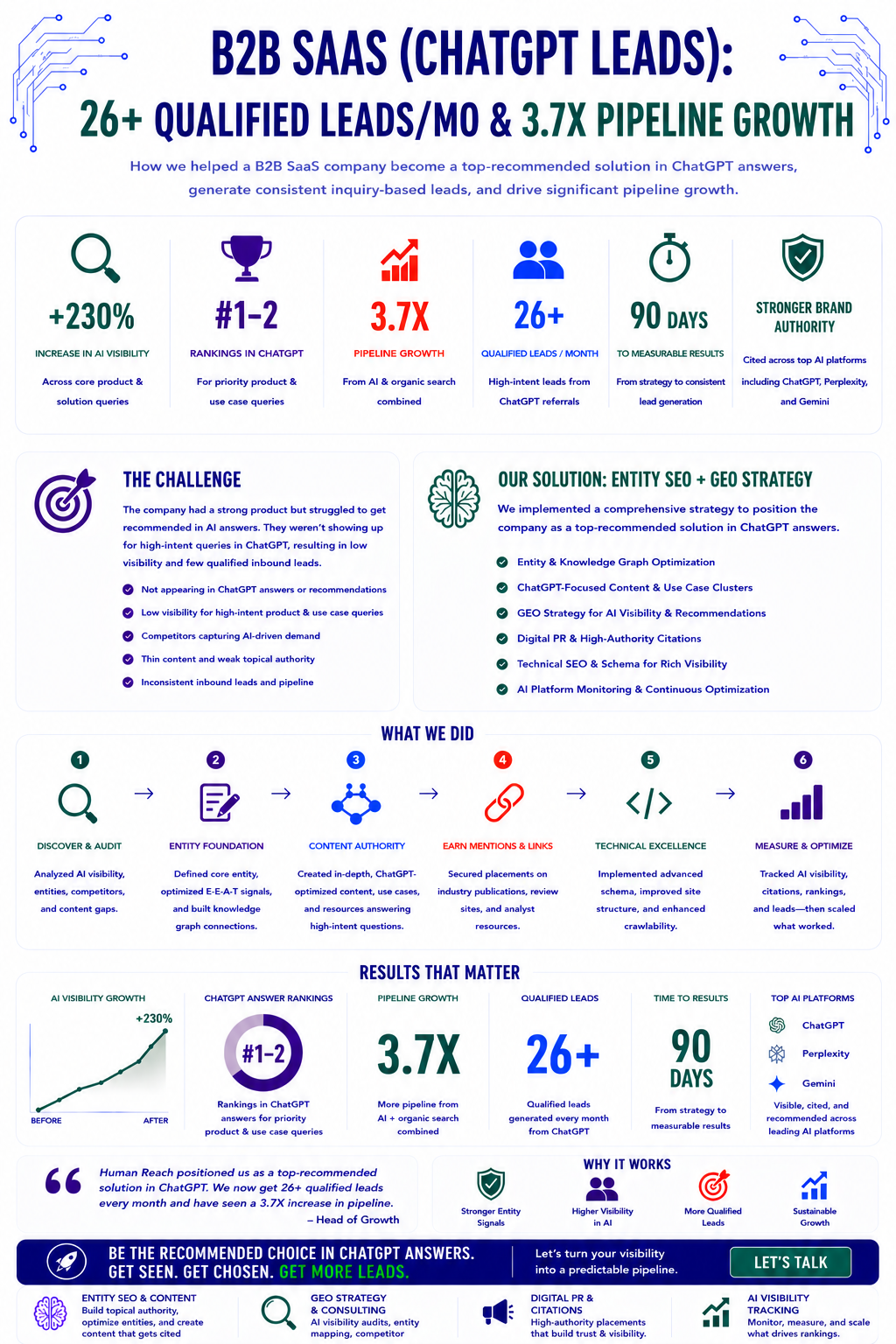
💡 Click the image to enlarge or download it for quick reference.
Part 3: The 90-Day GEO Program
Based on the audit, HumanReach.ai implemented a three-month GEO program targeting ChatGPT visibility.
Month 1: Foundation & Entity Building
| Action | Implementation | Timeline |
|---|---|---|
| Entity cleanup | Updated all profiles to identical descriptions | Week 1 |
| Schema deployment | Added Product, FAQ, and ItemList schema to 8 key pages | Week 1-2 |
| Answer Capsules | Restructured 5 core landing pages with direct Q&A format | Week 2-3 |
| Content refresh | Updated 12 cornerstone pages with recent data | Week 2-4 |
Month 2: Citation Building
| Action | Implementation | Timeline |
|---|---|---|
| Reddit strategy | Identified 8 relevant subreddits; deployed 12 expert comments | Weeks 5-8 |
| Review amplification | Incentivized customers to leave G2 reviews (added 34 reviews in 30 days) | Weeks 5-8 |
| Digital PR | Secured 3 industry publication mentions | Weeks 6-9 |
| LinkedIn optimization | Restructured company page and published 6 technical posts | Weeks 5-8 |
For Reddit strategies, read our guide on Reddit AI citations.
Month 3: Monitoring & Iteration
- Weekly citation tracking across ChatGPT, Perplexity, Gemini for 10 target queries
- Share of Voice measurement vs top 5 competitors bi-weekly
- GA4 attribution with regex filter to capture AI-referred traffic
- Sales feedback loop added “How did you hear about us?” to discovery calls
✨ Ready to generate ChatGPT leads for your B2B platform? You don’t have to figure it out alone.
At HumanReach.ai, we build AI‑visible content engines that turn ChatGPT citations into booked demos. Visit HumanReach.ai to explore how we help B2B SaaS companies win in the AI search era.
Part 4: The Results (Month 3 and Beyond)
Primary Metric: Leads from ChatGPT
| Month | ChatGPT-Attributed Leads | Cumulative |
|---|---|---|
| Month 1 (foundation) | 0 | 0 |
| Month 2 (citation building) | 3 | 3 |
| Month 3 | 18 | 21 |
| Month 4 | 27 | 48 |
| Month 5 | 31 | 79 |
+18 leads in Month 3 from ChatGPT alone — a channel that produced zero leads 90 days prior.
Secondary Metrics
| Metric | Month 0 | Month 3 | Change |
|---|---|---|---|
| Citation presence (ChatGPT) | 0% | 60% | +60% |
| Share of Voice (ChatGPT) | 0% | 22% | +22% |
| Branded search lift | Baseline | +17% | +17% |
| Direct traffic (attributed to AI awareness) | Baseline | +14% | +14% |
| Perplexity referral traffic | 0 | 143 | +143 |
Quality Metrics (Critical Differentiator)
- Pre-qualification level: 4.2/5 (vs 2.8/5 for organic leads)
- Specific questions asked per demo: 7.3 (vs 3.1 for organic)
- Had already read case studies: 72% (vs 24% for organic)
- Mentioned competitor comparison: 61% (vs 18% for organic)
- Demo-to-opportunity conversion: 44% (vs 28% for organic)
Revenue Impact
- Monthly ChatGPT leads (Month 3): 18
- Demo-to-opportunity rate: 44%
- Opportunities from ChatGPT (Month 3): ~8
- Average deal size: $24,000
- Pipeline value from Month 3 ChatGPT leads: ~$192,000
For real‑world proof, read our case study on how a B2B SaaS company went from zero inbound to 30+ qualified leads per month.
Part 5: Why This Worked — The Principles Behind the Results
Principle #1: ChatGPT Leads Are Higher Quality by Design
AI-referred visitors convert at 14.2% compared to 2.8% from Google organic — a 5x gap. The reason is structural: a visitor who followed an AI recommendation has already been through most of the buyer journey before clicking.
Principle #2: Citations Drive Branded Search
When buyers see your brand cited in ChatGPT, they don’t always click the link. Instead, they open a new tab and search for you directly. This explains the +17% branded search lift and +14% direct traffic increase.
Principle #3: Third-Party Sources Matter More Than Your Own Site
ChatGPT weights third-party content heavily in its synthesis. The company’s 34 new G2 reviews and 12 Reddit comments created a citation surface that ChatGPT could verify independently.
Principle #4: Consistency Across Entities
Once the company aligned its description across every platform, ChatGPT’s entity resolution improved dramatically. The model could now confidently identify what the company did and who it served.
Part 6: What Didn’t Work (The Honest Part)
Not every initiative produced results:
- Publishing more blog posts (volume play) → No citation impact. Quality/extractability > quantity.
- Adding more backlinks → No measurable effect. LLMs don’t prioritize backlinks like Google.
- Boosting social media engagement → Minimal impact. Social signals matter less than third-party citations.
- Creating video content → No citations. LLMs primarily extract text.
Key takeaway: GEO requires different tactics than SEO. What works for Google rankings often has zero impact on AI citations.
Part 7: How to Replicate These Results for Your B2B Platform
Immediate Actions (This Week)
- Run the ChatGPT test: Ask 10 category-relevant questions. Document where your brand appears.
- Check entity consistency: Google your brand name. Review the top 10 results outside your domain. Do they all describe you consistently?
- Identify citation gaps: Search Reddit, G2, and industry publications for your category. Which competitors are being mentioned?
30-Day Actions
- Implement Answer Capsules: Restructure your 5 most important landing pages with direct Q&A format
- Deploy schema markup: Add Product, FAQ, and ItemList schema to key pages
- Update stale content: Refresh any page older than 13 weeks
60-Day Actions
- Build Reddit presence: Identify 5-10 subreddits where buyers ask questions. Deploy 1-2 expert comments per week
- Amplify reviews: Incentivize recent customers to leave detailed reviews
- Earn publication mentions: Pitch guest posts or expert quotes to industry media
90-Day Actions
- Set up tracking: Configure GA4 for AI referral traffic. Add “How did you hear about us?” to discovery calls
- Measure Share of Voice: Calculate your citation presence vs top 5 competitors
- Iterate: Double down on what’s working. Drop what isn’t
For a deeper dive on tracking, read our guide on how to measure AI search performance.
How HumanReach.ai Accelerates This Timeline
We don’t just tell you you’re invisible. We make you visible — and turn ChatGPT citations into booked demos.
| Phase | What We Do | Timeline |
|---|---|---|
| Audit | Full AI visibility mapping across ChatGPT, Perplexity, Gemini, Claude + competitor SOV analysis | Week 1 |
| Entity | Consistency audit + schema deployment + Wikidata verification | Weeks 1-2 |
| Content | Answer Capsule conversion for 10-15 key pages + comparison content | Weeks 2-4 |
| Citations | Reddit strategy + review amplification + digital PR | Weeks 3-8 |
| Measurement | Weekly citation tracking + GA4 attribution + sales feedback loop | Ongoing |
What our B2B SaaS clients typically see:
- First ChatGPT citations: Weeks 6-10
- First attributed leads: Month 3
- 10-25 leads/month from AI: Months 4-6
- Positive ROI: Month 4
For more on building authority for AI, read our guide on topical authority and why it replaced backlinks.
Frequently Asked Questions (FAQ)
1. How long does it take to see ChatGPT leads?
In this case study, first ChatGPT-attributed leads appeared in Month 2 (3 leads). Significant volume (18 leads) came in Month 3. Results accelerated in Month 4 (27 leads) and Month 5 (31 leads). GEO is faster than SEO but still requires 90+ days for meaningful volume.
2. What was the most effective tactic?
The combination of Answer Capsules + Reddit comments + G2 reviews. Each tactic alone moved the needle modestly. Together, they created a citation surface that ChatGPT could verify independently.
3. Did they need to pay for ads?
No. Zero ad spend. The entire pipeline came from organic GEO work: content restructuring, citation building, and entity consistency.
4. Can smaller SaaS companies replicate these results?
Yes. This company had 45 employees and $8M ARR — not a giant. The tactics used (Answer Capsules, Reddit, G2 reviews, schema) are accessible to any B2B SaaS company with a content person or agency partner.
5. How do you track ChatGPT leads without referrer data?
ChatGPT does not pass referrer data. Attribution requires a combination of branded search lift analysis, direct traffic trends, and adding “How did you hear about us?” to sales discovery calls. The +17% branded search lift in this case was the clearest signal.
6. What is the ROI of this approach?
Month 3 pipeline from ChatGPT leads was ~$192,000. With a 25% projected close rate over 6 months, realized revenue of ~$48,000 from Month 3 alone. Payback period was under 60 days.
7. Is this repeatable for other B2B categories?
Yes. The principles apply to any B2B SaaS category where buyers use AI to research vendors. The specific queries and subreddits will differ, but the framework (audit → entity cleanup → Answer Capsules → citation building → tracking) is repeatable. For proof, see our industrial case study.
Source: HumanReach.ai — Helping B2B SaaS companies become the answer AI trusts and cites.
This article is part of the HumanReach.ai B2B SaaS Case Study Series.
Ready to Generate ChatGPT Leads for Your B2B Platform?
Your competitors are already winning AI-referred demos. Don’t let them win another quarter.
About the author: This case study was created by HumanReach.ai, an organic growth agency that helps local and global businesses thrive in the AI Search Reality. Visit HumanReach.ai to learn more.