

GEO 30 day roadmap: Your Google rankings are holding. But your leads are disappearing into AI answers — where your brand is nowhere to be found. This GEO 30 day roadmap shows you exactly how to restore your visibility where it matters most. GEO 30 day roadmap results typically show first Perplexity citations in 3-4 weeks.
Here is the truth the SEO agencies won’t tell you: The overlap between Google Top 10 rankings and AI-cited sources has collapsed from 70% to under 20% and is continuing to fall. You can rank #1 on Google and be completely invisible to the 500 million people asking ChatGPT for recommendations.
According to Gartner, traditional search volume will drop 25% by 2026. This makes GEO essential for any brand that wants to be found where decisions start.
If you are new to AI visibility, read our guides on what is AI visibility vs SEO and whether you really need to adapt to AI search in 2026 first.
GEO (Generative Engine Optimization) is not a replacement for SEO. It is the layer that ensures AI engines choose your content when building their answers. Here is your GEO 30 day roadmap to restore visibility where it matters most.
📑 Table of Contents
- Week 1: Assessment & Technical Foundation
- Week 2: Quick Wins That Signal Authority
- Week 3: Build Citation‑Worthy Content
- Week 4: Monitor, Iterate, and Plan
- What Results to Expect (Realistic Timeline)
- The Biggest Mistake I See
- How HumanReach.ai Accelerates This Timeline
- Frequently Asked Questions (FAQ)
- Ready to restore your AI visibility?
Week 1: Assessment & Technical Foundation
Days 1-2: Baseline Your Current AI Visibility
Before optimizing anything, you need to know where you stand. Check your brand across ChatGPT, Perplexity, Gemini, and Claude for 20-30 queries relevant to your business.
Most brands are surprised. Either they’re more visible than expected (rare) or completely invisible for important queries (common). Document every mention — yes or no.
Days 3-5: Competitor Analysis
Who is showing up instead of you? Understanding why they’re getting recommended gives you clues about what’s working. Look at:
- How they describe themselves (positioning)
- Where they’re mentioned online (citations from G2, Reddit, industry publications)
- What their reviews say (sentiment signals)
Days 6-7: Audit Your Digital Presence
Check every place your brand exists online: website, review sites (G2, Trustpilot, Capterra), industry publications, social profiles, and any third-party directories. Is your positioning consistent? Is your information accurate? Inconsistencies confuse AI engines and reduce citation probability.
For a deeper dive on tracking, read our guide on how to measure AI search performance.
Week 2: Quick Wins That Signal Authority
Days 8-10: Fix Positioning Inconsistencies
If your website says “innovative platform for modern businesses” and your G2 listing says “project management software for agencies,” that’s a problem.
Pick one clear positioning. Make it consistent everywhere. AI engines cross-reference multiple sources to verify your entity.
Days 11-14: Implement Schema Markup
This is the single highest-ROI technical action you can take. GPT-4’s extraction rate jumps from 16% to 54% when content includes structured data.
Deploy:
- Organization Schema on your homepage
- Product/Service Schema on relevant pages
- FAQ Schema on Q&A content
- SameAs links to LinkedIn, Crunchbase, Wikidata
Days 11-14 (concurrent): Update Key Profiles
Focus on profiles that AI engines frequently reference:
- G2 / Capterra / Trustpilot (for SaaS and B2B)
- Industry-specific review sites
- LinkedIn Company Page
- Crunchbase
Make sure each one clearly states what you do, who you serve, and what makes you different.
For a complete framework on getting cited, read our guide on how to get your brand into AI answers.
✨ Ready to restore your AI visibility but don’t have the time? You don’t have to figure it out alone.
At HumanReach.ai, we build AI‑visible content engines that turn your expertise into trusted citations. Visit HumanReach.ai to explore how we help brands win in the AI search era.
📊 The GEO 30-Day Roadmap — Visual Summary
Take a look at this comprehensive visual guide that showcases the entire 30-day strategy to restore your visibility in ChatGPT, Perplexity, and other AI search engines. This infographic breaks down the four-week plan, including technical audits, schema implementation, answer capsules, and the realistic timeline for results — all in one clear, actionable format designed for quick reference and easy sharing.
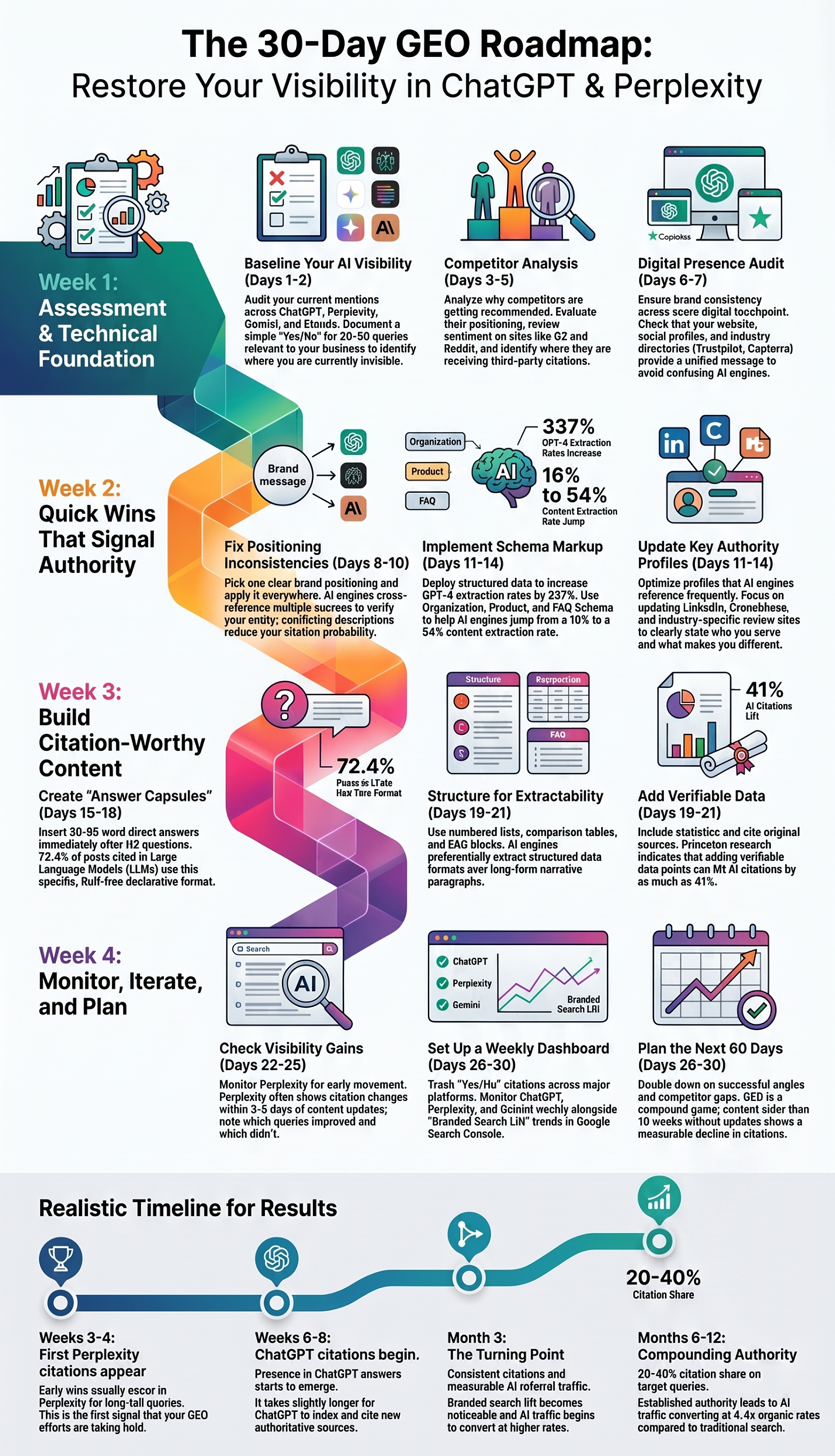
💡 Click the image to enlarge or download it for quick reference.
Week 3: Build Citation‑Worthy Content
Days 15-18: Create “Answer Capsules”
AI engines extract content differently than Google. The format that works best is the Answer Capsule: a direct 20-25 word answer placed immediately after an H2 formatted as a question. No fluff. Declarative tone.
Without capsule: “When we talk about technical SEO, we refer to a series of optimizations that can impact performance…”
With capsule: “Technical SEO is the optimization of website infrastructure to facilitate crawling, indexing, and performance in search engines.”
72.4% of posts cited in LLMs use Answer Capsules.
Days 19-21: Structure for Extractability
Create content that AI can lift directly:
- Listicles with clear numbering
- Comparison tables comparing your solution to alternatives
- Step-by-step guides with numbered instructions
- FAQ blocks with question → direct answer format
AI engines preferentially extract these formats.
Days 19-21 (concurrent): Add Verifiable Data
Princeton research found that adding statistics to content lifts AI citations by 41%. When you include data, cite your source. AI engines verify information and attribute credibility.
Week 4: Monitor, Iterate, and Plan
Days 22-25: Check Your Visibility Again
Has anything changed? Perplexity often shows movement within 3-5 days of changes. Even small movements are good signals. Note which queries improved and which didn’t.
Days 26-30: Set Up Ongoing Tracking
Create your weekly dashboard (15 minutes):
- Cited by ChatGPT? (Yes/No for your target queries)
- Cited by Perplexity? (Yes/No)
- Cited by Gemini? (Yes/No)
- Branded search lift trend (Google Search Console)
No expensive tools required to start.
Days 26-30: Plan Your Next 60 Days
Based on what you’ve learned:
- What’s working? Do more of it
- What’s not moving? Try different angles
- What competitors are doing that you’re not?
What Results to Expect (Realistic Timeline)
Following this GEO 30 day roadmap will produce results on this timeline:
| Timeframe | Expectation |
|---|---|
| Week 3-4 | First Perplexity citations for long-tail queries |
| Week 6-8 | ChatGPT citations begin appearing |
| Month 3 | Consistent citations across platforms; AI referral traffic measurable |
| Month 4-6 | Meaningful visibility; 20-40% citation share on target queries |
| Month 6-12 | Compounding authority; AI traffic converts at 4.4x organic rates |
Unrealistic expectations for Day 30:
- Complete transformation of AI visibility
- Dominating competitor recommendations
- Measurable revenue impact
GEO builds like SEO domain authority did in 2012. The brands investing now face far weaker competition than they will in 2028.
For real‑world proof, read our case study on how a B2B SaaS company built a predictable inbound pipeline.
The Biggest Mistake I See
People do a burst of optimization, see no immediate results, and quit. But content older than 13 weeks without updates shows measurable citation decline — meaning consistency matters more than intensity.
GEO is a compound game. Month 3 is usually the turning point when citations and AI referral traffic begin to grow. Brands that quit before month 3 lose everything they invested.
How HumanReach.ai Accelerates This Timeline
We don’t sell “optimization.” We sell restored visibility and lead flow. Our 30-day GEO launch includes:
- Entity building — Wikidata verification, consistent schema deployment, cross-platform authority signals
- Answer Capsule content — Structured for AI extraction, not human skimming
- Digital PR + crowd marketing — Citations on Reddit, Quora, and industry forums that AI engines trust
- Weekly citation tracking — Share of Voice reports across ChatGPT, Perplexity, Gemini, and Claude
Clients typically see:
- Perplexity citations: Week 3-4
- ChatGPT citations: Week 6-8
- Branded search lift: Month 3
- AI-referred conversions: Month 3-4
For more on building authority that works for both Google and AI, read our guide on topical authority and why it replaced backlinks.
Frequently Asked Questions (FAQ)
1. How long does GEO take to show results?
Perplexity citations often appear in 3-4 weeks. ChatGPT citations in 6-8 weeks. Branded search lift becomes measurable in month 3. AI-referred conversions typically start in month 3-4. GEO is faster than SEO but still requires patience.
2. What is an Answer Capsule?
An Answer Capsule is a direct 20-25 word answer placed immediately after an H2 formatted as a question. 72.4% of posts cited in LLMs use this format. It tells AI exactly what to extract.
3. Do I need to be on Reddit for GEO?
Not mandatory, but highly recommended. 47% of Perplexity citations come from Reddit. If you ignore Reddit, you are ignoring almost half of the citation opportunities.
4. What is the single most important technical action?
FAQ schema. Pages with FAQ schema are 2-3x more likely to be cited by LLMs. GPT-4’s extraction rate jumps from 16% to 54% when content includes structured data.
5. How do I track AI visibility without expensive tools?
Open ChatGPT, Perplexity, and Gemini weekly. Ask your target queries. Document Yes/No. Track branded search lift in Google Search Console. That’s your GEO dashboard. Read our guide on how to measure AI search performance.
6. Can I do this myself without an agency?
Yes, but it requires time and consistency. The GEO 30 day roadmap above is designed for DIY execution. However, most brands fail to maintain consistency past week 3. If you have the bandwidth, do it yourself. If not, consider help.
7. What is the ROI of GEO compared to SEO?
GEO is faster (citations in weeks vs months) and AI-referred traffic converts at 4.4x higher rates than organic search. For real results, see our B2B SaaS case study or our industrial case study.
Source: HumanReach.ai — Helping brands become the answer AI trusts and cites.
This article is part of the HumanReach.ai GEO Resource Hub.
Ready to Restore Your AI Visibility in 30 Days?
You don’t need to abandon SEO. You need to add GEO. The right framework and the right engine.
About the author: This guide was created by HumanReach.ai, an organic growth agency that helps local and global businesses thrive in the AI Search Reality. Visit HumanReach.ai to learn more.