


You’ve optimized your keywords. You’ve built your backlinks. You’ve published your content. And still, when someone asks ChatGPT for a recommendation, your brand is nowhere to be found.
Here’s why: LLMs don’t understand keywords. They understand entities.
Keywords are strings of text. Entities are distinct concepts — people, places, organizations, products, ideas. When a human asks ChatGPT “What’s the best CRM for a small agency?” — the model doesn’t search for pages containing those keywords. It retrieves entities that match the user’s intent and have strong, consistent identity signals across the web.
Entity SEO is the practice of making your brand’s entity unambiguous, consistent, and densely cited — so LLMs retrieve YOU first.
According to Gartner, traditional search volume will drop 25% by 2026. This makes entity SEO essential for any brand that wants to be found where decisions start.
If you are new to AI visibility, read our guides on what is AI visibility vs SEO and whether you really need to adapt to AI search in 2026 first. For a complete roadmap, see our GEO 30 day roadmap. To diagnose if AI has already made your brand invisible, see our AI brand invisibility signs guide.
Here is exactly how entity SEO works and how HumanReach.ai turns your brand into the one AI recommends first.
📑 Table of Contents
- What is an entity? (And why LLMs care)
- The 5 pillars of entity SEO
- How entity SEO differs from traditional SEO
- The entity SEO audit (what we check)
- The 90-day entity SEO roadmap
- How HumanReach.ai implements entity SEO
- Case example: Entity SEO in action
- Frequently Asked Questions (FAQ)
- Ready to become the entity AI recommends first?
What Is an Entity? (And Why LLMs Care)
Definition: An entity is a uniquely identifiable thing — a person, organization, product, place, or concept — that exists independently of how it’s described in any single document.
How LLMs use entities: When you ask ChatGPT a question, the model doesn’t search the web like Google. It retrieves relevant entities from its knowledge graph and training data, then synthesizes an answer.
Example user query: “What’s the best CRM for a small agency?”
- LLM entity retrieval process: Identify relevant entity types (CRM, small business, agency)
- Retrieve candidate entities: Salesforce, HubSpot, Pipedrive, Zoho
- Evaluate each entity’s signals: Consistency, density, relationships, sentiment
- Rank entities by signal strength: HubSpot (#1), Pipedrive (#2)
- Generate answer: “HubSpot is widely recommended for small agencies…”
Your brand’s entity signals determine where you appear in this retrieval list. Weak signals = invisible. Strong signals = recommended first.
For more on why rankings no longer protect you, read our analysis of the zero click search crisis.
📊 Entity SEO — Turning Your Brand Into the One AI Recommends First
Explore this comprehensive visual guide that reveals how LLMs retrieve and recommend brands through entity signals — not keywords. It breaks down the 5 pillars of entity SEO: Entity Identity, Entity Schema, Entity Relationships, Entity Density, and Entity Consistency. The infographic also contrasts traditional SEO with entity SEO across four critical dimensions, provides a detailed entity audit checklist, and maps out a 90-day roadmap to build a brand entity that AI recommends first. A must-see resource for any brand that wants to understand why ChatGPT recommends competitors instead of them — and how to fix it.
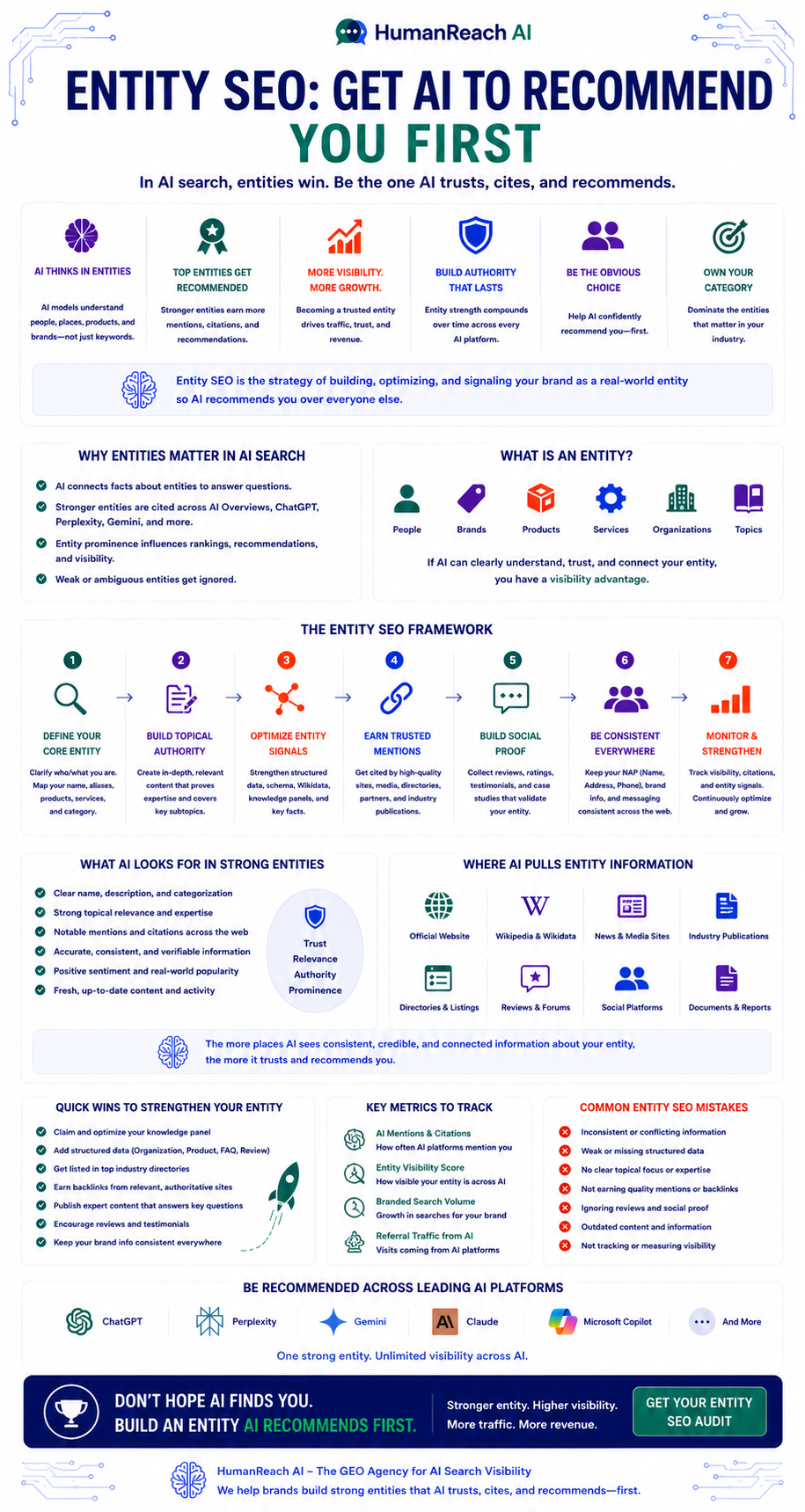
💡 Click the image to enlarge or download it for quick reference.
The 5 Pillars of Entity SEO
Entity SEO is not one thing. It’s five interconnected disciplines. Neglect any one, and your entity signals degrade.
Pillar #1: Entity Identity (Who Are You?)
LLMs need to know, without ambiguity, what your brand is. If your brand is described differently across the web, the LLM may treat each description as a separate entity — or worse, treat your brand as an unreliable entity and ignore it.
The test: Copy your brand description from your website. Search for mentions across 10-15 platforms. 90-100% consistent = Good entity identity. 60-80% = At risk. Below 60% = Critical.
Data point: 83% of brands fail this test.
Pillar #2: Entity Schema (Tell LLMs Directly)
Schema markup is how you tell LLMs (and search engines) exactly what your entity is, what it does, and how it relates to other entities.
Critical schema types for entity SEO: Organization (HIGHEST priority), Product/Service (HIGH), SameAs (HIGH), FAQ (HIGH).
The data: GPT-4’s extraction rate jumps from 16% to 54% with proper schema. Yet 63% of websites lack proper schema implementation.
Pillar #3: Entity Relationships (Who Are You Connected To?)
LLMs understand entities not in isolation, but in relationship networks. Key relationships: Competitor of, Product of, Used by, Integrates with, Similar to, Part of category.
Pillar #4: Entity Density (How Often Are You Mentioned?)
Entity density is the frequency with which your brand entity appears across trusted sources. LLMs interpret high density as “this entity matters” and retrieve it more often.
The density target: Brands with 30%+ Share of Voice in AI typically have 50-200+ third-party mentions per month.
Data point: 44% of B2B SaaS companies score below 50 in AI presence — and the gap is driven entirely by mention frequency.
Pillar #5: Entity Consistency (Same Entity, Everywhere)
Entity consistency is the degree to which every mention of your brand describes the same entity in the same way. Dimensions: Name, Description, Category, Logo, URL, Contact.
The consistency score: 90-100% = Excellent. 70-89% = Good. 50-69% = At risk. Below 50% = Critical.
Data point: 83% of brands have consistency scores below 80%.
For a complete framework on getting cited, read our guide on how to get your brand into AI answers.
How Entity SEO Differs from Traditional SEO
This is the critical distinction. Entity SEO is not “SEO for AI.” It’s a different discipline entirely.
| Dimension | Traditional SEO | Entity SEO |
|---|---|---|
| Unit of optimization | Keywords (strings) | Entities (things) |
| Primary target | Search engines (Google) | LLMs (ChatGPT, Perplexity) |
| Success metric | Keyword rankings | Entity retrieval ranking |
| Key signal | Backlinks (domain authority) | Entity density (mention frequency) |
The critical insight: You can have perfect traditional SEO and still have weak entity SEO. The overlap between Google Top 10 and AI-cited sources has collapsed to 17-38%.
For a deeper dive on tracking, read our guide on how to measure AI search performance.
The Entity SEO Audit (What We Check)
HumanReach.ai’s entity audit goes far beyond what traditional SEO agencies offer.
Our Entity Audit Checklist:
- Identity: Brand name consistency across 15+ platforms, description consistency, logo/visual consistency
- Schema: Organization schema, Product/Service schema, SameAs schema, FAQ schema
- Knowledge Graph: Wikidata entry, Wikipedia entry, Knowledge Panel in Google search
- Density: Reddit mention frequency (last 30 days), G2/Capterra review count and recency, industry publication mentions, forum mentions
- Relationships: Competitor relationships, integration/customer relationships
- Consistency: Overall entity consistency score
Time to complete: 2-4 hours for a full entity audit. Deliverable: Complete entity scorecard with priority action list.
✨ Ready to become the entity AI recommends first? You don’t have to figure it out alone.
At HumanReach.ai, we build entity SEO programs that turn your brand into the one LLMs retrieve first. Visit HumanReach.ai to learn more.
The 90-Day Entity SEO Roadmap
Month 1: Identity & Schema Foundation
Week 1: Entity audit, inconsistency documentation, Wikidata verification
Week 2: Standardize descriptions across 15+ platforms
Week 3: Deploy Organization + SameAs schema
Week 4: Deploy Product/Service + FAQ schema
Month 2: Density Building
Week 5: Reddit strategy deployment (10-15 expert comments)
Week 6: Review amplification campaign (20+ new G2 reviews)
Week 7: Digital PR for industry publication mentions (2-3 mentions)
Week 8: Forum presence (Quora, Stack Overflow)
Month 3: Relationship & Measurement
Week 9: Relationship content (comparison pages, partner content)
Week 10: Entity retrieval testing (weekly prompts across LLMs)
Week 11: Branded search lift analysis
Week 12: Share of Voice measurement + next-quarter roadmap
For Reddit strategies, read our guide on Reddit AI citations.
How HumanReach.ai Implements Entity SEO
What our clients typically see:
- Week 2-3: Entity consistency reaches 90%+
- Week 3-4: First Perplexity entity retrievals
- Week 6-8: Branded search lift begins (+5-15%)
- Week 8-12: First ChatGPT entity retrievals
- Month 3-4: Share of Voice reaches 15-30%
- Month 4-6: AI becomes top 3 lead source
For real‑world proof, read our case study on +18 leads per month from ChatGPT.
Case Example: Entity SEO in Action
The Brand: Mid-size B2B SaaS platform (compliance/risk management)
The Problem: Invisible to LLMs despite strong Google rankings. Entity consistency score: 47%.
The Entity Audit Findings: Brand described 5 different ways across platforms (Critical), no Wikidata entry (High), no SameAs schema (High), only 3 Reddit mentions in last 6 months (High).
The Results after 90 days:
- Entity consistency score: 47% → 94% (+47%)
- Reddit mentions (30 days): 3 → 47 (+1,467%)
- G2 reviews (recent): 12 → 46 (+283%)
- Perplexity citation presence: 0/5 → 4/5 (+80%)
- ChatGPT citation presence: 0/5 → 3/5 (+60%)
- Branded search lift: Baseline → +22%
- AI-attributed leads (Month 3): 0 → 14
The revenue impact: 14 AI-attributed leads in Month 3 × 25% close rate × $24,000 average deal size = $84,000 pipeline value.
Frequently Asked Questions (FAQ)
1. What is entity SEO?
Entity SEO is the practice of optimizing your brand’s identity, schema, density, relationships, and consistency so that LLMs (ChatGPT, Perplexity, Gemini) retrieve and recommend your entity first. Unlike traditional SEO, which optimizes for keywords, entity SEO optimizes for things.
2. How is entity SEO different from traditional SEO?
Traditional SEO optimizes for keywords and backlinks. Entity SEO optimizes for entity consistency, schema markup, mention density, and relationship mapping. Traditional SEO targets Google rankings. Entity SEO targets LLM retrieval. You need both, but most brands are invisible to LLMs while their SEO rankings look fine.
3. How long does entity SEO take to show results?
Entity consistency can improve to 90%+ in 2-3 weeks. First Perplexity entity retrievals appear in 3-4 weeks. Branded search lift begins in 6-8 weeks. First ChatGPT retrievals in 8-12 weeks. AI-attributed leads in 3-4 months.
4. Do I need to be on Reddit for entity SEO?
Highly recommended. Reddit drives 46.7% of Perplexity’s top citations. Entity density (mention frequency) is a primary signal for LLM retrieval. Without Reddit mentions, you’re missing almost half of the citation opportunities.
5. What is entity consistency?
Entity consistency means your brand is described identically across every platform where it appears — your website, G2, LinkedIn, Crunchbase, Wikidata, and industry directories. Inconsistent descriptions confuse LLMs and weaken your entity signals. 83% of brands have consistency scores below 80%.
6. What is the most important schema for entity SEO?
Organization schema is the highest priority — it tells LLMs your brand’s name, logo, description, and legal info. SameAs schema is also critical — it links your profiles across G2, LinkedIn, Crunchbase, and Wikidata. Together, they create a connected entity graph that LLMs trust.
7. What is the ROI of entity SEO?
In the case example above, entity SEO generated $84,000 in pipeline value from the first month of AI visibility. Brands with strong entity signals capture 80% of AI referral traffic, which converts at 5x the rate of organic search.
Source: HumanReach.ai — Helping brands become the entity AI recommends first.
This article is part of the HumanReach.ai GEO Resource Hub.
Ready to Become the Entity AI Recommends First?
Your competitors are building their entity networks. Every day you wait, their signals grow stronger.
About the author: This guide was created by HumanReach.ai, an organic growth agency that helps local and global businesses thrive in the AI Search Reality. Visit HumanReach.ai to learn more.