

Zero click search crisis: The rankings are holding. The dashboard looks healthy. This zero click search crisis explains why your clicks — and leads — are quietly collapsing. Zero click search crisis data shows that 60% of searches now end without a click.
Zero Click Search Crisis: The Data Behind the Silent Collapse
If you have opened your analytics recently, you have probably noticed something unsettling: your positions in Google haven’t moved (maybe they have even improved), but your organic traffic is leaking.
You are not imagining things. You are not losing to a direct competitor in the traditional sense. You are losing to the search results page itself.
Welcome to the reality of the zero click search crisis. Google’s AI does not just list the web — it consumes it. And unless you adapt your strategy right now, your brand is becoming invisible right when customers are ready to buy.
According to Gartner, traditional search volume will drop 25% by 2026. This is the data behind the silent collapse of organic traffic and why “ranking #1” is no longer a guarantee of revenue.
If you are new to this shift, read our guides on what is AI visibility vs SEO and whether you really need to adapt to AI search in 2026 first.
📑 Table of Contents
- The “Answer Box” just got a lot bigger (and hungrier)
- Why “informational” content is no longer a viable funnel
- The B2B nightmare: ChatGPT is selling for the competition
- The visibility gap: when ranking #1 means nothing
- The verdict: clicks vs citations
- Frequently Asked Questions (FAQ)
- Ready to stop losing leads to AI?
1. The “Answer Box” Just Got a Lot Bigger (and Hungrier)
For years, SEOs worried about the “position zero” featured snippet. In 2026, that worry has evolved into a full‑blown crisis.
Google’s AI Overviews (AIOs) and the new “AI Mode” have fundamentally changed the transaction between a user and a search engine. Historically, Google sent traffic to the answer. Now, Google is the answer.
Hard numbers behind the zero click search crisis:
| Statistic | Value |
|---|---|
| Zero‑click searches (% of total) | ~60% |
| #1 organic CTR with AI Overview present | ~11% (down from ~27%) |
| CTR drop for informational queries with AI overviews | 25-60% |
You aren’t losing to the competitor below you. You are losing to the AI sitting above you.
2. Why “Informational” Content Is No Longer a Viable Funnel
If you built your lead generation strategy on the classic “top of funnel” model — create blog posts, rank for questions, capture email — the zero click search crisis has pulled the rug out from under you.
AI Overviews trigger predominantly on informational queries. These are the “how to,” “what is,” and “why does” questions that used to be the lifeblood of content marketing. Because AI answers these questions instantly and accurately, the user’s “need to click” has dropped to nearly zero.
Data point: When an AI Overview is present, only 8% of users click on a traditional search result. Even the links inside the AI box get clicked just 1% of the time.
Your blog posts are now training data for Google’s profit engine, not a customer acquisition channel.
For a deeper dive on how to structure content that survives the zero click search crisis, read our guide on how to get your brand into AI answers.
3. The B2B Nightmare: ChatGPT Is Selling for the Competition
While Google zero‑click is bad, the rise of Large Language Models (LLMs) like ChatGPT, Perplexity, and Meta AI is the silent killer for high‑ticket B2B sales.
Half of B2B software buyers now start their research on an AI search platform rather than Google. They aren’t looking at blue links; they are asking a bot: “What is the best CRM for scaling SaaS companies?”
If your brand isn’t cited in that answer, you don’t exist.
The twist that most marketing directors miss: AI traffic actually converts like crazy. Even though the volume is lower than traditional Google traffic, the quality is unmatched.
- AI‑referred visitors convert at an average rate of 14.2% compared to Google Organic’s 2.8%.
- Ahrefs reported that AI‑referred visitors accounted for only 0.5% of their sessions but drove 12.1% of all signups — a 23x higher conversion rate.
The problem isn’t that AI traffic is bad. The problem is that you aren’t getting the traffic.
For real‑world proof, read our case study on how a B2B SaaS company went from zero inbound to 30+ qualified leads per month.
4. The “Visibility” Gap: When Ranking #1 Means Nothing
This is the crux of the zero click search crisis. The correlation between ranking in Google and being cited in AI is breaking apart.
| Metric | Historical overlap | Overlap in early 2026 |
|---|---|---|
| Google Top 10 rankings vs AI citations | ~75% | 17‑38% |
You can sit at the top of Google for a high‑intent keyword and be completely invisible to the majority of your audience who are now using Perplexity or AI Overviews.
For a complete understanding of how to measure your AI visibility, read our guide on how to measure AI search performance.
📊 You’re #1 on Google — But Leads Are Down. AI Stole Your Traffic.
Explore this comprehensive visual guide that reveals the brutal reality of the zero-click search crisis. It breaks down the hard numbers — 60% zero-click searches, CTR for #1 dropping from 27% to 11%, and the collapse of the informational content funnel. The infographic also exposes the B2B nightmare where ChatGPT is selling for your competition, shows the dramatic visibility gap (75% overlap dropping to 17-38%), and contrasts the old SEO funnel with the new GEO approach. A must-see resource for any brand that’s ranking #1 but watching leads disappear.
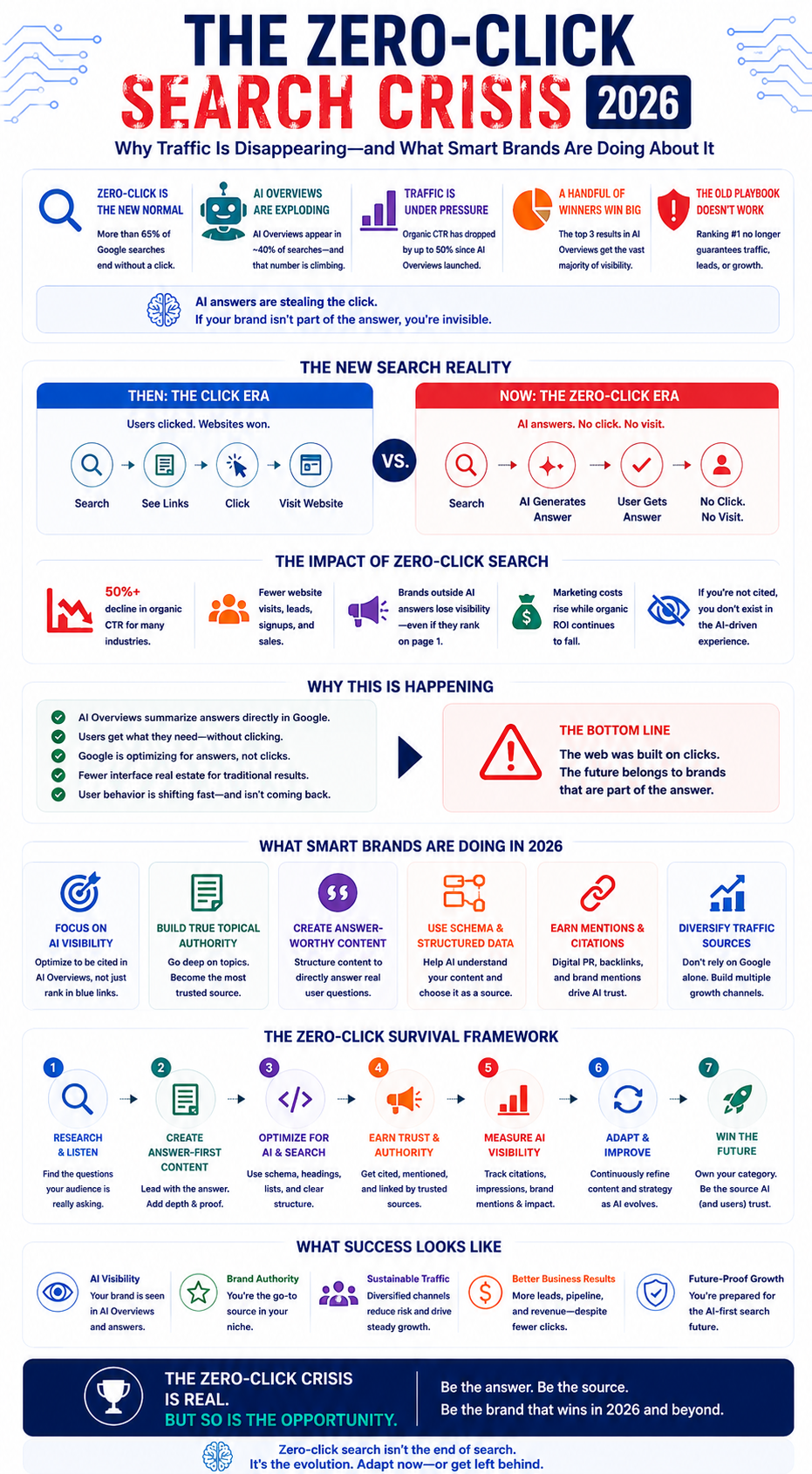
💡 Click the image to enlarge or download it for quick reference.
The Verdict: Clicks vs. Citations
We are witnessing the largest shift in digital discovery in 25 years. The game is no longer “ranking.” The game is citation.
If you are still measuring success solely by Google ranking positions, you are flying blind. You need to measure your share of voice in AI answers. You need to optimize for how LLMs extract data, not just how Googlebot crawls links.
The zero click search crisis you are experiencing is not a bug in the system; it is the new feature of Search 2.0. The question is not whether you can stop Google from showing AI answers — you can’t. The question is: Will you be the source the AI trusts, or the footnote the AI ignores?
✨ Ready to stop losing leads to AI and start getting cited? You don’t have to figure it out alone.
At HumanReach.ai, we build AI‑visible content engines that turn your expertise into trusted citations. Visit HumanReach.ai to explore how we help brands win in the AI search era.
Frequently Asked Questions (FAQ)
1. Is SEO dead in 2026?
No. SEO is not dead. But SEO‑only is dying. The zero click search crisis shows that 60% of searches are zero‑click, and AI Overviews appear in 60%+ of Google searches. SEO still wins for transactional queries. But for informational queries, SEO alone is no longer enough. You need both SEO and GEO.
2. What is the zero click search crisis?
The zero click search crisis refers to the rapid decline in organic click‑through rates caused by AI Overviews and answer boxes. Approximately 60% of all Google searches now end without a click to a third‑party website. Users get their answers directly from the search results page.
3. How can I adapt to AI search?
Focus on citation presence, not just rankings. Add FAQ schema to your pages (2‑3x more likely to be cited). Write content in Q&A format (H2 = question, paragraph = answer). Build presence on Reddit and Quora where LLMs look for sources. For a full framework, read our guide on how to get your brand into AI answers.
4. Does AI traffic actually convert?
Yes. AI‑referred visitors convert at 14.2% on average, compared to 2.8% for Google organic. In some cases, AI traffic drives 23x higher conversion rates. The challenge is getting cited — not converting the traffic.
5. Should I stop blogging?
No. But you need to change how you write. Stop writing generic informational content. Start writing answer‑focused content in Q&A format with FAQ schema. Your blog posts can become citation magnets if structured correctly.
6. How do I track if AI is stealing my traffic?
Monitor three metrics weekly: 1) Citation presence (ask ChatGPT about your brand), 2) Branded search lift (Google Search Console), 3) Organic CTR by query type. If your branded search is up but organic clicks are down, GEO is working. For a complete dashboard, read our guide on how to measure AI search performance.
7. What is the ROI of GEO vs SEO?
GEO is faster and often higher‑ROI than SEO for informational content. Citations can appear in 3‑6 weeks, compared to 6‑12 months for top Google rankings. And AI‑referred traffic converts at 5‑10x higher rates. For real results, see our B2B SaaS case study or our industrial case study.
Source: HumanReach.ai — Helping brands become the answer AI trusts and cites.
This article is part of the HumanReach.ai GEO Resource Hub.
Ready to Stop Losing Leads to AI?
You don’t need to abandon SEO. You need to add GEO. The right framework and the right engine.
About the author: This guide was created by HumanReach.ai, an organic growth agency that helps local and global businesses thrive in the AI Search Reality. Visit HumanReach.ai to learn more.