


Implementing a comprehensive topical authority framework has fundamentally transformed how modern discovery systems evaluate digital assets. Growth teams often wonder whether legacy off-page link acquisition networks remain the definitive signal for search visibility. The structural reality is that while backlink profiles continue to offer baseline validation data, algorithmic parsers and multi-model indexing networks now prioritize comprehensive subject depth over raw link counts.
Shifting Strategic Priorities: The Decline of Link Centrality
The operational shift away from simple backlink building has created clear strategic confusion. For over twenty years, commercial optimization loops treated off-page authority accumulation as the primary lever for competitive positioning. However, modern intent processing systems have fundamentally changed, evaluating data environments based on how systematically and accurately your digital infrastructure covers entire subject clusters rather than tracking isolated domain mention volumes.
With active Gartner telemetry documenting a permanent 25% contraction across legacy desktop and mobile search queries by 2026, understanding how next-generation indexers calculate conceptual mastery is essential to avoid losing market share.
This data architecture guide is developed by HumanReach.ai, a specialized organic growth agency engineered to align corporate knowledge networks with the strict validation layers used by conversational search systems. The implementation roadmap detailed below outlines the exact technical methodology utilized to establish verified category authority across both semantic web layouts and large language model knowledge graphs.
If your execution team is currently evaluating its long-term visibility metrics, we suggest referencing our core deep dives analyzing generative engine optimization versus traditional frameworks, as well as our ecosystem readiness report on adapting enterprise assets for conversational search interfaces.
? Table of Contents
- What is topical authority? (In plain English)
- Why did topical authority replace backlinks?
- Do I still need backlinks in 2026?
- How to build topical authority (step by step)
- Frequently Asked Questions (FAQ)
- The bottom line
What is topical authority? (In plain English)
Topical authority means covering a subject so completely that search engines and AI platforms recognize you as the go-to source for that topic.
Think of it like this:
- Backlinks: Other websites saying “trust this source” (external validation)
- Topical authority: Your content proving “we know this topic” (internal validation)
For example, a website about coffee might have 100 articles covering every aspect: bean types, brewing methods, equipment reviews, history, health effects, and regional variations. That site has high topical authority on coffee — even if it has fewer backlinks than a general news site that mentions coffee occasionally.
Google and AI platforms now prioritize depth over breadth. A site that covers one topic completely will often outrank a generalist site with more backlinks.
Why did topical authority replace backlinks?
Backlinks became a primary ranking factor because they were hard to fake. But over time, several problems emerged:
- Link spam: People bought and sold backlinks, manipulating search results
- Authority hoarding: Old domains with irrelevant backlinks kept ranking despite poor content
- LLM behavior: AI platforms like ChatGPT don’t use backlinks at all — they prioritize helpful answers
Google’s 2024-2026 algorithm updates have increasingly favored E-E-A-T (Experience, Expertise, Authoritativeness, Trustworthiness) and topical depth over raw link counts. Studies show that sites with comprehensive topic coverage rank higher than sites with many backlinks but shallow content.
For a deeper understanding of how authority works, read our guide on how Google and LLMs decide who is an expert.
Do I still need backlinks in 2026?
Short answer: Yes, but they are no longer the primary focus.
Here is what changed:
| Factor | Before (2015-2020) | Now (2026) |
|---|---|---|
| Primary signal | Backlinks | Topical depth + E-E-A-T |
| Backlinks role | Essential (top 3 factor) | Supporting (still matters, not dominant) |
| Content role | Secondary | Primary |
| LLM citations | N/A | Based on structure + depth, not links |
What still needs backlinks:
- Competitive niches where everyone has good content (links are tie-breakers)
- New websites without established domain authority
- Local SEO (citations and directory links still matter)
What no longer depends on backlinks:
- AI citations (ChatGPT, Perplexity, Gemini don’t read backlinks)
- Informational queries where AI provides direct answers
- Sites with exceptional topical depth (content can overcome link gaps)
For a complete framework on getting cited without links, read how to get your brand into AI answers.
? What Is Topical Authority and Why Did It Replace Backlinks?
Explore this comprehensive visual guide that explains the fundamental shift in how Google and AI platforms evaluate expertise. It breaks down why topical authority has replaced backlinks as the primary signal — from the problems with link spam and authority hoarding to the rise of E-E-A-T and LLM behavior. The infographic clearly contrasts what changed between 2015-2020 and 2026, answers whether you still need backlinks, and provides a practical step-by-step framework to build topical authority that works for both Google and AI search engines. A must-see resource for any brand that wants to understand the new rules of SEO in the AI era.
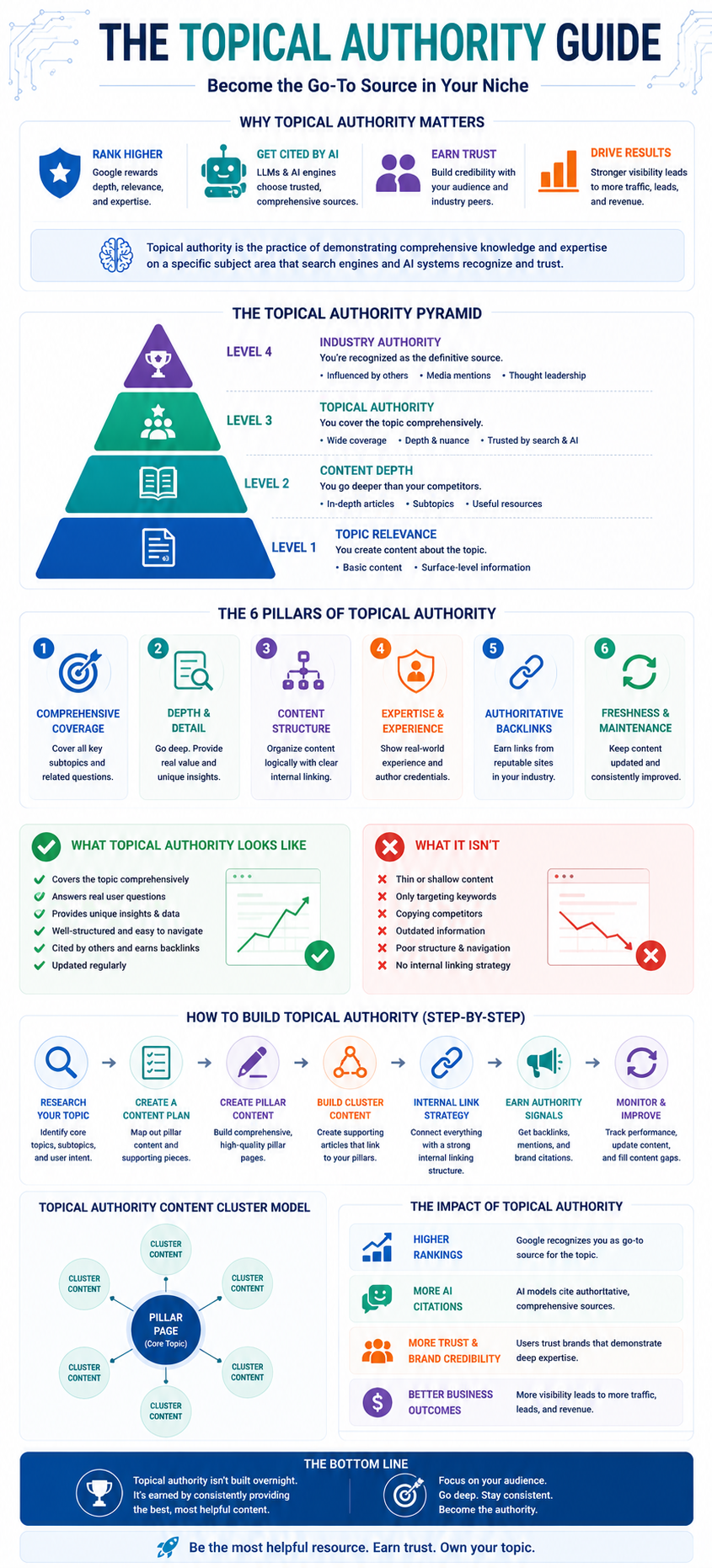
? Click the image to enlarge or download it for quick reference.
How to build topical authority (step by step)
Step 1 — Choose your core topic
Pick one topic you want to dominate. Don’t try to cover everything. For example: “fractional sales hiring” instead of “business growth.”
Step 2 — Map all possible subtopics
Use tools like Reddit, Quora, AnswerThePublic, and Google’s “People also ask” to find every question users have about your topic.
Step 3 — Create a pillar page
Write a comprehensive guide (3000+ words) covering the core topic. This is your “hub.”
Example structure:
- What is [topic]?
- Why is [topic] important?
- How to [core action] step by step
- Common mistakes and how to avoid them
- Tools and resources
- Frequently asked questions
Step 4 — Build cluster content
Create 10-20 supporting articles answering specific subtopics. Each should link back to the pillar page, and the pillar page should link to each cluster.
Example clusters for “fractional sales hiring”:
- “How to hire a fractional VP of Sales”
- “Fractional sales vs full-time sales: which is better?”
- “Cost of hiring fractional sales talent”
- “Best fractional sales agencies for B2B SaaS”
Step 5 — Use FAQ schema on every page
Pages with FAQ schema are 2-3x more likely to be cited by LLMs. It also helps Google understand your content structure. Learn more at Schema.org FAQPage documentation.
Step 6 — Write in Q&A format
Use H2 as the question and the paragraph as the answer. This works for both Google featured snippets and AI citations.
Step 7 — Build backlinks strategically (not obsessively)
Focus on quality over quantity. A few links from relevant, authoritative sources are better than hundreds of spammy links. Prioritize links that drive referral traffic, not just SEO value.
For tracking your progress, read our guide on how to measure AI search performance.
✨ Still wondering if topical authority is worth the effort? You don’t have to figure it out alone.
At HumanReach.ai, we build content engines that turn your expertise into trusted citations across both Google and AI platforms. Visit HumanReach.ai to explore how we help brands win in the AI-powered discovery era.
Frequently Asked Questions (FAQ)
1. What is topical authority in simple terms?
Topical authority means covering a subject so completely that search engines and AI platforms recognize you as the go-to source. It’s about depth, not breadth. One topic covered perfectly is better than ten topics covered superficially.
2. Why did topical authority replace backlinks?
Backlinks became too easy to manipulate (buying and selling links). Google and AI platforms now prioritize content quality and depth. Topical authority is harder to fake — you can’t pretend to cover a topic completely.
3. Do I still need backlinks in 2026?
Yes, but they are no longer the primary focus. Backlinks are now a supporting factor. Topical depth, content quality, and E-E-A-T signals matter more. In competitive niches, links still help as tie-breakers.
4. How long does it take to build topical authority?
For Google: 6-12 months to see significant ranking improvements. For AI platforms: 3-6 weeks to see first citations. The key is consistency — publish regularly, cover every subtopic, and update old content.
5. How many articles do I need for topical authority?
It depends on the topic. A narrow niche might need 20-30 articles. A broad topic might need 100+. The goal is to answer every question a user might have about that topic, not to hit a specific number.
6. Can a small brand beat a big brand with topical authority?
Yes. Google and AI platforms prioritize depth over domain size. If you cover a niche topic more completely than a big brand, you can outrank them. Focus on one topic at a time and go deep.
7. Does topical authority help with AI citations?
Absolutely. AI platforms like ChatGPT and Perplexity prioritize helpful, comprehensive answers. When you cover a topic completely, you answer more questions that users might ask, increasing your chances of being cited.
8. What is the difference between topical authority and E-E-A-T?
E-E-A-T (Experience, Expertise, Authoritativeness, Trustworthiness) is Google’s framework for evaluating content quality. Topical authority is the practical application — covering a topic completely demonstrates E-E-A-T.
9. Do I need to delete old content to build topical authority?
No. Update it instead. Freshness matters for both Google and AI platforms. Add new information, improve structure, add FAQ schema, and update the publication date.
10. What is the single biggest mistake brands make with topical authority?
Trying to cover too many topics at once. Pick one core topic. Build depth. Then move to the next. Depth always beats width for both Google and LLMs.
The bottom line
Topical authority replaced backlinks as the primary SEO signal.
Topical authority is about covering a subject completely. It replaced backlinks as the primary authority signal because it’s harder to fake and aligns with how AI platforms evaluate expertise.
Do I still need backlinks in 2026?
Yes, but they are no longer the primary focus. Prioritize topical depth and content quality. Use backlinks strategically as a supporting factor, not the main goal.
Your 6-step start today:
- Choose one core topic
- Map all subtopics using Reddit and Quora
- Create a pillar page (3000+ words)
- Build 10-20 cluster articles
- Add FAQ schema to every page
- Write in Q&A format (H2 = question, paragraph = answer)
For a deeper dive, read our guides on how Google and LLMs decide who is an expert and how to get your brand into AI answers.
Source: HumanReach.ai — Helping brands become trusted sources in the AI search landscape.
This article is part of the HumanReach.ai Resource Hub.
Ready to Build Your Own Topical Authority?
You don’t need to be a content expert. You don’t need a big agency. You need the right framework and the right engine.
About the author: This guide was created by HumanReach.ai, an organic growth agency that helps local and global businesses thrive in the AI Search Reality. Visit HumanReach.ai to learn more.