

Do I Really Need to Learn GEO in 2026? Is SEO Dead or Just Different?
Do I really need to learn AI visibility in 2026? This is the #1 question I see in SEO communities, Slack channels, and Twitter DMs. Everyone is afraid. Everyone is confused. Do I really need to learn Generative Engine Optimization is the question that keeps SEOs awake at night.
“I’ve spent years mastering SEO. Do I have to throw it all away and learn something new?”
The short answer: No. But you need to add AI search optimization to your toolkit. SEO is not dead. It’s just not enough anymore.
According to Gartner, traditional search volume will drop 25% by 2026. According to Semrush research, 60% of searches are now zero-click.
This guide is brought to you by HumanReach.ai, an organic growth agency that helps brands become the answer AI trusts and cites. The framework below is the same methodology HumanReach.ai uses to transform invisible brands into AI-cited sources.
This guide gives you the complete answer — when AI citations matter, when SEO still wins, and what you actually need to learn in 2026. If you are still unsure about the basics, read our guide on what is Generative Engine Optimization vs SEO first.
📑 Table of Contents
- Do I really need to learn AI visibility? The short answer
- Is SEO dead in 2026? The hard data
- What is AI visibility? (In plain English)
- When SEO still wins (don’t abandon this)
- When AI search optimization wins (and why)
- The ‘both’ framework — what you actually need to learn
- Frequently Asked Questions (FAQ)
- The bottom line
Do I really need to learn AI visibility? The short answer
Do I really need to learn Generative Engine Optimization in 2026? Here is the most honest answer you will get:
| Your situation | Do you need AI visibility? |
|---|---|
| You run an e-commerce store (transactional) | 🟡 Low priority. SEO still wins. |
| You run a blog or media site (informational) | 🔴 HIGH priority. AI citations are essential. |
| You run a B2B SaaS (comparative + informational) | 🔴 HIGH priority. AI is where your buyers are. |
| You run a local business (near me queries) | 🟡 Medium priority. Watch this space. |
The bottom line: Do I really need to learn AI search optimization in 2026? If your customers ask “how to,” “what is,” “best X,” or “X vs Y” — yes, you need AI visibility.
Is SEO dead in 2026? The hard data
Is SEO dead? Let’s look at the numbers.
What the data says:
| Statistic | Source |
|---|---|
| 60% of searches are now zero-click | Semrush / SparkToro |
| AI Overviews appear in 60%+ of Google searches | Industry studies |
| 25% drop in traditional search volume predicted by 2026 | Gartner |
| Click-through rates drop 25-60% when AI summaries appear | Multiple studies |
Is SEO dead? No. But the pie is shrinking. There are fewer clicks to go around. However, the clicks that remain are more valuable (transactional intent).
So when someone asks “Do I really need to learn AI visibility in 2026?” the answer depends on your content type. If you rely on informational traffic, yes. If you rely on transactional traffic, SEO is still fine — but AI citations are a bonus.
Once you start implementing AI search optimization, you’ll need to know how to track AI visibility performance to measure your success.
What is AI visibility? (In plain English)
Generative Engine Optimization (GEO) = AI visibility.
It means optimizing your content so that AI search engines cite you as a source — even if the user never clicks your link.
In plain English: SEO helps you rank on Google. AI visibility helps you get quoted by AI. For a deeper explanation, check out our guide on what is AI visibility vs SEO.
AI visibility vs SEO — the simple difference:
| Dimension | SEO | AI visibility (GEO) |
|---|---|---|
| Goal | Rank #1 on Google | Get cited as a source in AI answers |
| Target | Search engine crawlers | LLMs (AI models) |
| Success metric | Clicks, impressions, position | Citations, brand lift, answer inclusion |
| Primary tactic | Keywords, backlinks, technical SEO | Structured data, conversational content, forum presence |
| Timeline | Months to see results | Weeks to see citations |
📊 SEO vs. GEO: The Search Landscape in 2026
Explore this comprehensive visual guide that clearly contrasts traditional SEO with Generative Engine Optimization (GEO) in the 2026 search landscape. It maps out the critical data — including the 25% predicted drop in traditional search volume, 60% zero-click searches, and 60%+ AI Overview prevalence — that explains why SEO alone is no longer enough. The visual also breaks down the key differences in goals, targets, and success metrics between SEO and GEO, identifies which business types need GEO most urgently, and provides a clear 30-day action plan to start building AI visibility. A must-see resource for anyone wondering if they need to learn AI search optimization this year.
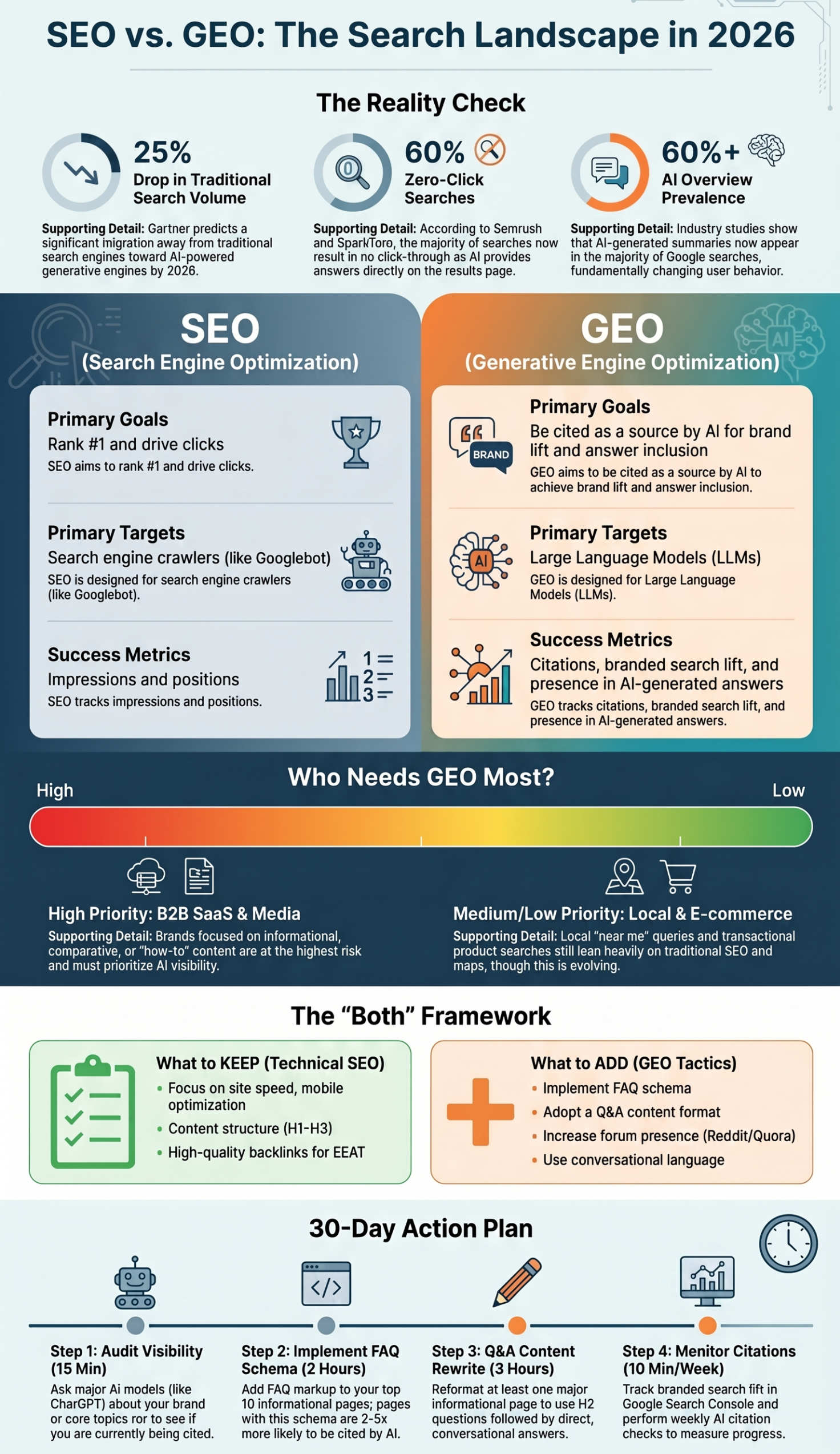
💡 Click the image to enlarge or download it for quick reference.
When SEO still wins (don’t abandon this)
Do I really need to learn AI search optimization for everything? No. Here is where SEO still dominates:
- Transactional queries: “buy running shoes,” “sign up for Netflix” — users want to click and purchase
- Local queries: “plumber near me” — maps and local pack still dominate
- Navigational queries: “Nike customer service” — user knows the brand, wants the site
- Product-specific queries: “iPhone 15 Pro Max price” — user wants to compare and buy
Is SEO dead for these? No. Keep investing in SEO for transactional content.
When AI search optimization wins (and why)
So do I really need to learn AI citations for informational content? Yes. Here is why:
- Informational queries: “how does melatonin work?” — user wants explanation, not a click
- Comparative queries: “HubSpot vs Salesforce” — AI can summarize differences
- Recommendation queries: “best project management tool for designers” — AI aggregates Reddit + reviews
- How-to queries: “how to change a tire” — AI can list steps (no click needed)
Do I really need to learn AI visibility for these? Absolutely. If you don’t optimize for AI citations, your competitors will.
For a complete framework on getting cited, read how to get your brand into AI answers.
✨ Still wondering if AI visibility is worth your time? You don’t have to figure it out alone.
At HumanReach.ai, we build AI‑visible content engines that turn your expertise into trusted citations. Visit HumanReach.ai to explore how we help brands win in the AI search era.
The ‘both’ framework — what you actually need to learn
Do I really need to learn AI search optimization from scratch? No. Here is what you actually need to learn:
What you already know (SEO) — keep doing:
- Keyword research
- Technical SEO (site speed, mobile, indexing)
- Backlink building (still matters for EEAT)
- Content structure (H1, H2, H3, paragraphs)
What you need to ADD (AI visibility) — learn these:
- FAQ schema (pages with it are 2-3x more likely to be cited). Learn more at Schema.org FAQPage documentation.
- Q&A format (write H2 as question, paragraph as answer)
- Forum presence (Reddit, Quora — LLMs cite them heavily)
- Conversational language (write like you’re answering a human, not a keyword bot)
Your learning roadmap (30 days):
| Week | What to learn | Time commitment |
|---|---|---|
| Week 1 | FAQ schema (how to implement) | 2 hours |
| Week 2 | Q&A content format (rewrite 1 page) | 3 hours |
| Week 3 | Reddit/Quora strategy (where to answer) | 2 hours |
| Week 4 | AI citation tracking (how to monitor) | 1 hour |
Do I really need to learn AI visibility in depth? No. You need to learn 20% that gives 80% of the results.
Frequently Asked Questions (FAQ)
1. Do I really need to learn AI visibility in 2026 or can I ignore it?
Do I really need to learn Generative Engine Optimization in 2026? It depends on your business. If you publish informational content (blogs, guides, tutorials), yes — you absolutely need AI citations. If you only sell products (transactional queries), AI visibility is lower priority but still helpful for brand lift. The safest answer: learn the basics. It’s not hard. Read our detailed guide on AI visibility vs SEO to understand the difference.
2. Is SEO dead in 2026?
Is SEO dead? No. SEO is not dead. But SEO-only is dying. The data shows 60% of searches are zero-click, and AI Overviews appear in 60%+ of Google searches. SEO still wins for transactional queries. But for informational queries, SEO alone is no longer enough. You need both SEO and AI search optimization.
3. How much time do I need to learn AI visibility?
You don’t need months. AI visibility is not a completely new discipline. It’s a set of additions to what you already know. With 8-10 hours of focused learning, you can understand the core concepts and start implementing them. The 80/20 rule applies here: 20% of AI search optimization knowledge gives 80% of the results.
4. Is AI visibility harder than SEO?
No. AI visibility is actually simpler. SEO has hundreds of ranking factors, technical complexity, and constant algorithm updates. Generative Engine Optimization has a handful of clear tactics: FAQ schema, Q&A format, forum presence, and conversational language. Anyone who knows SEO can learn AI citations in a week.
5. Will AI visibility replace SEO completely?
No. Not in the next 3-5 years. Transactional queries still need clicks. Google makes 80%+ of revenue from ads — they need clicks. AI search engines may not need clicks, but Google will always have a click incentive. The future is both: SEO for transactional, AI visibility for informational.
6. What happens if I ignore AI citations?
If you ignore AI visibility and your competitors don’t, they will appear in AI answers. Your brand becomes invisible to users who rely on AI search engines for answers. You lose authority, brand lift, and assisted conversions. For informational publishers, ignoring AI search optimization means losing traffic to competitors who adapt.
7. Can my current SEO team learn AI visibility?
Yes. In fact, your SEO team is the best person to learn Generative Engine Optimization. They already understand content structure, keywords, and technical SEO. AI visibility is an addition, not a replacement. A good SEO can become AI-competent in 2-4 weeks of focused learning.
8. Do I need new tools for AI search optimization?
Not really. You can start with free tools: ChatGPT (to audit your visibility), Google Search Console (to track branded search lift), and Schema.org (to add FAQ markup). As you scale, you might want citation tracking tools, but they are not necessary to start.
9. How do I know if AI visibility is working?
Track three metrics: 1) Citation presence (ask AI about your brand weekly), 2) Branded search lift (is branded search growing in GSC?), 3) Assisted conversions (are direct traffic or branded conversions increasing?). If these go up, AI citations are working — even if organic clicks go down slightly. Read our guide on how to track AI visibility performance.
10. Is AI visibility just a trend or here to stay?
AI visibility is not a trend. AI search is not going away. Google AI Overviews, ChatGPT Search, and Perplexity are here for the long term. As LLMs improve, citations will become even more important. Learning Generative Engine Optimization now gives you a competitive advantage while most brands are still ignoring it.
The bottom line
Do I really need to learn AI visibility in 2026?
If you publish informational content: Yes.
If you run a transactional e-commerce store: Maybe later, but start watching.
If you run a B2B SaaS: Yes, your buyers are already using AI search.
Is SEO dead?
No. But SEO alone is no longer enough.
Your 4-step start today:
| Step | Action | Time |
|---|---|---|
| 1 | Audit your AI visibility (ask ChatGPT about your brand) | 15 min |
| 2 | Add FAQ schema to your top 10 informational pages | 2 hours |
| 3 | Rewrite one informational page in Q&A format | 3 hours |
| 4 | Monitor citations weekly for 4 weeks | 10 min/week |
You do not need to become an AI visibility expert. You just need to start. For a deeper dive, read our complete guide on what is AI visibility vs SEO and how to get your brand into AI answers.
Source: HumanReach.ai — Helping brands become the answer AI trusts and cites.
This article is part of the HumanReach.ai AI Visibility Resource Hub.
Ready to Build Your Own AI‑Visible Pipeline?
You don’t need to be a content expert. You don’t need a big agency. You need the right framework and the right engine.
About the author: This guide was created by HumanReach.ai, an organic growth agency that helps local and global businesses thrive in the AI Search Reality. Visit HumanReach.ai to learn more.