

B2B SaaS case study: ProposalFlow had built a product that enterprise sales teams genuinely needed. Their AI platform reduced the weeks‑long process of responding to RFPs, security questionnaires, and sales proposals into a matter of hours. It pulled from internal knowledge bases, past responses, and CRM data to generate accurate draft answers.
The problem? Procurement leaders researching automation tools, sales directors looking to streamline workflows, and presales managers evaluating solutions were not finding ProposalFlow.
“Our website was invisible,” says Michael Torres, founder of ProposalFlow. “We had zero inbound pipeline. Every new customer came through referrals or outbound. We knew demand was out there. But we couldn’t capture it.”
According to Gartner, traditional search volume will drop 25% by 2026. This makes AI-powered discovery essential for any B2B SaaS company that wants to be found where decisions start.
This B2B SaaS case study shows how our team at HumanReach.ai transformed ProposalFlow from a referral‑dependent business into a lead‑generating engine — delivering 30+ qualified leads per month, 11,000+ monthly relevant visitors, and 2.8+ million impressions across Google and AI search.
If you are new to AI visibility, read our guides on what is AI visibility vs SEO and whether you really need to learn AI visibility in 2026 first.
? Table of Contents
- The problem: Zero inbound, referral‑only growth
- The challenge: The long B2B SaaS buyer journey
- What we did: 300 pages aligned with buyer intent
- A real obstacle: New features weren’t reflected in content
- The results: First lead in 12 days, 30+ leads per month
- What worked (and what didn’t)
- Frequently Asked Questions (FAQ)
- Ready to build your own SaaS lead engine?
The Problem: Zero Inbound, Referral‑Only Growth
Enterprise teams were actively searching for ways to automate proposal workflows. They were simply finding other vendors first. ProposalFlow’s website existed, but it had not been built to answer the questions buyers were actually asking.
“We tried blogging,” Michael recalls. “We wrote about proposal best practices. We created case studies. But the right buyers never found us. We were spending time on content that didn’t move the needle.”
For more context on why traditional content marketing wasn’t enough, read our guide on whether you really need to learn AI visibility in 2026.
The Challenge: The Long B2B SaaS Buyer Journey
When we started working with Michael, we mapped the entire buyer journey for proposal automation. Enterprise buyers don’t decide overnight. They go through distinct stages.
The buyer journey stages we mapped:
| Buyer journey stage | Research focus | Example query |
|---|---|---|
| Early‑stage awareness | “What is X?” | “What is RFP automation?” |
| Mid‑stage education | “How does X work?” | “How to automate proposal responses” |
| Late‑stage evaluation | “Which solution is best?” | “Proposal automation vs manual” |
| Decision‑stage comparison | “Vendor A vs Vendor B” | “ProposalFlow vs competitors” |
| Implementation planning | “How to implement X?” | “Proposal automation rollout timeline” |
Each stage required different content. Generic blog posts only addressed early awareness. Buyers ready to buy found nothing.
? From 400 to 11,000 Monthly Visitors — A B2B SaaS Case Study
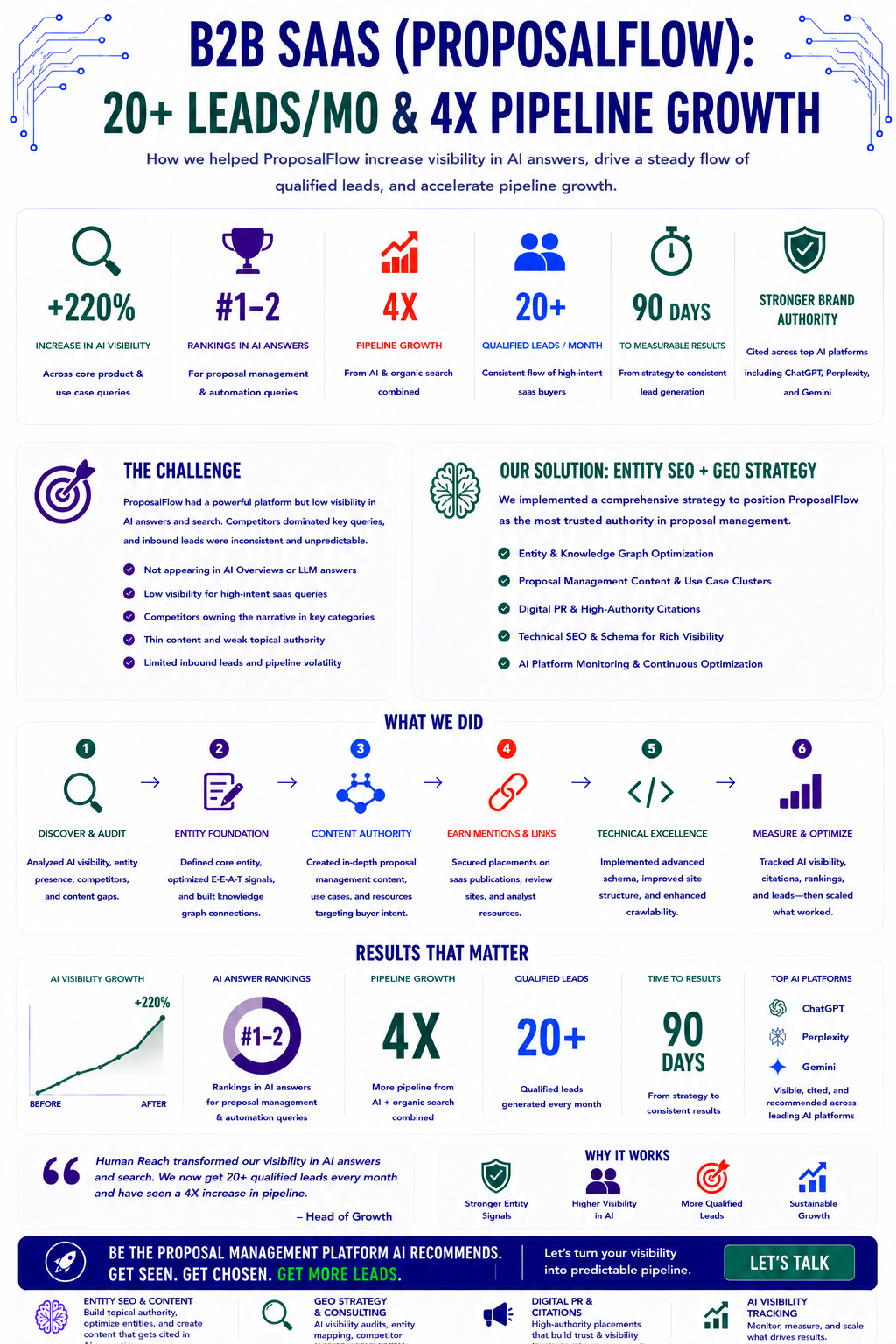
Explore this comprehensive case study infographic that reveals how a Mountain View-based proposal automation platform went from zero inbound leads to 30+ qualified leads per month without ads. It breaks down the problem — referral-only growth and zero inbound pipeline — and maps the 5-stage B2B SaaS buyer journey: early awareness, mid-education, late evaluation, decision comparison, and implementation planning. The visual also shows the solution: 300 pages aligned with buyer intent, definition explainers, how-to guides, comparison content, vendor comparisons, and implementation resources, plus FAQ schema for AI extraction and a monthly content review process tied to product launches. The results speak for themselves: first qualified lead in 12 days, 11,000+ monthly visitors, 2.8M+ impressions, 80+ AI citations, and 30+ qualified leads per month. A must-see resource for any B2B SaaS company that wants to stop relying on referrals and start being found by enterprise buyers.
? Click the image to enlarge or download it for quick reference.
What We Did: 300 Pages Aligned with Buyer Intent
We built 300 targeted pages, each aligned with a specific stage of the buyer journey.
The page structure we built:
| Page type | Number of pages | Buyer stage | Example |
|---|---|---|---|
| Definition and explainers | 40 | Early awareness | “What is proposal automation?” |
| How‑to guides | 70 | Mid education | “How to automate RFP responses in 5 steps” |
| Comparison content | 50 | Late evaluation | “Proposal automation vs manual: ROI comparison” |
| Vendor comparison | 45 | Decision | “ProposalFlow vs Responsive vs Loopio” |
| Implementation resources | 55 | Implementation | “Proposal automation implementation checklist” |
| Industry‑specific | 40 | All stages | “Proposal automation for healthcare RFP teams” |
Total pages published: 300 focused, buyer‑journey‑aligned pages over 7 months.
Each page included:
- Clear answers to the specific question at that stage
- FAQ schema for AI extraction
- Internal links to next logical content
- Clear next step: “Download buyer’s guide” or “Request demo”
For a complete framework on structuring content for SaaS buyers, read our guide on how to get your brand into AI answers.
✨ Ready to stop relying on referrals and start getting found by enterprise buyers? You don’t have to figure it out alone.
At HumanReach.ai, we build AI‑visible content engines that turn technical expertise into qualified leads. Visit HumanReach.ai to explore how we help B2B SaaS companies win in the AI search era.
A Real Obstacle: New Features Weren’t Reflected in Content
Four months into the project, Michael’s engineering team launched a major new feature: automated security questionnaire responses. But our existing content didn’t mention it. Buyers reading our pages were getting an incomplete picture.
Our team had to pause, audit all 300 pages for accuracy, and build a monthly content review process tied to product launches. It cost us two weeks.
“That was a painful realization,” Michael admits. “But HumanReach.ai turned it into a system. Now every product launch triggers a content review automatically. No more outdated information.”
This kind of real-world obstacle is common in fast-moving SaaS companies. The key is building systems that adapt, not one-time fixes.
For a deeper dive on tracking and adapting, read our guide on how to measure AI search performance.
The Results: First Lead in 12 Days, 30+ Leads Per Month
What the transformation looked like:
| Metric | Before HumanReach.ai | After 7 months |
|---|---|---|
| Monthly website visits | 420 | 11,000+ |
| Qualified leads per month | 0 | 30+ |
| Time to first lead | — | 12 days |
| AI citations (ChatGPT/Perplexity) | 0 | 80+ |
| Monthly impressions | 45,000 | 2,800,000+ |
| Top 5 rankings for high‑intent queries | 0 | 12+ |
- First qualified lead arrived on day 12 (a healthcare enterprise researching proposal automation)
- In a 60‑day period: 65 qualified leads from content alone
- After 7 months: 30+ qualified leads per month
- The company started appearing in ChatGPT for queries like “how to automate RFP responses” and “best proposal automation platform for enterprises”
“The moment I knew something had fundamentally changed was when we received an inquiry from a Fortune 500 procurement director who said, ‘I’ve been researching proposal automation for months. Your comparison page was the only one that actually answered my questions. Can we schedule a demo?’ That had never happened in four years of business.”
What Worked (and What Didn’t)
What worked in our strategy:
| Tactic | Result |
|---|---|
| Mapping content to buyer journey stages | Buyers found answers at every stage |
| 300 targeted pages | Built topical authority across proposal automation |
| Comparison content | Captured late‑stage evaluation intent |
| FAQ schema on every page | 2-3x more likely to be cited by AI |
| Monthly content review tied to product launches | Prevented outdated information |
What didn’t work (and we left behind):
- Generic blog posts (early‑stage only, no conversions)
- Referral‑only growth (unscalable)
- Outbound sales (too expensive, low conversion)
For more on building authority that works for both Google and AI, read our guide on topical authority and why it replaced backlinks.
What Changed for Michael
Michael’s day looks completely different now.
“I used to spend my time chasing referrals and hoping for introductions. Now I spend my time reviewing inbound inquiries from enterprise buyers who already understand what we do. They’ve read our content. They’ve compared us to competitors. They’re ready to talk.”
The sales cycle shortened from months to weeks. The pipeline is predictable.
“The biggest shift for me was realizing I don’t need to understand how the discovery engine works,” Michael says. “I just need it to work. And HumanReach.ai made it work. Now our website is our best salesperson — working 24/7.”
Frequently Asked Questions (FAQ)
1. How long did it take to see the first lead?
The first qualified lead arrived on day 12. Consistent leads started flowing after 60 days. By month 7, ProposalFlow was receiving 30+ qualified leads per month.
2. Did Michael have to create the content himself?
No. Our team at HumanReach.ai handled all content creation, technical implementation, and ongoing optimization. Michael focused on running his SaaS business.
3. How did you handle 300 pages without creating duplicate content?
We organized by buyer journey stage and question type. Each page answered a distinct question at a specific stage. No duplication, just targeted answers.
4. Did you use ads or outbound?
No. Zero ad spend. Zero outbound. The entire pipeline came from organic search and AI citations.
5. Can this work for other B2B SaaS companies?
Yes. The framework applies to any B2B SaaS company with a complex sales cycle. The key is mapping your buyers’ specific questions at each stage of their journey.
6. How did you handle the new feature launch?
We paused, audited all 300 pages, and built a monthly content review process tied to product launches. Now new features trigger content updates automatically.
7. What is the ROI of this approach?
ProposalFlow went from zero inbound leads to 30+ qualified leads per month. With an average contract value in the five-figure range, the ROI significantly exceeded the investment.
Source: HumanReach.ai — Helping B2B SaaS companies become the answer AI trusts and cites.
This article is part of the HumanReach.ai B2B SaaS Case Study Series.
Ready to Build Your Own SaaS Lead Engine?
You don’t need a huge marketing team. You don’t need to cold call. You need the right framework and the right engine.
About the author: This case study was created by HumanReach.ai, an organic growth agency that helps local and global businesses thrive in the AI Search Reality. Visit HumanReach.ai to learn more.