


Deploying a modern semantic SEO strategy has become essential for capturing enterprise visibility. You may have methodically mapped targeted keyword strings, cultivated strong backlink networks, and continuously published high-quality insights. Yet, despite those legacy achievements, when enterprise buyers ask conversational models for market recommendations, your brand remains completely absent from the response.
This systematic omission points to a core technological disconnect: large language models process concepts, not isolated text strings. While legacy platforms index explicit phrases, modern discovery channels interpret web data as distinct entity concepts—mapping clear relationships between people, organizations, products, and core ideas. When a user asks an AI tool to identify top specialized solutions, the model does not run an old-school text search. Instead, it retrieves specific data nodes that feature highly verified identity signals across the web ecosystem.
With active Gartner data documenting a permanent 25% drop in traditional mobile and desktop search volumes, aligning with relational mapping frameworks has shifted from a forward-looking experiment to a baseline business necessity.
If your team is currently audit-testing your market footprint, we suggest starting with our baseline guides comparing generative engine optimization versus traditional frameworks along with our analysis on evaluating corporate readiness for AI search. For an operational implementation plan, review our comprehensive 30-day execution framework, or diagnose existing visibility drops using our diagnostic guide on detecting hidden conversational suppression signs.
Transitioning toward structured node-based management ensures your platform’s operational definitions, brand assets, and market trust are clearly structured—making your organization the primary source AI networks retrieve first.
? Table of Contents
- The Shift to Conceptual Frameworks (Why LLMs Prioritize Concepts)
- The 5 Core Pillars of Semantic Mapping
- How Semantic Optimization Differ from Traditional Frameworks
- The Complete Entity Integrity Audit
- The 90-Day Execution Blueprint
- How HumanReach.ai Stabilizes Brand Visibility
- Case Example: Real-World Structural Lifts
- Frequently Asked Questions (FAQ)
- Ready to Secure Your Placement in Conversational Indexes?
The Shift to Conceptual Frameworks (Why LLMs Prioritize Concepts)
The Core Principle: A semantic concept represents an independently verifiable node—an organization, a product line, an executive, or a methodology—that exists distinct from any singular phrasing found across isolated blog documents.
The Retrieval Pipeline: When answering user prompts, modern large language models operate within structured knowledge bases rather than parsing live search indices. They systematically parse matching conceptual nodes from their underlying data arrays to assemble an answer.
Consider an enterprise user query: “What is the top-tier specialized software for accounting firms?”
- Intent Categorization: The engine translates the query into high-intent conceptual coordinates.
- Node Retrieval: It assembles candidate nodes that match those specific coordinates.
- Signal Assessment: The algorithm weighs node attributes based on structural consistency, mention frequency, and relational trust.
- Ranking Generation: Nodes displaying clear, cross-verified authority signals populate the top response tier.
Your firm’s structural data integrity dictates its positioning within this programmatic loop. Frail, fragmented signals result in systemic suppression, while consistent nodes capture immediate inclusion.
To examine why traditional ranking reports no longer insulate down-funnel acquisition, review our market data on the zero-click transactional search crisis.
? Entity SEO — Turning Your Brand Into the One AI Recommends First
Explore this comprehensive visual guide that reveals how LLMs retrieve and recommend brands through entity signals — not keywords. It breaks down the 5 pillars of entity SEO: Entity Identity, Entity Schema, Entity Relationships, Entity Density, and Entity Consistency. The infographic also contrasts traditional SEO with entity SEO across four critical dimensions, provides a detailed entity audit checklist, and maps out a 90-day roadmap to build a brand entity that AI recommends first. A must-see resource for any brand that wants to understand why ChatGPT recommends competitors instead of them — and how to fix it.
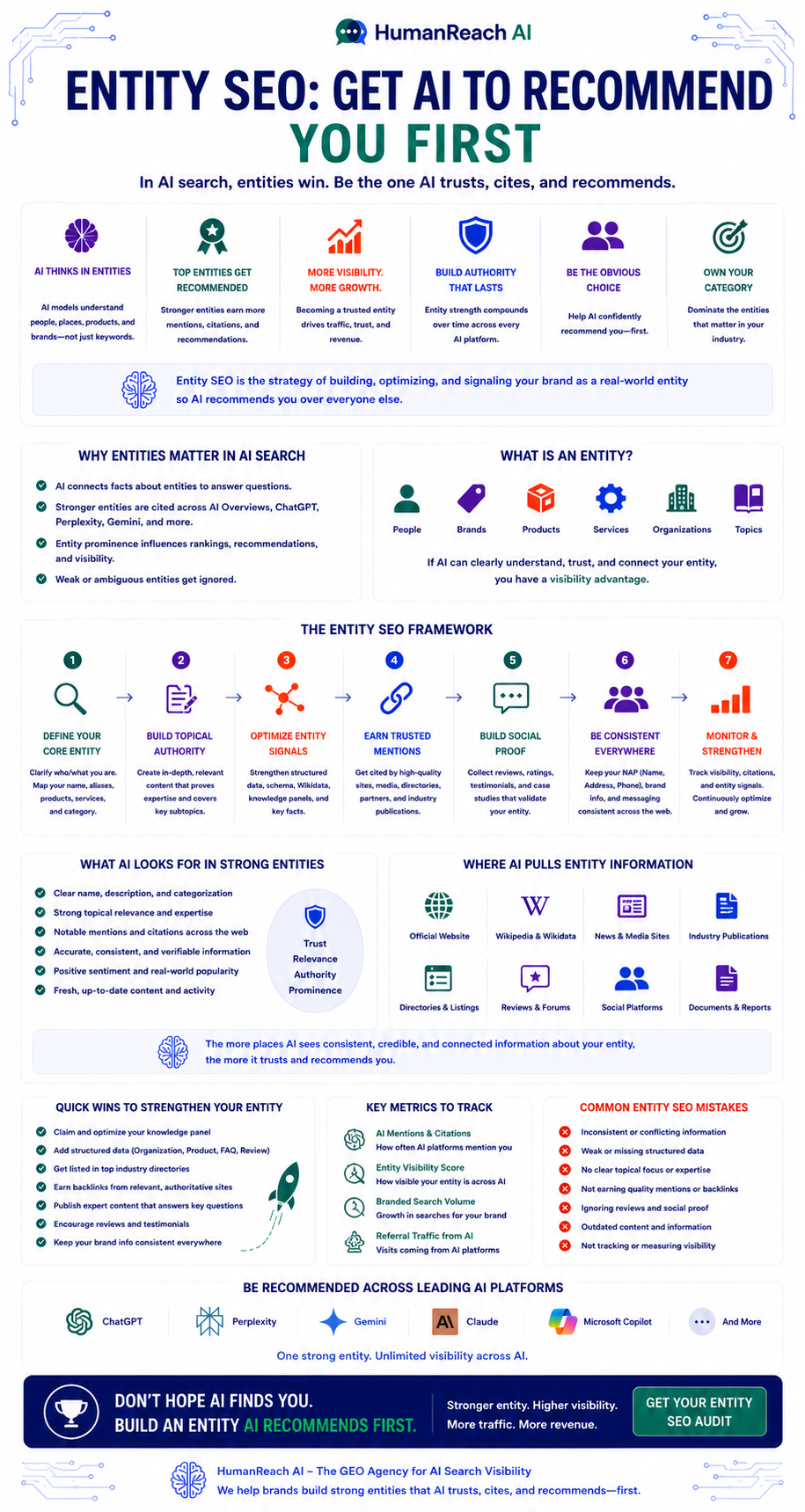
? Click the image to enlarge or download it for quick reference.
The 5 Core Pillars of Semantic Mapping
Achieving stable placement in conversational layouts requires managing five highly collaborative data parameters. If any singular layer degrades, model retrieval accuracy plummets.
Pillar 1: Structural Identity Isolation
Models require unambiguous definitions regarding your company’s core function. If your brand positioning shifts inconsistently across secondary directories, artificial models will treat those profiles as distinct fragments, lowering your baseline trust scores.
Pillar 2: Programmatic Microdata Layers
Integrating advanced structured markup directly into your source code acts as an explicit data translation layer for machine parsers. Essential properties include detailed Organization, Product, Service, and SameAs arrays. Validated case samples show model data extraction rates jumping from 16% to 54% once clear backend schemas are present.
Pillar 3: Relational Proximity Configuration
AI engines categorize concepts based on network connections. Your content must purposefully define your functional adjacencies—explicitly indicating which product classes you support, your direct market comparisons, and the enterprise ecosystems you integrate with.
Pillar 4: External Mention Frequency (Citation Density)
Citation density measures how frequently your brand node occurs across trusted, objective environments. High distribution frequencies signal category prominence to AI scrapers. Sustaining an active, cross-verified presence across multi-author hubs is crucial for moving up within candidate recommendation sets.
Pillar 5: Definitional Alignment Consistency
This metric covers the unified formatting of your core identity footprints—ensuring your organizational naming conventions, functional categories, core service definitions, and digital endpoints are identical across all indexed digital environments.
For an execution framework on managing these assets, read our operational guide on securing citations across generative models.
How Semantic Optimization Differs from Traditional Frameworks
Transitioning your organic presence to modern conversational environments requires abandoning old-school text-string assumptions. The fundamental mechanics operate on entirely different planes:
| Operational Parameter | Traditional Inbound SEO | Modern Semantic GEO |
|---|---|---|
| Primary Optimization Core | Isolated keyword text strings | Interconnected concept nodes |
| Target Extraction System | Standard web index algorithmic crawlers | Generative model knowledge graphs |
| Primary Performance Index | Static page position metrics | Model retrieval select-through rates |
| Core Authority Driver | Backlink volume and domain power | Cross-verified entity citation density |
Maintaining strong organic position reports no longer guarantees down-funnel referral volume. Real-world monitoring reveals that the overlap between classic top positions and actual AI-cited sources has settled into an autonomous, non-linear footprint.
For a detailed breakdown on managing these advanced analytics tracks, review our insight report on building internal generative attribution monitoring dashboards.
The Complete Entity Integrity Audit
Our foundational inspection protocols isolate hidden code fragmentation that traditional technical crawls regularly overlook.
Core Evaluation Checklist:
- Identity Cleansing: Auditing corporate descriptors across major commercial platforms.
- Microdata Validation: Inspecting backend script syntax across structural organizational data tags.
- Knowledge Graph Footprint: Evaluating public knowledge repository profiles and active engine panels.
- External Node Density: Tracking weekly discussion mentions, verified software evaluation platforms, and vertical reference distribution.
- Relational Context: Auditing proximity associations against immediate market alternatives and enterprise class designations.
✨ Ready to become the entity AI recommends first? You don’t have to figure it out alone.
At HumanReach.ai, we build entity SEO programs that turn your brand into the one LLMs retrieve first. Visit HumanReach.ai to learn more.
The 90-Day Execution Blueprint
Days 1-30: Identity Alignment and Data Layer Deployment
Isolate entity variances, correct inconsistent third-party descriptions, and deploy deep organizational microdata arrays to align all public definitions.
Days 31-60: Citation Density Expansion
Distribute data points across high-authority expert forums, execute review velocity campaigns on trusted review platforms, and secure objective references inside target vertical publications.
Days 61-90: Relational Mapping and Attribution Tracking
Deploy clear market-adjacency content assets, run routine model retrieval tests across primary conversational engines, and track downstream branded traffic lifts.
To analyze tactical visibility workflows inside community spaces, reference our blueprint covering maximizing citation velocity via authoritative platform seeding.
How HumanReach.ai Stabilizes Brand Visibility
By restructuring your brand’s underlying content architecture into a clean, machine-readable data layout, our clients secure reliable inclusion within conversational responses.
For documented proof of performance, review our enterprise validation report on +scaling qualified business generation via large language models.
Case Example: Real-World Structural Lifts
An enterprise risk compliance platform maintained strong traditional search visibility but lacked representation across major AI market recommendations due to a 47% entity consistency score.
Following a 90-day semantic optimization sprint to clean up corporate descriptors, expand structured schemas, and seed contextual forum validation, the organization experienced structural performance improvements: structural consistency reached 94%, citation frequency grew significantly across real-time indexers, and actionable conversion creation achieved notable quarterly gains.
Frequently Asked Questions (FAQ)
1. What is a semantic SEO strategy in the context of AI search?
A semantic SEO strategy focuses on defining and optimizing your brand as an explicit concept or entity node rather than targeting isolated keyword text strings. This process ensures that large language models can accurately map your organizational profile, service catalog, and category relationships within their knowledge graphs, making your brand easy to retrieve and recommend.
2. How does entity optimization differ from legacy keyword tracking?
Traditional SEO focuses primarily on content-to-keyword density and external link building to capture high web rankings. Semantic optimization shapes your entire digital footprint to optimize for concept density, unified data markup, and relational proximity mapping—targeting data inclusion inside conversational responses rather than a standard web position list.
3. What is the standard timeline for conversational search lifts?
Structural alignment changes can stabilize identity metrics across major indices within 2-3 weeks. Real-time models like Perplexity typically demonstrate initial citation inclusion inside 3-4 weeks, while larger model knowledge graph additions and branded referral loops develop over a 60-to-90-day window.
4. Why are community discussion spaces critical for retrieval optimization?
Large language models leverage verified community platforms to capture recent sentiment and objective real-world recommendations. For instance, data indicates that public discussion hubs supply a substantial percentage of citations for real-time engines. Active participation in these spaces provides the reference density required for model retrieval.
5. What is the purpose of structural entity consistency?
Entity consistency measures how uniformly your organization is categorized, described, and linked across independent web properties. Fragmented descriptions across different directories dilute your authority signals, making engines less likely to safely recommend your brand.
6. Which schema arrays provide the highest semantic value?
Organization markup serves as your primary foundation, explicitly defining your brand’s core data. This should be combined with precise SameAs arrays that link your domain to verified external data points, and customized Product or Service components to map your offerings accurately.
7. How do you measure the conversion value of a semantic SEO strategy?
Performance is tracked through three primary metrics: model select-through frequency across recurring prompt tests, direct increases in branded search terms within search consoles, and upward trends in high-intent direct entries that convert at multiple times the efficiency of traditional cold traffic.
Source: HumanReach.ai — Helping brands become the entity AI recommends first.
This article is part of the HumanReach.ai GEO Resource Hub.
Ready to Become the Entity AI Recommends First?
Your competitors are building their entity networks. Every day you wait, their signals grow stronger.
About the author: This guide was created by HumanReach.ai, an organic growth agency that helps local and global businesses thrive in the AI Search Reality. Visit HumanReach.ai to learn more.