


Deploying targeted protocols for AI search for ecommerce has become an urgent business requirement for modern storefronts. Your individual product lines may still hold strong technical indexes, and your top-level collections might sit at the peak of standard search page layouts. Yet, despite those legacy metrics, actual referral sessions are dipping and digital transaction volume remains stubbornly flat.
This operational disconnect occurs because generative summaries and predictive merchant interfaces have fundamentally altered consumer product discovery paths. When shoppers submit complex comparative prompts, search systems bypass classic external directories to compile comprehensive options natively on-screen. Consequently, your primary web links are often obscured within generative drop-downs or pushed far beneath synthetic interface blocks.
With active Gartner metrics showing a permanent 25% drop in traditional mobile and desktop search query actions, establishing technical presence inside machine-readable layouts is essential to secure modern digital revenue pipelines.
If your organization is currently evaluating its cross-platform data footprint, we recommend starting with our core foundational overviews on generative engine optimization versus classic SEO along with our marketplace readiness study covering adapting to corporate AI search architectures. For explicit optimization steps, reference our deep dive into structural data clusters via semantic entity optimization.
Real-world platform evaluations demonstrate that when synthetic answers occupy primary interface layouts, click-through volume for top-ranked organic results drops dramatically from roughly 27% down to 11%. Independent search data shows this structural evolution diverts hundreds of millions of prospective discovery interactions away from online retailers every month.
However, performance tracking reveals an important distinction: direct transactional pathways—such as explicit SKU lookups and checkout environments—remain largely insulated. The major disruption affects top-of-funnel comparison and evaluation content—the specific “best option for product class” informational research journeys that have traditionally driven early discovery acquisition.
Fortunately, the identical data layer that highlights this disruption also outlines the recovery mechanism. Digital merchants who purposefully structure their inventory architectures for programmatic data extraction are successfully reclaiming visibility within machine-synthesized panels—frequently outperforming pre-AI conversion baselines.
Here is the exact framework to realign your digital assets and capture buyer volume within the next-generation shopping interface.
? Table of Contents
- Quantifying Your Disrupted Acquisition Channels
- Case Study: Reclaiming 40% Organic Volume in 90 Days
- Why Current Product Assets Fail Generative Extraction
- The 90-Day Digital Commerce GEO Playbook
- The Move Toward Autonomous Agentic Commerce
- How HumanReach.ai Restores Merchant Pipeline Value
- Frequently Asked Questions (FAQ)
- Ready to Rebuild Your Product Discovery Footprint?
Quantifying Your Disrupted Acquisition Channels
Safeguarding your transaction volume requires pinpointing exactly where your user acquisition tracks are structurally exposed.
The Ecommerce Vulnerability Spectrum across Conversational Models:
| User Intent Category | Target Query Sample | Zero-Click Interface Risk | Impacted Pipeline Asset |
|---|---|---|---|
| Informational Research | “how to measure mountain bike frame size” | 75-85% | Editorial resources, buying guides, and blog repositories |
| Commercial Comparison | “top durable running shoes for flat feet” | 45-55% | High-volume collection and category discovery pipelines |
| Transactional Execution | “buy brand model size 10 blue” | <2% | Direct SKU variants and product detail pages (Mainly Stable) |
While the reduction in standard keyword referrals presents a challenge for basic visibility models, the expansion of the generative ecosystem is staggering: direct model-driven referral tracks to commerce destinations have scaled at triple-digit rates. Market surveys show that nearly two-thirds of active consumers are perfectly comfortable executing acquisitions directly from machine-synthesized recommendations. The crucial factor is ensuring your catalog data sits cleanly inside the index pool.
To analyze why traditional rank configurations no longer safeguard conversion volume, review our data overview on the zero-click search pipeline shift.
? How Online Stores Recover Sales Lost to AI Snippets
Explore this comprehensive visual guide that reveals how online stores are recovering sales lost to AI Overviews. It breaks down the vulnerability spectrum — from informational queries losing 75-85% of clicks to transactional queries losing less than 2% — and shows the real impact: 265 million clicks lost per month in Germany alone. The infographic also maps out the 90-day ecommerce GEO recovery roadmap, covering product data architecture fixes, schema implementation, unique data injection, comparison content optimization, and measurement. A must-see resource for any online store that wants to restore traffic lost to AI snippets and capture the 393% growth in AI-referred retail traffic.
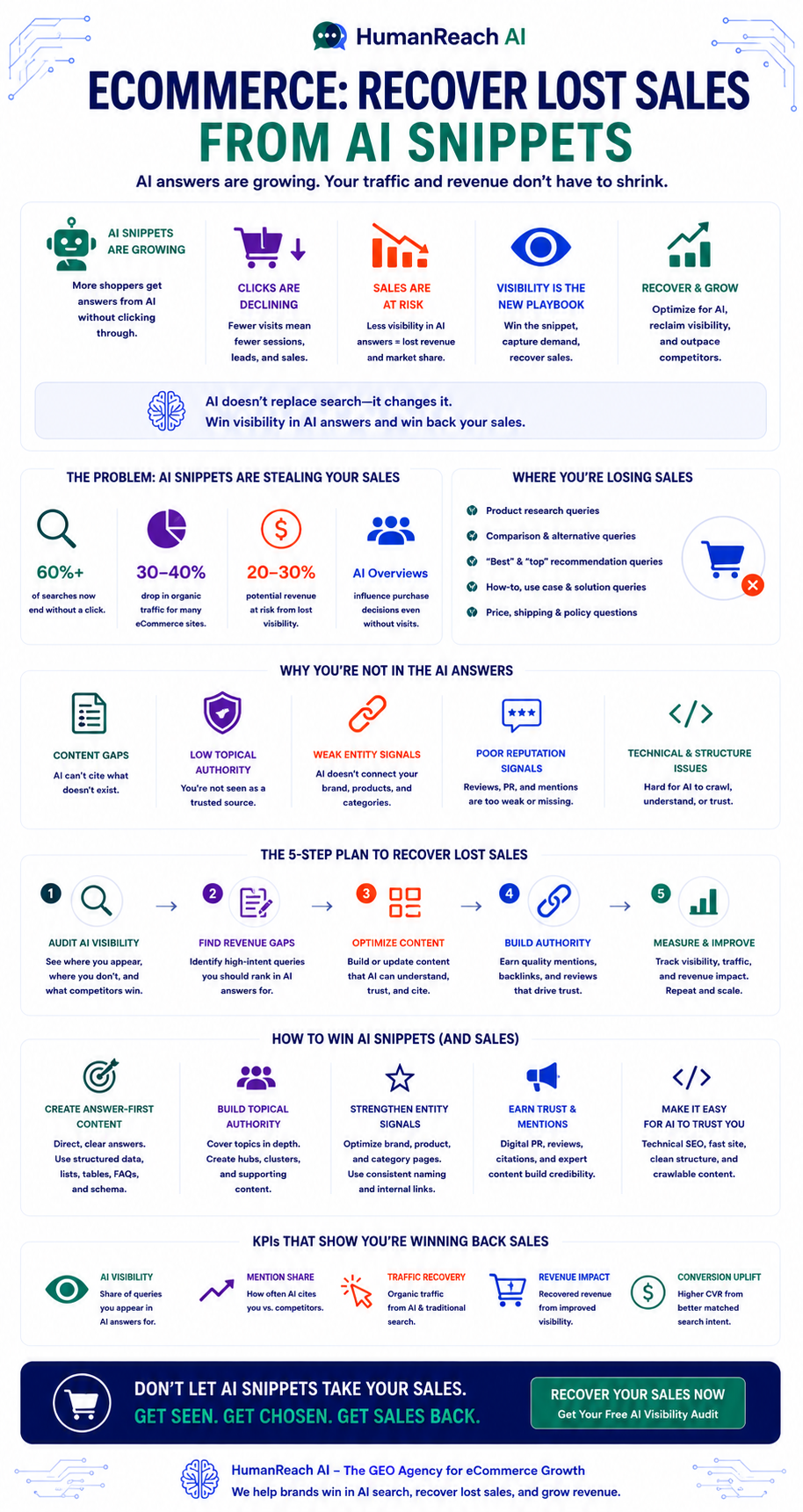
? Click the image to enlarge or download it for quick reference.
Case Study: Reclaiming 40% Organic Volume in 90 Days
Realigning digital assets with conversational models requires strict, programmatic data precision.
The Context: A prominent mid-market merchant relied on high-volume category rankings. When conversational engines integrated deeply with global retail platforms, their traditional top-of-page listings were systematically moved beneath generative content panels, causing an immediate drop in unbranded traffic paths.
The Strategy Deployment: The group executed a targeted ninety-day technical content realigned across three core layers:
- Layer 1: Re-architected catalog data feeds to deliver rich, micro-structured specifications to machine scrapers.
- Layer 2: Synthesized returns metadata, internal sizing trends, and historical customer care interactions directly into automated product text modules.
- Layer 3: Condensed massive pools of raw buyer reviews into clean, machine-extractable summary matrices outlining precise functional benefits.
The Logged Outcomes: Within a single quarter, unbranded organic access recovered fully, demonstrating single-digit growth above prior performance levels. Active model citations expanded across dozens of targeted inventory classifications, while global conversion efficiency across generic category traffic scaled by over 30%.
To examine the comprehensive framework for optimizing conversational footprint paths, review our operational guide on securing direct brand presence inside primary generative layouts.
Why Current Product Assets Fail Generative Extraction
Most digital commerce configurations are engineered for human visual evaluation rather than automated programmatic ingestion. This focus creates critical data friction for AI web crawlers.
Three Systemic Bottlenecks Disrupting Retail Model Ingestion:
- Incomplete Attribute Arrays: Missing global trade parameters, specific manufacturer identifiers, and standardized taxonomy classifications mean algorithms cannot identify the exact product node.
- Generic Descriptive Copy: Relying on superficial marketing jargon instead of providing definitive, extractable structural product features.
- Context-Thin Collection Grids: Serving basic pagination arrays to bots without providing matching contextual, semantic information layers.
Modern product engines manage tens of billions of catalog records via advanced neural networks. If your system’s underlying inventory data is fragmented, inaccurate, or hidden, your catalog simply does not exist within generative shopping summary outputs.
✨ Ready to recover sales lost to AI snippets? You don’t have to figure it out alone.
At HumanReach.ai, we rebuild product visibility in AI-powered shopping. Visit HumanReach.ai to learn more.
The 90-Day Digital Commerce GEO Playbook
This structured workflow realigns digital assets with modern conversational shopping environments.
Month 1: Infrastructure Alignment and Attribute Cleanse Isolate your base model footprint across ChatGPT, Perplexity, and conversational interface modes. Expand short textual assets into long, detail-rich product specifications, and integrate advanced script block markups across your entire catalog layer to maximize model extraction rates.
Month 2: Semantic Asset Activation and Comparative Optimization Inject proprietary internal operational metadata into detail tabs—such as sizing satisfaction metrics and common product-use queries. Build explicit alternative evaluation guides and structured tables, and pre-digest user review trends into clean pros-and-cons summaries for automated scrapers.
Month 3: Performance Tracking and Strategic Iteration Monitor share of voice metrics across generative engines, measure branded search lift signals inside tracking consoles, and modify content arrays based on logged attribution patterns.
For an updated methodology on configuring conversational data tracking layers, review our manual on building enterprise generative attribution analytics frameworks.
The Move Toward Autonomous Agentic Commerce
Major search ecosystems are fundamentally re-engineering retail search around automated agents. Modern framework configurations utilize integrated product graphs to coordinate discovery through clear paths: prioritizing complete machine comprehension, maintaining attractive unstructured asset layers, and guaranteeing high presence across automated checkout environments.
This rapid shift introduces automated cross-engine transactions and machine-to-machine exchange protocols. Success requires recognizing that modern discovery platforms share a single foundation: highly accurate, micro-structured data layers.
How HumanReach.ai Restores Merchant Pipeline Value
We modify and realign your catalog architectures to guarantee stable indexation inside the next-generation shopping environments.
Standard Operational Milestone Paths:
- Weeks 2-3: System data alignment completed and structured schema blocks fully deployed.
- Weeks 4-6: Validation of initial catalog assets within real-time model answers.
- Weeks 6-8: Documented lifts in baseline branded query volume (+5-15%).
- Month 3: Measured recovery across affected unbranded category traffic paths.
- Months 4-6: Long-term conversion optimization showing significant efficiency lifts above baseline.
Frequently Asked Questions (FAQ)
1. How does the deployment of AI search for ecommerce affect unbranded retail traffic?
As conversational engine layouts populate search interfaces, traditional informational and comparison query tracks resolve natively on-screen. This change reduces classic click-through rates, requiring online stores to transform their catalog architectures into structured data blocks that conversational engines can reliably pull and cite.
2. Which product classifications display the highest exposure to zero-click summary layouts?
Informational guides lose roughly 75-85% of standard traffic, and comparative list queries face drops of 45-55%. Explicit transactional SKU paths remain highly stable, meaning optimization strategies should focus heavily on restructuring your mid-funnel category resources first.
3. What specific data assets do large language models require to recommend an inventory item?
Models demand complete global trade parameters, detailed product descriptions exceeding 500 characters, bulleted feature highlight strings, accurate pricing layers, and synthesized user consensus tables containing clear feature pros-and-cons lists.
4. How can digital merchants reliably monitor their visibility inside conversational summaries?
Merchants run systematic test queries across primary models to manually log SKU citation velocity across key categories. Because classic search data consoles do not provide native dashboards for conversational tracking yet, establishing distinct tracking scripts is necessary.
5. Does the implementation of deep microdata scripts modify conversational extraction?
Yes. Case validations indicate that deploying advanced structured scripts can shift raw content extraction efficiency from 16% up to 54%. Ensuring your product data features pristine Product, Offer, and Brand arrays directly improves model retrieval reliability.
6. What are the underlying functions of agentic commerce frameworks?
Agentic commerce is the operational layout where automated software profiles run product evaluation, selection, and checkout phases natively. This model relies on clean inventory data feeds and real-time validation layers to execute programmatic purchasing decisions.
7. What is the average return timeline for digital commerce generative optimization?
Validated merchant deployments show clear recovery patterns within 90 days of structural rollout, alongside long-term conversion efficiency improvements across non-branded categories once data layer transparency is fully optimized.
Source: HumanReach.ai — Helping online stores recover sales lost to AI snippets.
This article is part of the HumanReach.ai Ecommerce GEO Resource Hub.
Ready to Recover Your Lost Sales?
Your products are great. Your data is the problem. Let’s fix it.
About the author: This guide was created by HumanReach.ai, an organic growth agency that helps local and global businesses thrive in the AI Search Reality. Visit HumanReach.ai to learn more.