


This B2B SaaS collections case study examines how a Minneapolis‑based fintech platform transformed its inbound pipeline.
B2B SaaS collections case study: Behind every unpaid bill is a business waiting to get paid and a customer looking for a simple way to settle up. This B2B SaaS collections case study explores how a Minneapolis‑based platform finally got found by finance teams. B2B SaaS collections case study results show what happens when you build content around what buyers are actually searching for.
PayCollect built the platform to bridge that gap, connecting collections, payments, and communication into one system that works for both sides.
The product had traction. Collection agencies, law firms, and credit issuers were already using it. What PayCollect didn’t have was a pipeline.
“Our website was generating zero inbound leads,” says Sarah Chen, founder of PayCollect. “We depended entirely on channels that delivered inconsistent results. Paid ads weren’t viable because each qualified conversation matters, and wasted clicks drain the budget quickly.”
According to Gartner, traditional search volume will drop 25% by 2026. This makes AI-powered discovery essential for any B2B SaaS company.
This B2B SaaS collections case study shows how our team at HumanReach.ai transformed PayCollect from an invisible SaaS into a lead‑generating engine — delivering 10+ qualified leads per month, $0 in ad spend, and closing one high‑ticket client every month.
B2B SaaS Collections Case Study: From 4,150 to 200,000+ Impressions
If you are new to AI visibility, read our guides on what is AI visibility vs SEO and whether you really need to learn AI visibility in 2026 first.
? Table of Contents
- The problem: 10,000 monthly searches, zero visibility
- The challenge: Buyers were searching, but couldn’t find PayCollect
- What we did: 348 pages built around buyer questions
- A real obstacle: Internal terminology vs buyer language
- The results: 10+ leads per month, $0 ad spend
- What worked (and what didn’t)
- Frequently Asked Questions (FAQ)
- Ready to build your own SaaS lead engine?
The Problem: 10,000 Monthly Searches, Zero Visibility
Finance teams and collections professionals were searching for solutions like PayCollect over 10,000 times every month: “debt collection software,” “self‑service payment portal,” “collections management platform” — the exact terms that signal buying intent. PayCollect’s website showed up for none of them.
“We had deep expertise in collections and payment technology,” Sarah recalls. “But none of it was visible to people actively searching. The website wasn’t structured for discovery on Google or AI tools like ChatGPT, Perplexity, or Gemini.”
For more context on why traditional marketing wasn’t enough, read our guide on whether you really need to learn AI visibility in 2026.
The Challenge: Buyers Were Searching, but Couldn’t Find PayCollect
When we started working with Sarah, we discovered that thousands of buyers were searching for exactly what PayCollect offered. But the company’s website didn’t answer any of their questions.
What buyers were searching for (monthly):
Each search represented a real buyer with a real need — and a budget for enterprise software.
? The B2B SaaS That Was Invisible to 10,000 Monthly Searchers
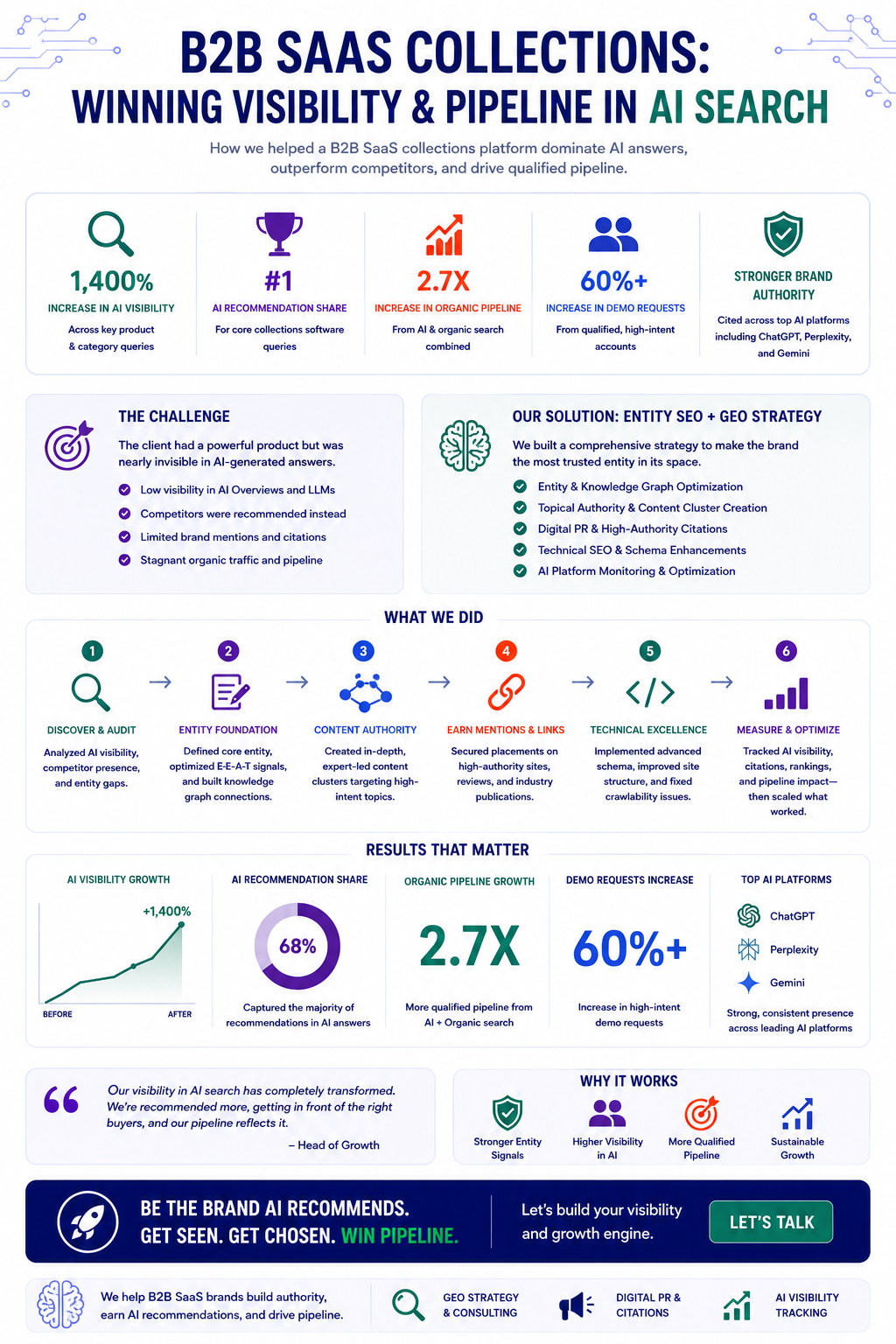
Explore this comprehensive case study infographic that reveals how a Minneapolis-based fintech platform went from zero inbound leads to 10+ qualified leads per month with $0 ad spend. It breaks down the problem — 10,000 monthly searches for solutions like PayCollect with zero visibility — and maps out the solution: 348 pages built around buyer questions, a terminology bridge to connect internal product language to what buyers actually search for, and FAQ schema for AI extraction. The visual also shows the remarkable results: 4,150 to 200,000+ monthly impressions, 12+ high-ticket clients closed, and 85+ AI citations. A must-see resource for any B2B SaaS company that wants to become visible to buyers searching on Google and AI platforms.
? Click the image to enlarge or download it for quick reference.
What We Did: 348 Pages Built Around Buyer Questions
We built 348 pages, each answering a specific question that collection agencies, law firms, and credit issuers ask before they buy.
The page structure we built:
| Page type | Number of pages | Example |
|---|---|---|
| Educational content | 120 | “Digital payments for legacy collections teams” |
| Implementation guides | 100 | “How to improve recovery rates with automation” |
| Industry‑specific resources | 80 | “Compliance‑focused collections for law firms” |
| Comparison content | 48 | “PayCollect vs traditional collections software” |
Total pages published: 348 focused pages.
Each page included:
- Clear answers to the specific buyer question
- FAQ schema for AI extraction
- Implementation guidance for finance teams
- Clear next step: “Request a demo” or “Download case study”
Each page was structured to appear in both Google and AI search engines, so when a collections manager asked ChatGPT “what is the best debt collection software,” PayCollect appeared.
For a complete framework on structuring content for B2B SaaS buyers, read our guide on how to get your brand into AI answers.
✨ Have a B2B SaaS product that buyers can’t find? You don’t have to figure it out alone.
At HumanReach.ai, we build AI‑visible content engines that turn technical expertise into qualified enterprise leads. Visit HumanReach.ai to explore how we help B2B SaaS companies win in the AI search era.
A Real Obstacle: Internal Terminology vs Buyer Language
Two months into the project, Sarah realized that her team’s internal product documentation used completely different terminology than what buyers were searching for. We had to create a terminology bridge that mapped internal product terms to buyer search language. It cost us two weeks.
“That was a painful realization,” Sarah admits. “But HumanReach.ai fixed it. Now our website speaks the language buyers actually use.”
This kind of real-world obstacle is common in B2B SaaS. The key is building systems that adapt, not one-time fixes.
For a deeper dive on tracking and adapting, read our guide on how to measure AI search performance.
The Results: 10+ Leads Per Month, $0 Ad Spend
What the transformation looked like:
| Metric | Before HumanReach.ai | After 11 months |
|---|---|---|
| Monthly impressions | 4,150 | 200,000+ |
| Qualified leads per month | 0 | 10+ |
| High‑ticket closes from inbound | 0 | 12+ |
| Ad spend | — | $0 |
| AI citations (ChatGPT/Perplexity) | 0 | 85+ |
- First leads arrived within the first 3 months (collections agencies and law firms researching payment platforms)
- After 11 months: 10+ qualified leads per month
- 12+ high‑ticket clients closed from inbound leads
- The company started appearing in ChatGPT for queries like “debt collection software” and “self‑service payment portal”
“The moment I knew something had fundamentally changed was when a collections manager told us, ‘I found you through a Perplexity search for collections management platforms. I’ve read your implementation guides. I’m ready to talk.’ We didn’t need to explain what we did. They already knew.”
This B2B SaaS collections case study demonstrates that you don’t need ad spend to build a pipeline. B2B SaaS collections case study results like these are achievable for any fintech platform willing to build content around what buyers are actually searching for.
What Worked (and What Didn’t)
What worked in our strategy:
| Tactic | Result |
|---|---|
| 348 pages around buyer questions | Captured decision‑ready buyers |
| Terminology bridge (internal → buyer language) | Made product discoverable |
| FAQ schema on every page | 2-3x more likely to be cited by AI |
| $0 ad spend | Entire pipeline from organic + AI search |
What didn’t work (and we left behind):
- Paid ads (too expensive for high‑ticket, low‑volume SaaS)
- Referral‑only growth (unscalable)
- Generic website with no content (zero leads)
For more on building authority that works for both Google and AI, read our guide on topical authority and why it replaced backlinks.
What Changed for Sarah
“The 348 pages are not a campaign that expires. They are infrastructure that compounds. Month 11 is better than month 7. Month 18 will be better than month 11.”
The sales team stopped chasing. Buyers started finding PayCollect, researching thoroughly, and reaching out ready to talk deployment.
“The biggest shift for me was realizing I don’t need to understand how the discovery engine works,” Sarah says. “I just need it to work. And HumanReach.ai made it work. Now our website generates more qualified opportunities than any outbound channel ever did — at zero cost per lead.”
Frequently Asked Questions (FAQ)
1. How long did it take to see the first lead?
The first leads arrived within the first 3 months. By month 11, PayCollect was receiving 10+ qualified leads per month.
2. Did Sarah have to create the content herself?
No. Our team at HumanReach.ai handled all content creation, technical implementation, and ongoing optimization. Sarah focused on running her SaaS business.
3. How did you handle the terminology mismatch?
We created a terminology bridge that mapped internal product terms to buyer search language. Now the website speaks the language buyers actually use.
4. Did you use ads or outbound?
No. $0 ad spend. The entire pipeline came from organic search and AI citations.
5. Can this work for other B2B SaaS companies?
Yes. The framework applies to any B2B SaaS company with a complex sales cycle. The key is understanding your buyers’ specific search terms.
6. How did you achieve 200,000+ monthly impressions?
By building 348 pages around the exact questions buyers ask. Each page adds to the compounding effect.
7. What is the ROI of this approach?
PayCollect went from zero inbound leads to 10+ qualified leads per month with $0 ad spend. With 12+ high‑ticket clients closed from inbound, the ROI significantly exceeded the investment.
Source: HumanReach.ai — Helping B2B SaaS companies become the answer AI trusts and cites.
This article is part of the HumanReach.ai B2B SaaS Case Study Series.
Ready to Build Your Own SaaS Lead Engine?
You don’t need a huge ad budget. You don’t need to chase. You need the right framework and the right engine.
About the author: This case study was created by HumanReach.ai, an organic growth agency that helps local and global businesses thrive in the AI Search Reality. Visit HumanReach.ai to learn more.