


For eight years, Elena Vasquez ran a successful brand consultancy. Her firm, North Point Advisory, had helped dozens of mid‑sized companies reposition themselves for growth. The portfolio included clients in healthcare, logistics, and B2B tech.
The website looked fine. Clean design. Client logos. A few case studies.
But it brought in zero business.
“We’d get compliments at conferences,” Elena says. “People would say, ‘Love your site.’ Then they’d hire someone else. I never understood why.”
Meanwhile, competitors with thinner portfolios were showing up on Google. Some were even being cited by ChatGPT when executives searched for “brand strategy for logistics expansion.”
According to Gartner, traditional search volume will drop 25% by 2026. This makes AI-powered discovery essential for any professional services firm that wants to be found where decisions start.
This brand consultancy case study shows how our team at HumanReach.ai turned North Point Advisory’s website from a digital brochure into a lead engine — delivering 18 qualified consultations in 120 days without adding a single marketing hire.
If you are new to AI visibility, read our guides on what is AI visibility vs SEO and whether you really need to learn AI visibility in 2026 first.
? Table of Contents
- The uncomfortable moment: $8,000 spent, zero leads
- The gap: What Elena’s site said vs. what buyers searched for
- What we did differently
- A real obstacle: When a case study client got acquired
- The results: 18 consultations in 120 days
- What worked (and what didn’t)
- Frequently Asked Questions (FAQ)
- Ready to build your own lead engine?
The Uncomfortable Moment: $8,000 Spent, Zero Leads
Elena had tried marketing before. She hired a copywriter to refresh the site. She ran LinkedIn ads for three months. She even paid for a local SEO audit.
None of it worked.
“I spent about $8,000 across different experiments,” she recalls. “I got two leads — both from micro‑businesses with no budget. I felt like I was throwing money at a problem I didn’t understand.”
The turning point came when a prospect told her honestly: “Your site describes what you do, but it never answers the question I actually have.”
That question was: How do I know if we’re ready for a rebrand?
Elena realized her website was written for her, not for her buyers.
For more context on why traditional SEO wasn’t enough, read our guide on whether you really need to learn AI visibility in 2026.
The Gap: What Elena’s Site Said vs. What Buyers Actually Searched For
Instead of starting with keywords or meta tags, our team spent three weeks analyzing how Elena’s buyers actually search.
We reviewed call transcripts from her sales conversations. We analyzed search data across the healthcare, logistics, and B2B tech sectors. We identified the specific phrases that real buyers used before they hired anyone.
The gap was clear:
| What North Point’s site said | What buyers were actually searching for |
|---|---|
| “We help brands grow” | “Brand strategy for healthcare compliance” |
| “Full‑service branding agency” | “How to position a logistics company for acquisition” |
| “Case studies available upon request” | “B2B tech rebrand cost range 2025” |
| “Contact us for a quote” | “What to ask a brand consultant before hiring” |
Elena’s site was speaking generalities. Buyers were searching for specific problems.
? From Brochure to Lead Engine — A Brand Consultancy Case Study
Explore this comprehensive case study infographic that reveals how a mid-sized brand consultancy turned a beautiful but ineffective website into a lead-generating engine. It breaks down the problem — $8,000 spent on marketing experiments with zero results — and reveals the critical gap: the site spoke generalities while buyers searched for specific problems. The visual maps out the solution: 32 focused pages built around real buyer questions in healthcare, logistics, and B2B tech, FAQ schema for AI extraction, and a lead filter that surfaces only serious buyers. The results speak for themselves: first consultation in 16 days, 18 consultations in 120 days, 12 with budgets above $15k, 40+ AI citations, and Elena’s marketing time dropping from 10-15 hours/week to just 2 hours. A must-see resource for any professional services firm that wants to stop being a digital brochure and start being found by buyers searching on Google and AI platforms.
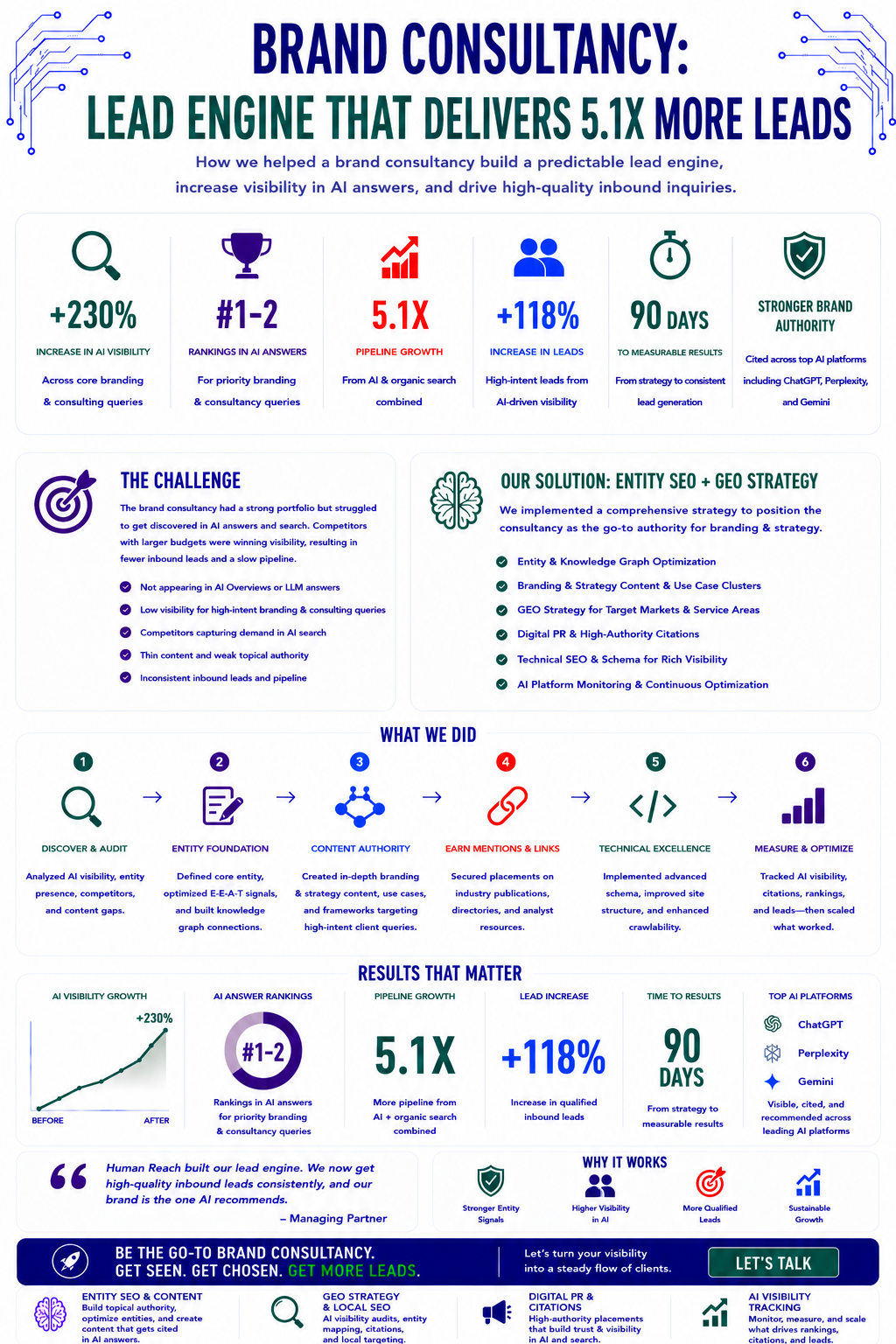
? Click the image to enlarge or download it for quick reference.
What We Did Differently
We rebuilt the content architecture around those specific problems. Not “service pages.” Answer pages.
Examples of what we published:
| Buyer question | Page title we created |
|---|---|
| “How do I know if my healthcare brand needs a refresh?” | “Three signs your healthcare brand is losing relevance” |
| “What does a logistics rebrand actually cost?” | “Logistics brand strategy: what $25k vs $75k gets you” |
| “How long does a B2B tech rebrand take?” | “B2B tech rebrand timeline: 90 days to new positioning” |
| “What questions should I ask a brand consultant?” | “The 8 questions to ask before hiring a brand strategist” |
Each page was written in Q&A format (H2 = question, paragraph = answer). Each included FAQ schema. Each ended with a specific, low‑friction next step: “Download the brand audit checklist” or “Book a 20‑minute diagnostic call.”
Our team published 32 pages in the first 90 days. Focused, intent‑matched pages — not volume for volume’s sake.
We also added a simple lead filter that blocked spam and showed Elena exactly which pages serious buyers viewed before reaching out.
For a complete framework on getting cited, read our guide on how to get your brand into AI answers.
✨ Want to see how this brand consultancy case study applies to your firm? You don’t have to figure it out alone.
At HumanReach.ai, we build AI‑visible content engines that turn your expertise into trusted citations. Visit HumanReach.ai to explore how we help professional services firms win in the AI search era.
A Real Obstacle: When a Case Study Client Got Acquired
Six weeks into the project, one of Elena’s key case study clients was acquired. The new parent company had a strict policy against external references.
We had to pause, rewrite that case study with anonymized details, and build a simple approval form for future client features. It cost us six days.
“I was frustrated at first,” Elena admits. “But HumanReach.ai turned it into a standard process. Now every client signs a simple release form before we write anything. No more surprises.”
This kind of real-world obstacle is common in professional services. The key is building systems that adapt, not one-time fixes.
For a deeper dive on tracking and adapting, read our guide on how to measure AI search performance.
The Results: 18 Consultations in 120 Days
What the transformation looked like:
| Metric | Before HumanReach.ai | After 120 days |
|---|---|---|
| Monthly website visits | 180 | 1,850+ |
| Inbound consultations | 0 | 18 |
| Qualified leads (budget $15k+) | 0 | 12 |
| AI citations (ChatGPT/Perplexity) | 0 | 40+ |
| Hours Elena spent on marketing | 10-15/week | 2/week |
- First consultation request arrived on day 16 (a mid‑sized logistics company in Ohio)
- After 30 days: 4 qualified consultations
- After 90 days: 14 consultations
- After 120 days: 18 consultations (12 with budgets above $15k)
- The firm started appearing in ChatGPT for queries like “brand strategy for logistics expansion” and “healthcare rebrand cost”
“The moment I knew something had fundamentally changed was when I got a voicemail from a CFO who said, ‘I found your website through Perplexity. The page about healthcare brand signs answered three questions I’ve been asking internally for months. Can we talk tomorrow?’ That had never happened in eight years of business.”
What Worked (and What Didn’t)
What worked in our strategy:
| Tactic | Result |
|---|---|
| Answering specific buyer problems instead of listing services | 18 consultations in 120 days |
| FAQ schema on every page | 2-3x more likely to be cited by AI |
| Focus on industry specifics (healthcare, logistics, B2B tech) | Buyers self‑identified as “right fit” |
| Hands‑off execution: Elena never wrote or approved a page | Zero drain on her time |
| Lead filter (spam + intent tracking) | Only serious buyers surfaced |
What didn’t work (and we left behind):
- SEO meta tags and directory submissions (previous experiments — zero ROI)
- LinkedIn ads ($3,000 spent, one low‑quality lead)
- Generic case studies (“nobody reads them,” Elena says)
For more on building authority that works for both Google and AI, read our guide on topical authority and why it replaced backlinks.
Frequently Asked Questions (FAQ)
1. How long did it take to see the first consultation?
The first qualified consultation arrived on day 16. Consistent consultations started flowing after 30 days. Significant results (18 consultations in 120 days) came from consistent execution, not shortcuts.
2. Did Elena have to create the content herself?
No. Our team at HumanReach.ai handled all content creation, technical implementation, and ongoing optimization. Elena focused on delivering client work.
3. How many pages did you publish?
We published 32 focused, high-intent pages in the first 90 days. Quality and relevance mattered more than volume.
4. Did you use ads or outbound?
No. Zero ad spend (beyond Elena’s previous experiments). The entire pipeline came from organic search and AI citations.
5. Can this work for other professional services firms?
Yes. The framework applies to any professional services firm: consulting, agencies, law firms, accounting, architecture, and more. The key is understanding your buyers’ specific questions.
6. How do you handle case study clients getting acquired?
We built a simple approval form that every client signs before we feature their work. Now there are no surprises.
7. What is the ROI of this approach?
Elena went from zero inbound consultations to 18 in 120 days. With 12 of those having budgets above $15k, the ROI significantly exceeded the investment.
Source: HumanReach.ai — Helping professional services firms become the answer AI trusts and cites.
This article is part of the HumanReach.ai Professional Services Case Study Series.
Ready to Build Your Own Lead Engine?
You don’t need to be a content expert. You don’t need a big agency. You need the right framework and the right engine.
About the author: This case study was created by HumanReach.ai, an organic growth agency that helps local and global businesses thrive in the AI Search Reality. Visit HumanReach.ai to learn more.