

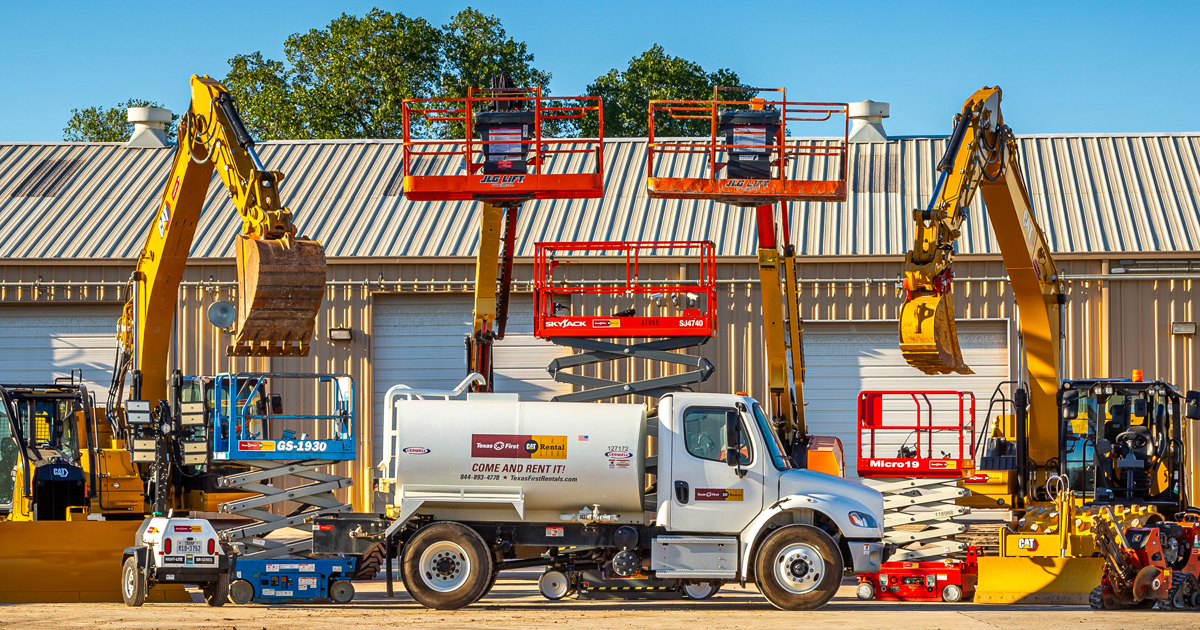
Equipment rental case study: For over 20 years, Great Lakes Waste Equipment had built a solid reputation across the Midwest. Their fleet included roll‑off trucks, rear‑load compactors, and automated side‑loaders. They served waste management companies in Ohio, Indiana, Illinois, and Michigan with reliable equipment and responsive service.
New business came through referrals, industry events, and relationships built over decades. The phone rang often enough. The fleet stayed busy enough.
But the world had shifted.
Operations managers who used to call three people they knew were now opening Google and typing “rear‑load truck rental near me.” Procurement teams were searching “short‑term garbage truck lease” and building shortlists from search results. Some were even asking ChatGPT: “What are the best waste equipment rental companies in the Midwest?”
Great Lakes Waste Equipment appeared in none of those results.
According to Gartner, traditional search volume will drop 25% by 2026. This makes AI-powered discovery essential for any equipment rental business that wants to be found where decisions start.
This equipment rental case study shows how our team at HumanReach.ai transformed Great Lakes Waste Equipment from a referral‑dependent business into a search‑dominant lead engine — generating 15+ qualified rental inquiries per month and fully booking their fleet in 90 days, with Tom barely involved in the process.
If you are new to AI visibility, read our guides on what is AI visibility vs SEO and whether you really need to learn AI visibility in 2026 first.
? Table of Contents
- The problem: 20 years of referrals, zero web leads
- The challenge: 2,000+ ways to search for the same thing
- What we did: Mapping every buyer query
- A real obstacle: Outdated fleet availability
- The results: First lead in 10 days, fully booked fleet in 90
- What worked (and what didn’t)
- Frequently Asked Questions (FAQ)
- Ready to build your own rental lead engine?
The Problem: 20 Years of Referrals, Zero Web Leads
Tom Wilkins had spent two decades building relationships. His equipment was reliable. His customers stayed with him. But he couldn’t remember the last time a new customer found him through the website.
“Our website was basically a digital business card,” Tom says. “It listed our equipment. It had a phone number. That was it. No one was finding us through Google, and definitely not through ChatGPT.”
Tom had tried a few things over the years. A local marketing company built a basic website. A freelancer ran some Google Ads. Nothing worked.
“I was spending money on things that didn’t move the needle,” he recalls. “I knew we had good equipment. I knew we could serve more customers. But I didn’t know how to get in front of them when they were actually searching.”
For more context on why traditional SEO wasn’t enough, read our guide on whether you really need to learn AI visibility in 2026.
The Challenge: 2,000+ Ways to Search for the Same Thing
When we started working with Tom, we asked a simple question: how are operations managers and procurement teams actually searching for rental equipment?
Our team spent two weeks analyzing search patterns across the Midwest. We reviewed search data for every possible variation of “trash truck rental,” “garbage truck rental,” “roll‑off rental,” and “compactor truck for hire.”
The scale of the problem:
| Query type | Number of variations | Example |
|---|---|---|
| Equipment type + rental | 450 | “rear‑load truck rental” |
| Equipment type + location | 380 | “roll‑off rental near me” |
| Urgency + equipment | 275 | “emergency garbage truck replacement” |
| Seasonal + capacity | 210 | “summer waste truck lease” |
| Long‑term + supplement | 180 | “additional compactor truck for hire” |
| Comparison queries | 150 | “roll‑off vs rear‑load rental cost” |
| Other variations | 580 | “waste equipment rental companies Midwest” |
Total queries mapped: 2,225 distinct, high‑intent searches.
Each query represented a real rental opportunity. But Tom’s old website was invisible for all of them.
? From Zero Web Leads to Fully Booked Fleet in 90 Days
Explore this comprehensive case study infographic that reveals how a Midwest waste equipment rental company went from zero web leads to a fully booked fleet in 90 days. It breaks down the problem — 20 years of referrals, zero web leads — and maps the scale of the challenge: over 2,200 distinct buyer queries across equipment types, locations, urgency, seasonality, and comparisons. The visual also shows the solution: 214 pages built around buyer scenarios (emergency, seasonal, long-term, comparison, and location-specific), each with FAQ schema for AI extraction and real-time availability integration. The results speak for themselves: first qualified inquiry in 10 days, 15+ leads per month, 50+ AI citations, fleet utilization from 70% to 100% fully booked, and Tom’s marketing time dropping from 10-15 hours/week to just 1-2 hours. A must-see resource for any equipment rental business that wants to stop relying on referrals and start being found by buyers searching on Google and AI platforms.
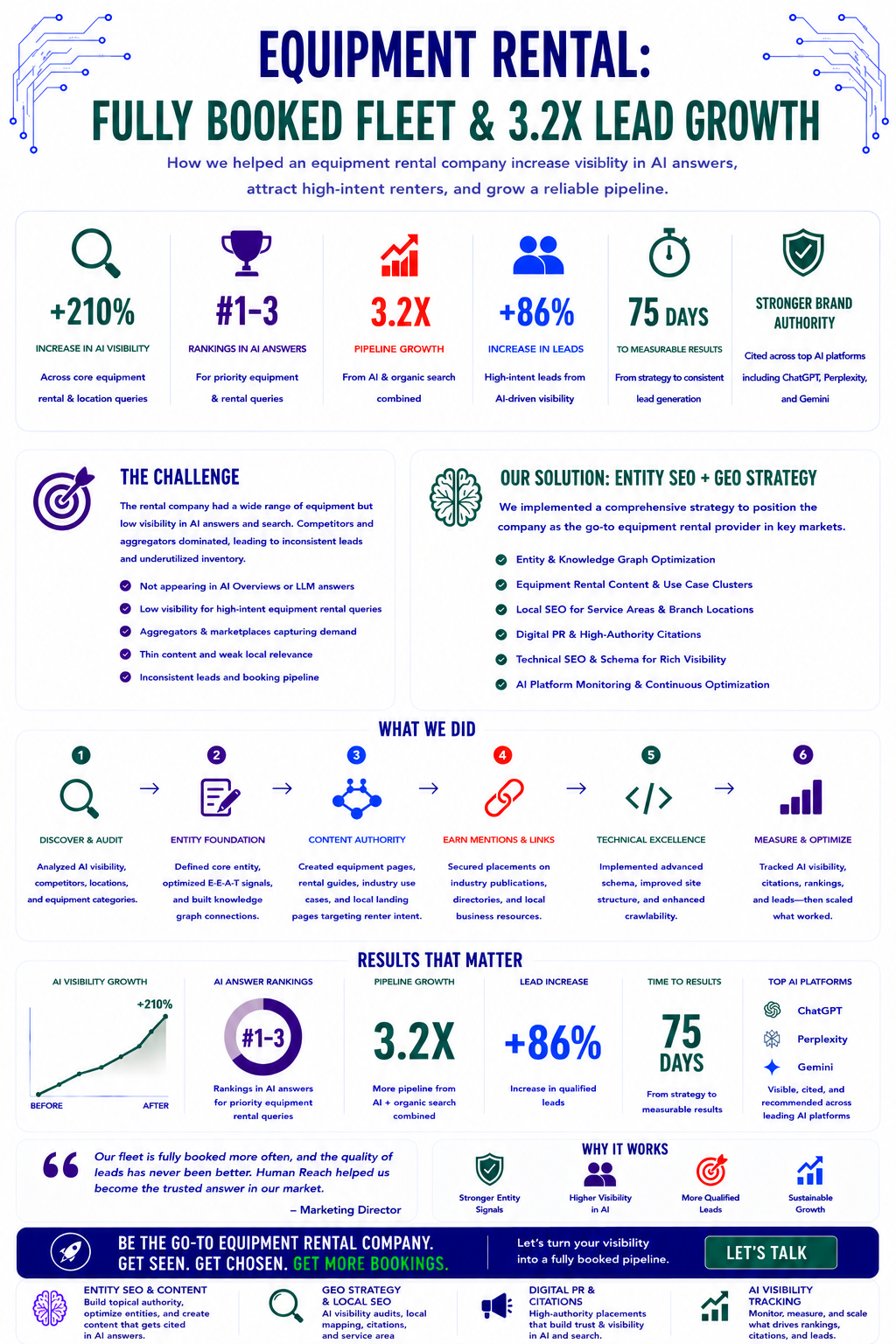
? Click the image to enlarge or download it for quick reference.
What We Did: Mapping Every Buyer Query
We didn’t build generic “equipment rental” pages. We built pages that answered the exact questions buyers were asking.
The page structure we built:
| Buyer scenario | Page type | Number of pages |
|---|---|---|
| Emergency breakdown (same‑week replacement) | Emergency rental page | 45 |
| Seasonal demand spikes (summer volume) | Seasonal capacity page | 38 |
| Long‑term fleet supplementation | Fleet supplement page | 42 |
| Equipment comparison (roll‑off vs rear‑load) | Comparison guide | 24 |
| Location‑specific rental (e.g., “rental near me”) | Geographic page | 65 |
Total pages published: 214 focused, buyer‑driven pages in 60 days.
Each page included:
- Clear answers to buyer questions (H2 = question, paragraph = answer)
- FAQ schema for AI extraction
- Location precision (only served markets where Tom could actually deliver)
- Clear next step: “Check availability” or “Request a quote”
For a complete framework on structuring local content, read our guide on how to get your brand into AI answers.
✨ Got a fleet of equipment that needs to be found by local buyers? You don’t have to figure it out alone.
At HumanReach.ai, we build AI‑visible content engines that turn local search demand into qualified rental inquiries. Visit HumanReach.ai to explore how we help equipment rental companies win in the AI search era.
A Real Obstacle: Outdated Fleet Availability
Three weeks into the project, Tom realized that his fleet availability data was stored in an old spreadsheet that no one updated consistently. If we published pages with “check availability” links, customers would have been calling about trucks that were already booked.
Our team had to pause, build a simple integration that pulled real‑time availability from his dispatch system, and create a dashboard where his team could flag sold‑out equipment. It cost us a full week.
“I didn’t even think about that,” Tom admits. “But HumanReach.ai caught it before we launched. Now our website only shows what’s actually available. No more frustrated customers calling about trucks we already rented.”
This kind of real-world obstacle is common in equipment rental. The key is building systems that adapt, not one-time fixes.
For a deeper dive on tracking and adapting, read our guide on how to measure AI search performance.
The Results: First Lead in 10 Days, Fully Booked Fleet in 90 Days
What the transformation looked like:
| Metric | Before HumanReach.ai | After 90 days |
|---|---|---|
| Monthly website visits | ~50 | 1,400+ |
| Qualified rental inquiries | 0 | 15+ per month |
| Time to first lead | — | 10 days |
| AI citations (ChatGPT/Perplexity) | 0 | 50+ |
| Fleet utilization | ~70% | 100% (fully booked) |
| Hours Tom spent on marketing | 10-15/week | 1-2/week |
- First qualified inquiry arrived on day 10 (a waste management company in Indiana needing an emergency rear‑load replacement)
- After 30 days: 10+ qualified leads
- After 60 days: 12+ leads per month
- After 90 days: 15+ leads per month, fleet fully booked
- The company started appearing in ChatGPT for queries like “roll‑off rental near me” and “garbage truck rental Midwest”
“The moment I knew something had fundamentally changed was when I got a call from a fleet supervisor who said, ‘I asked Perplexity for emergency waste truck rental in Ohio, and your company was the first result. Can you get me a roll‑off by tomorrow?’ That had never happened in 20 years of business.”
What Worked (and What Didn’t)
What worked in our strategy:
| Tactic | Result |
|---|---|
| Mapping 2,225 buyer queries | Captured every way customers search |
| Scenario‑based pages (emergency, seasonal, long‑term) | Matched real buyer urgency |
| Geographic precision | No wasted visibility outside service area |
| FAQ schema on every page | 2-3x more likely to be cited by AI |
| Real‑time availability integration | No more calls about booked trucks |
What didn’t work (and we left behind):
- Previous local marketing agency (basic website, zero leads)
- Google Ads ($1,500 spent, one low‑quality lead)
- Generic “equipment rental” pages (no one found them)
For more on building authority that works for both Google and AI, read our guide on topical authority and why it replaced backlinks.
What Changed for Tom
Tom’s day looks completely different now.
“I used to spend Monday mornings wondering where the next rental would come from. Now I spend Monday mornings reviewing inquiries that came in over the weekend — usually 2-3 serious ones. I check availability, send quotes, and move on with my week.”
The fleet went from 70% utilization to 100%. Tom now has a waitlist.
“The biggest shift for me was realizing I don’t need to understand how any of this works,” Tom says. “I just need it to work. And HumanReach.ai made it work. Now we have the opposite problem — we need more trucks.”
Frequently Asked Questions (FAQ)
1. How long did it take to see the first rental inquiry?
The first qualified inquiry arrived on day 10. Consistent inquiries started flowing after 30 days. By day 90, the fleet was fully booked.
2. Did Tom have to create the content himself?
No. Our team at HumanReach.ai handled all content creation, technical implementation, and ongoing optimization. Tom focused on running his rental business.
3. How did you handle 2,000+ search variations without creating 2,000 pages?
We organized by buyer scenario (emergency, seasonal, long‑term, comparison) and location. Each page answered multiple related queries. Buyers found answers without needing a page per search variation.
4. Did you use ads or outbound?
No. Zero ad spend. The entire pipeline came from organic search and AI citations.
5. Can this work for other equipment rental businesses?
Yes. The framework applies to any equipment rental business: construction equipment, party rentals, medical equipment, tool rental, and more. The key is understanding your buyers’ specific urgency and location.
6. How did you handle the real‑time availability problem?
We built a simple integration that pulled availability from Tom’s dispatch system and flagged sold‑out equipment. Now the website only shows what’s actually available.
7. What is the ROI of this approach?
Tom went from spending $1,500+ on Google Ads with zero results to 15+ qualified rental inquiries per month. With a fully booked fleet and a waitlist, the ROI significantly exceeded the investment.
Source: HumanReach.ai — Helping equipment rental companies become the answer AI trusts and cites.
This article is part of the HumanReach.ai Equipment Rental Case Study Series.
Ready to Build Your Own Rental Lead Engine?
You don’t need a huge marketing team. You don’t need to guess what buyers are searching for. You need the right framework and the right engine.
About the author: This case study was created by HumanReach.ai, an organic growth agency that helps local and global businesses thrive in the AI Search Reality. Visit HumanReach.ai to learn more.