

Event Tech Case Study: From Zero to 50 Leads in 6 Months
Event tech case study: EventFlow had built a platform that every event organizer dreamed of having. Based in Amsterdam, Netherlands, it could check in thousands of attendees at major conferences using facial recognition, print badges on demand, and provide zero‑touch verification. Real‑time dashboards showed event directors exactly who was arriving, which sessions were filling, and where foot traffic was flowing.
With a great product, they expanded from a single office in Amsterdam to serve teams across more than 40 countries in Europe, North America, and the Middle East.
However, they eventually hit a ceiling. Word‑of‑mouth referrals could only take them so far. The product was never the problem — awareness was.
“Most potential buyers didn’t even realize this level of event technology existed,” says Thomas Dupont, founder of EventFlow. “They were actively searching for ways to reduce entry delays, improve reporting, and modernize event operations. But they weren’t typing ‘facial recognition check‑in platform’ into Google or AI search engines.”
According to Gartner, traditional search volume will drop 25% by 2026. This makes AI-powered discovery essential for any event tech company that wants to be found where decisions start.
This event tech case study shows how our team at HumanReach.ai helped EventFlow build a predictable inbound pipeline — generating 50+ qualified leads in 6 months, increasing website traffic by 2.5x, and turning an undiscovered category into a steady stream of opportunities.
If you are new to AI visibility, read our guides on what is AI visibility vs SEO and whether you really need to learn AI visibility in 2026 first.
? Table of Contents
- The problem: A great product nobody was searching for
- The challenge: Meeting buyers where they were already researching
- What we did: 200 pages built around buyer problems
- A real obstacle: Technical limitations we couldn’t hide
- The results: 50+ qualified leads in 6 months
- What worked (and what didn’t)
- Frequently Asked Questions (FAQ)
- Ready to build your own event tech lead engine?
The Problem: A Great Product Nobody Was Searching For
EventFlow’s challenge was a category creation and education problem. Targeting only bottom‑funnel keywords like “facial recognition check‑in” would miss the majority of buyers. The real growth opportunity was earlier in the journey, during the broader research event directors were already doing.
“We tried traditional SEO,” Thomas recalls. “We optimized for ‘event check‑in software’ and ‘facial recognition for events.’ But barely anyone was searching for those terms. The people who needed us didn’t know we existed.”
For more context on why traditional SEO wasn’t enough, read our guide on whether you really need to learn AI visibility in 2026.
The Challenge: Meeting Buyers Where They Were Already Researching
When we started working with Thomas, we mapped how event organizers actually research solutions. They weren’t searching for “facial recognition check‑in.” They were searching for problems.
What buyers were actually searching for:
| Buyer question (actual search) | What they were really looking for | Our page type |
|---|---|---|
| “How to reduce entry delays at conferences” | Faster check‑in | Problem/solution page |
| “Event reporting best practices” | Better analytics | Educational guide |
| “Crowd management for large events” | Flow control | Capability intro |
| “Badge printing solutions for conferences” | On‑site operations | Feature page |
Each search represented a real problem. EventFlow’s product solved it. But buyers didn’t know the solution existed.
? The Event Tech Company Nobody Was Searching For
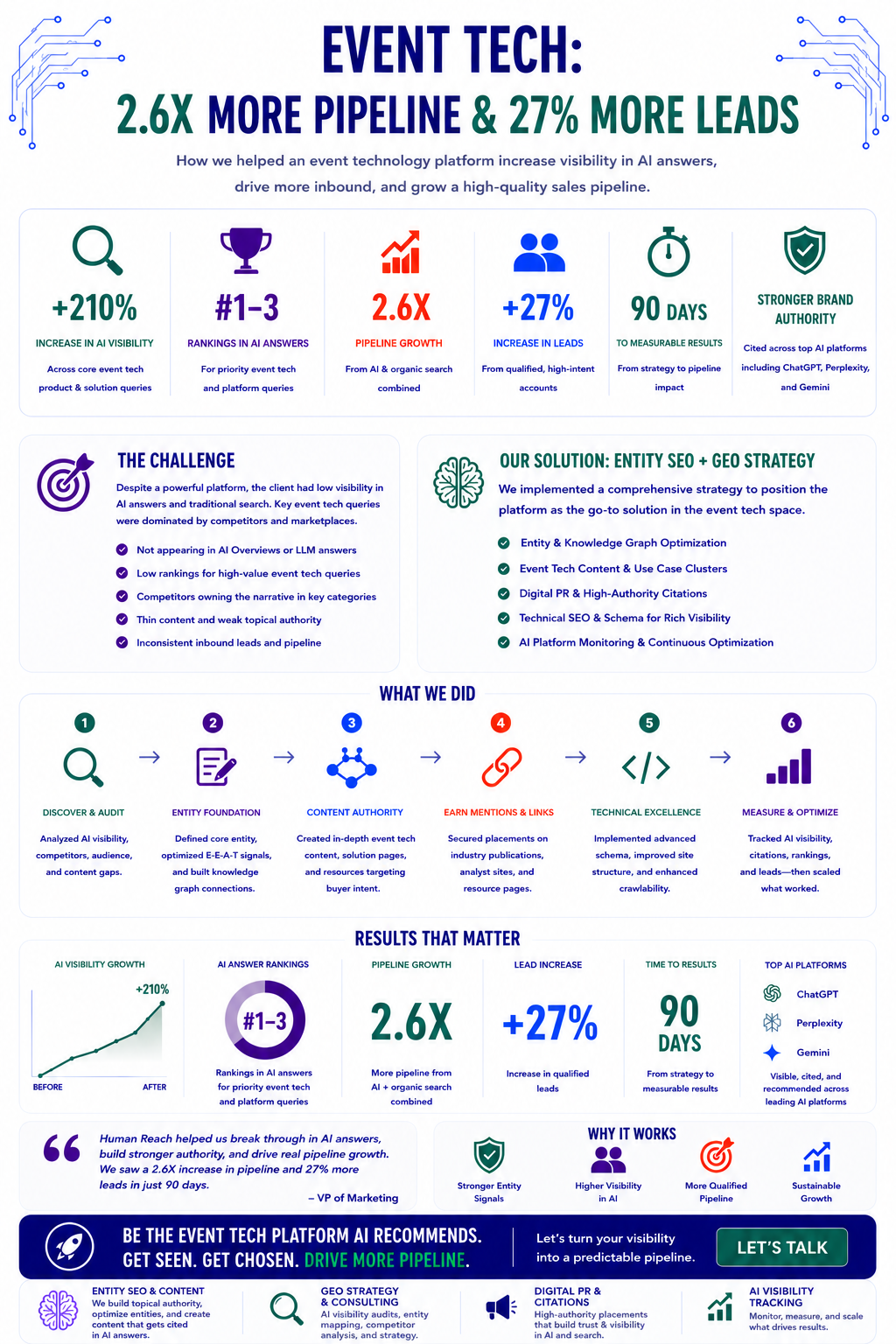
Explore this comprehensive case study infographic that reveals how an Amsterdam-based facial recognition check-in platform went from zero to 50+ qualified leads in 6 months. It breaks down the problem — a great product that nobody was searching for — and maps the solution: 200 pages built around buyer problems instead of product features, covering entry delays, event reporting, crowd management, badge printing, and post-event analytics. The visual also shows the remarkable results: first qualified lead in 24 days, 2.5x increase in website traffic, 45+ AI citations, 19% conversion rate from inquiry to qualified, and 8-10 qualified leads per month by month 6. A must-see resource for any event tech company that wants to stop explaining their category and start being found by buyers researching their real problems.
? Click the image to enlarge or download it for quick reference.
What We Did: 200 Pages Built Around Buyer Problems
We didn’t build pages around product features. We built pages around the problems buyers were already researching.
The content structure we built:
| Problem category | Number of pages | Target search intent | Example page |
|---|---|---|---|
| Entry delays and crowd management | 45 | “How to speed up event entry” | “10 ways to reduce check‑in lines” |
| Event reporting and analytics | 38 | “Real‑time event data” | “What to track during your conference” |
| Badge and credential management | 32 | “On‑site badge printing” | “Badge solutions for 10,000+ attendees” |
| Facial recognition technology | 28 | “Is facial recognition secure for events?” | “Facial recognition check‑in: a complete guide” |
| Multi‑event and enterprise scale | 35 | “Event tech for global conferences” | “Scaling event operations across countries” |
| Post‑event analytics | 22 | “Measuring event success” | “How to calculate event ROI with data” |
Total pages published: 200 focused, problem‑centric pages over 5 months.
Each page included:
- Clear explanation of the problem
- How EventFlow’s solution addresses it
- FAQ schema for AI extraction
- Clear next step: “See how it works” or “Request a demo”
For a complete framework on structuring content for undiscovered categories, read our guide on how to get your brand into AI answers.
✨ Have a great product that nobody is searching for? You don’t have to figure it out alone.
At HumanReach.ai, we build AI‑visible content engines that turn unknown categories into predictable lead pipelines. Visit HumanReach.ai to explore how we help event tech companies win in the AI search era.
A Real Obstacle: Technical Limitations We Couldn’t Hide
Two months into the project, Thomas realized that his platform’s facial recognition accuracy varied significantly between indoor and outdoor venues. But our content didn’t mention this limitation. Prospects reading our pages were getting an incomplete picture.
Our team had to pause, audit all 200 pages for technical accuracy, and build a venue‑specific guide that honestly addressed the limitation. It cost us 10 days.
“That was uncomfortable to admit,” Thomas says. “But HumanReach.ai convinced me that honesty builds trust. Now our content explicitly mentions where the technology works best — and where it doesn’t. Prospects appreciate the transparency.”
This kind of real-world obstacle is common in emerging tech categories. The key is building trust through honesty, not hiding limitations.
For a deeper dive on tracking and adapting, read our guide on how to measure AI search performance.
The Results: 50+ Qualified Leads in 6 Months
What the transformation looked like:
| Metric | Before HumanReach.ai | After 6 months |
|---|---|---|
| Monthly website visits | 2,100 | 5,800+ |
| Qualified leads | 0 | 50+ |
| Time to first lead | — | 24 days |
| AI citations (ChatGPT/Perplexity) | 0 | 45+ |
| Conversion rate (inquiry to qualified) | — | 19% |
| Monthly qualified opportunities | 0 | 8‑10 by month 6 |
- First qualified lead arrived on day 24 (a conference organizer in Germany researching crowd management)
- After 3 months: 18 qualified leads
- After 6 months: 50+ qualified leads (8‑10 per month)
- The company started appearing in ChatGPT for queries like “how to reduce event entry delays” and “event check‑in solutions for large conferences”
“The moment I knew something had fundamentally changed was when we received an inquiry from a Fortune 500 event director who said, ‘I wasn’t looking for facial recognition check‑in. I was searching for ways to speed up our conference entry. Your page on reducing check‑in lines made me realize there was a better way. Can we talk?’ That had never happened in five years of business.”
What Worked (and What Didn’t)
What worked in our strategy:
| Tactic | Result |
|---|---|
| Problem‑centric content (not product‑centric) | Buyers found answers to their real questions |
| 200 pages targeting research‑stage problems | Built visibility before competitors existed |
| Honest limitation documentation | Built trust with technical buyers |
| FAQ schema on every page | 2-3x more likely to be cited by AI |
| Targeting both Google and AI search | Captured buyers across both channels |
What didn’t work (and we left behind):
- Bottom‑funnel keywords only (too few searches)
- Traditional SEO (category didn’t exist)
- Cold outreach (inefficient for undiscovered category)
For more on building authority that works for both Google and AI, read our guide on topical authority and why it replaced backlinks.
What Changed for Thomas
Thomas’s day looks completely different now.
“I used to spend my time explaining what facial recognition check‑in even was. Now prospects arrive already understanding the technology. They’ve read our guides. They’ve seen the use cases. They’re ready to talk about deployment timelines.”
The sales cycle shortened from months to weeks.
“The biggest shift for me was realizing I don’t need to create a category from scratch,” Thomas says. “I just need to show up where buyers are already researching their problems. And HumanReach.ai made that happen. Now our website educates the market while I sleep.”
Frequently Asked Questions (FAQ)
1. How long did it take to see the first lead?
The first qualified lead arrived on day 24. Consistent leads started flowing after 60 days. By month 6, EventFlow was receiving 8‑10 qualified leads per month.
2. Did Thomas have to create the content himself?
No. Our team at HumanReach.ai handled all content creation, technical implementation, and ongoing optimization. Thomas focused on running his event tech business.
3. How did you handle the indoor/outdoor accuracy limitation?
We paused, audited all 200 pages, and built a venue‑specific guide that honestly addressed the limitation. Now prospects know exactly where the technology works best.
4. Did you use ads or outbound?
No. Zero ad spend. Zero cold outreach. The entire pipeline came from organic search and AI citations.
5. Can this work for other event tech companies?
Yes. The framework applies to any event tech company: check‑in solutions, event apps, registration platforms, virtual event tools, and more. The key is understanding your buyers’ real problems.
6. How did you handle the category creation challenge?
We built content around problems, not product features. Buyers found us while researching their operational challenges, not while searching for our specific technology.
7. What is the ROI of this approach?
EventFlow went from zero inbound leads to 50+ qualified opportunities in six months. With average deal sizes in the five-figure range, the ROI significantly exceeded the investment.
Source: HumanReach.ai — Helping event tech companies become the answer AI trusts and cites.
This article is part of the HumanReach.ai Event Tech Case Study Series.
Ready to Build Your Own Event Tech Lead Engine?
You don’t need people searching for your product category. You need to show up where they’re already researching their problems.
About the author: This case study was created by HumanReach.ai, an organic growth agency that helps local and global businesses thrive in the AI Search Reality. Visit HumanReach.ai to learn more.