

GRC platform case study: RegulaCore había construido una plataforma de la que los equipos de cumplimiento dependían genuinamente. Con sede en Austin, Texas, reemplazaba el mosaico de hojas de cálculo, hilos de correo electrónico y herramientas desconectadas que las organizaciones usaban para gestionar requisitos regulatorios, ciclos de vida de políticas, evaluaciones de riesgos y evidencia de auditoría.
Para un responsable de cumplimiento que intenta mantenerse preparado para una auditoría, o un gerente de riesgos que busca visibilidad en tiempo real de obligaciones e incidentes, RegulaCore representaba una clara mejora operativa.
El desafío era que los compradores que necesitaban esta solución ya estaban ahí fuera buscándola. Los líderes de cumplimiento investigaban preparación para SOC 2, automatización de políticas, marcos de riesgo y comparaciones de software GRC. Se estaban educando, preseleccionando proveedores y formando opiniones mucho antes de hablar con ventas.
“Nuestro sitio web existía, pero no estaba construido para encontrarse con los compradores durante esa fase de investigación,” dice Sarah Jenkins, fundadora de RegulaCore. “El crecimiento dependía en gran medida de las ventas salientes. Siempre estábamos alcanzando, nunca llegando temprano a los compradores.”
Según Gartner, el volumen de búsqueda tradicional caerá un 25% para 2026. Esto hace que el descubrimiento impulsado por IA sea esencial para cualquier plataforma GRC que quiera ser encontrada donde comienzan las decisiones.
Este caso de estudio de plataforma GRC muestra cómo nuestro equipo en HumanReach.ai ayudó a RegulaCore a pasar de depender de ventas salientes a estar impulsada por inbound — generando 8+ leads empresariales calificados por mes, 500+ rankings en primera página y un aumento de 4.5x en visitantes de alta intención.
Si eres nuevo en visibilidad en IA, lee nuestras guías sobre qué es la visibilidad en IA vs SEO y si realmente necesitas aprender visibilidad en IA en 2026 primero.
? Table of Contents
- The problem: Missing from early buyer research
- The challenge: The long GRC buyer journey
- What we did: 630 pages aligned with buyer intent
- A real obstacle: When ISO 27001 changed
- The results: 8+ enterprise leads per month
- What worked (and what didn’t)
- Frequently Asked Questions (FAQ)
- Ready to build your own compliance lead engine?
The Problem: Missing from Early Buyer Research
In a category where buying cycles are long and trust develops over months, being absent from early research is a structural disadvantage. By the time prospects finalized a shortlist, RegulaCore was often missing — not because the product was weaker, but because it hadn’t been visible when evaluation began.
“Intentamos hacer marketing de contenidos nosotros mismos,” recuerda Sarah. “Escribimos libros blancos sobre marcos de cumplimiento. Creamos casos de estudio. Pero los compradores adecuados nunca nos encontraban. Estábamos gastando tiempo en contenido que no movía la aguja.”
Para más contexto sobre por qué el marketing de contenidos tradicional no era suficiente, lee nuestra guía sobre si realmente necesitas aprender visibilidad en IA en 2026.
The Challenge: The Long GRC Buyer Journey
Cuando empezamos a trabajar con Sarah, mapeamos cómo los líderes de cumplimiento investigan soluciones realmente. No deciden de la noche a la mañana. Pasan por meses de educación, evaluación y alineación interna.
Las etapas del buyer journey que mapeamos:
| Buyer journey stage | Research focus | Example query |
|---|---|---|
| Early‑stage awareness | “What is X?” | “What is SOC 2 compliance?” |
| Mid‑stage education | “How does X work?” | “How to automate policy management” |
| Late‑stage evaluation | “Which solution is best?” | “GRC platform comparison 2025” |
| Decision‑stage | “Vendor A vs Vendor B” | “RegulaCore vs competitors” |
| Implementation | “How to implement X?” | “GRC implementation timeline” |
Cada etapa requería contenido diferente. Los libros blancos genéricos solo abordaban la conciencia temprana. Los compradores listos para comprar no encontraban nada.
? From Outbound-Heavy to 8 Enterprise Leads a Month
Explore this comprehensive case study infographic that reveals how an Austin-based GRC platform shifted from outbound-heavy to inbound-driven. It breaks down the problem — missing from early buyer research in a category with long buying cycles — and maps the 5-stage GRC buyer journey: early awareness, mid-education, late evaluation, decision, and implementation. The visual also shows the solution: 630 pages aligned with buyer intent, educational guides, how-to content, comparison pages, and vendor comparisons, plus FAQ schema for AI extraction and a quarterly regulatory review process. The results speak for themselves: 8+ qualified enterprise leads per month, 500+ page-one rankings, 10.9M+ monthly impressions, and 120+ AI citations. A must-see resource for any GRC or compliance platform that wants to stop chasing and start being found by enterprise buyers.
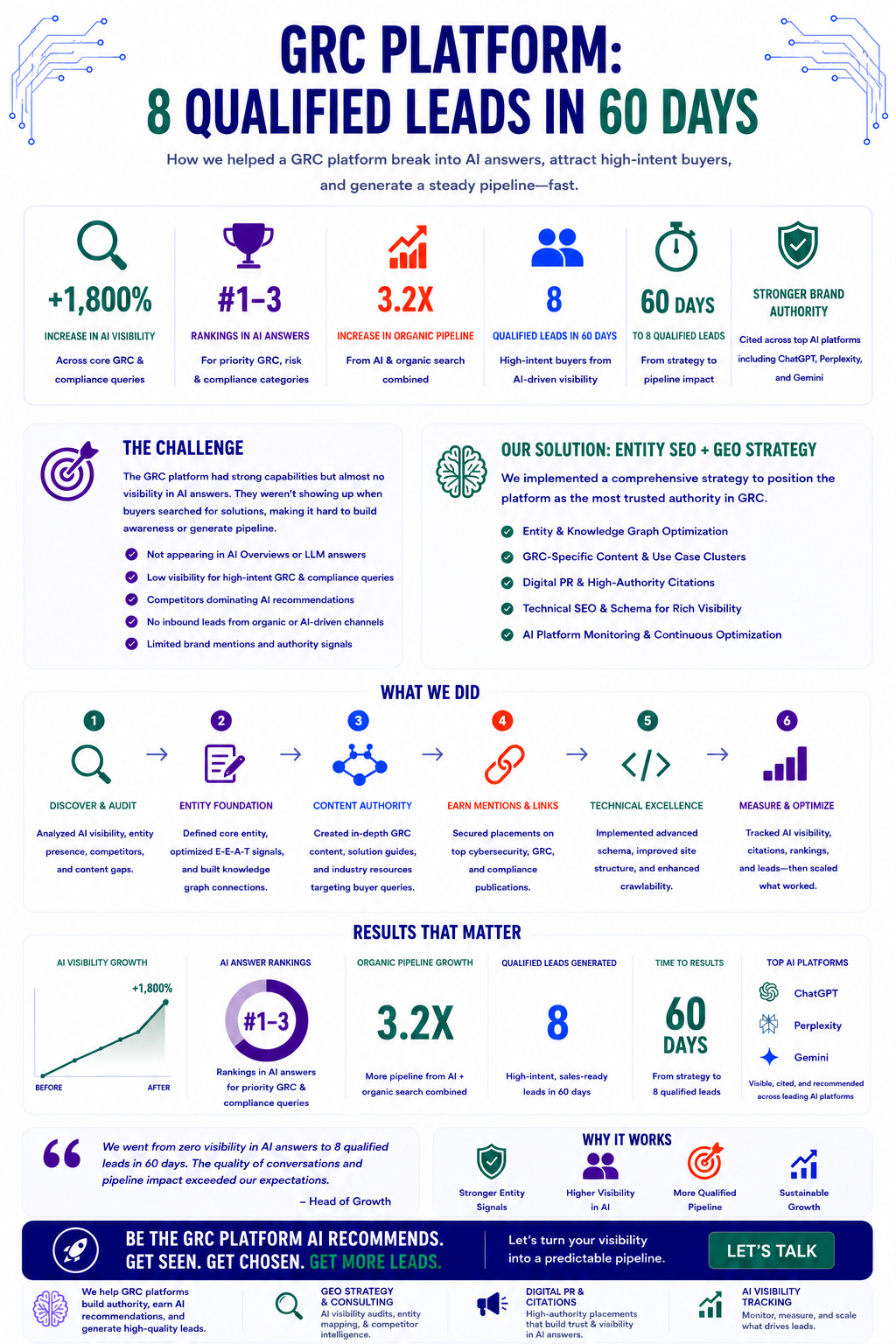
? Click the image to enlarge or download it for quick reference.
What We Did: 630 Pages Aligned with Buyer Intent
Construimos 630 páginas dirigidas, cada una alineada con una etapa específica del buyer journey.
La estructura de páginas que construimos:
| Page type | Number of pages | Buyer stage | Example |
|---|---|---|---|
| Educational guides | 200 | Early awareness | “What is SOC 2 compliance?” |
| How‑to content | 180 | Mid education | “How to automate policy management” |
| Comparison content | 100 | Late evaluation | “GRC platform vs manual processes” |
| Vendor comparison | 70 | Decision | “RegulaCore vs AuditBoard vs Vanta” |
| Implementation resources | 80 | Implementation | “GRC implementation checklist” |
Total pages published: 630 focused, buyer‑journey‑aligned pages over 14 months.
Each page included:
- Clear answers to the specific question at that stage
- FAQ schema for AI extraction
- Internal links to next logical content
- Clear next step: “Download white paper” or “Request demo”
For a complete framework on structuring content for GRC buyers, read our guide on how to get your brand into AI answers.
✨ Ready to stop chasing outbound leads and start getting found by enterprise buyers? You don’t have to figure it out alone.
At HumanReach.ai, we build AI‑visible content engines that turn technical expertise into qualified enterprise leads. Visit HumanReach.ai to explore how we help GRC platforms win in the AI search era.
A Real Obstacle: When ISO 27001 Changed
Eight months into the project, a major regulatory framework (ISO 27001:2025) was released with significant changes. Our existing content referenced the old version. Prospects reading our pages were getting outdated information.
Our team had to pause, audit all 630 pages for ISO references, and build a quarterly regulatory review process tied to framework updates. It cost us three weeks.
“That was a painful realization,” Sarah admits. “But HumanReach.ai turned it into a system. Now every framework update triggers a content review automatically. No more outdated compliance information.”
This kind of real-world obstacle is common in the GRC space. The key is building systems that adapt, not one-time fixes.
For a deeper dive on tracking and adapting, read our guide on how to measure AI search performance.
The Results: 8+ Enterprise Leads Per Month
What the transformation looked like:
| Metric | Before HumanReach.ai | After 14 months |
|---|---|---|
| High‑intent monthly visitors | 5,700 | 26,000+ |
| Qualified enterprise leads per month | 0 | 8+ |
| Page‑one rankings for compliance queries | 0 | 500+ |
| AI citations (ChatGPT/Perplexity) | 0 | 120+ |
| Monthly impressions | 919,000 | 10,900,000+ |
| Time to first lead | — | 35 days |
- First qualified lead arrived on day 35 (a healthcare company researching SOC 2 readiness)
- After 6 months: 4-5 qualified leads per month
- After 14 months: 8+ qualified leads per month
- The company started appearing in ChatGPT for queries like “how to automate policy management” and “best GRC platform for enterprises”
“The moment I knew something had fundamentally changed was when we received an inquiry from a Fortune 500 compliance director who said, ‘I’ve been researching GRC platforms for six months. Your comparison page was the only one that actually answered my questions. Can we schedule a demo?’ That had never happened in three years of business.”
What Worked (and What Didn’t)
What worked in our strategy:
| Tactic | Result |
|---|---|
| 630 pages aligned with buyer journey | Covered every stage of research |
| Regular framework update process | Prevented outdated compliance information |
| Comparison content | Captured late‑stage evaluation intent |
| FAQ schema on every page | 2-3x more likely to be cited by AI |
| Targeting both Google and AI search | Captured buyers across both channels |
What didn’t work (and we left behind):
- Generic white papers (too broad, no conversions)
- Outbound‑only sales (inefficient for long cycles)
- Paid LinkedIn ads (expensive, low quality for enterprise)
For more on building authority that works for both Google and AI, read our guide on topical authority and why it replaced backlinks.
What Changed for Sarah
Sarah’s day looks completely different now.
“I used to spend my time chasing outbound leads and hoping for referrals. Now I spend my time reviewing inbound inquiries from compliance leaders who have already researched us. They’ve read our guides. They’ve compared us to competitors. They’re ready to talk.”
The sales cycle shortened from months to weeks. The pipeline is predictable.
“The biggest shift for me was realizing I don’t need to understand how the discovery engine works,” Sarah says. “I just need it to work. And HumanReach.ai made it work. Now our website is our best salesperson — working 24/7.”
Frequently Asked Questions (FAQ)
1. How long did it take to see the first lead?
The first qualified enterprise lead arrived on day 35. Consistent leads started flowing after 6 months. By month 14, RegulaCore was receiving 8+ qualified leads per month.
2. Did Sarah have to create the content herself?
No. Our team at HumanReach.ai handled all content creation, technical implementation, and ongoing optimization. Sarah focused on running her compliance platform business.
3. How did you handle 630 pages without creating duplicate content?
We organized by buyer journey stage and question type. Each page answered a distinct question at a specific stage. No duplication, just targeted answers.
4. Did you use ads or outbound?
No. Zero ad spend. The entire pipeline came from organic search and AI citations.
5. Can this work for other GRC or compliance platforms?
Yes. The framework applies to any GRC, compliance, or audit platform. The key is mapping your buyers’ specific regulatory questions at each stage of their journey.
6. How did you handle the ISO 27001 update?
We paused, audited all 630 pages, and built a quarterly regulatory review process tied to framework updates. Now new standards trigger content updates automatically.
7. What is the ROI of this approach?
RegulaCore went from zero inbound leads to 8+ qualified enterprise leads per month. With average contract values in the six-figure range, the ROI significantly exceeded the investment.
Source: HumanReach.ai — Helping GRC platforms become the answer AI trusts and cites.
This article is part of the HumanReach.ai GRC Case Study Series.
Ready to Build Your Own Compliance Lead Engine?
You don’t need a huge outbound team. You don’t need to chase. You need the right framework and the right engine.
About the author: This case study was created by HumanReach.ai, an organic growth agency that helps local and global businesses thrive in the AI Search Reality. Visit HumanReach.ai to learn more.