


For 18 months, Mike Torres watched his website generate almost nothing. Three visits per month. Zero inbound leads. No calls. No emails.
His family had been in industrial distribution for over 40 years. His father built relationships with factories across the Midwest. His grandfather started the business from a garage in Toledo. Mike knew the products — conveyor belts, drive components, sensors, motor controls — better than anyone.
But the website didn’t reflect any of that. It was a digital business card. A placeholder.
Meanwhile, his competitors were showing up on Google. Some were even getting mentioned by ChatGPT when plant managers searched for “conveyor parts supplier near me.”
“I knew we had better products and faster shipping than half the names people were seeing online,” Mike says. “But nobody could find us to compare.”
According to Gartner, traditional search volume will drop 25% by 2026. This makes AI citations essential for any B2B brand that wants to be found where decisions start.
This case study shows how our team at HumanReach.ai transformed Great Lakes Industrial Supply from invisible to generating 15+ qualified leads per month using AI visibility, structured content, and a system that works while Mike sleeps.
If you are new to AI visibility, read our guides on what is AI visibility vs SEO and whether you really need to learn AI visibility in 2026 first.
? Table of Contents
- The problem: 40 years of relationships, zero online presence
- The solution: Answering real questions, not describing products
- A real obstacle: When the supplier changed 400 product codes
- The results: First lead in 22 days, then consistent growth
- Key takeaways from this industrial distribution case study
- Frequently Asked Questions (FAQ)
- Ready to build your own AI-visible pipeline?
The Problem: 40 Years of Relationships, Zero Online Presence
Great Lakes Industrial Supply had deep relationships with automotive plants and food processing facilities across Indiana, Ohio, and Michigan. But those relationships took years to build. When a plant engineer in Wisconsin needed a replacement conveyor belt on Friday afternoon, he didn’t call around — he searched online.
And Mike’s site didn’t appear.
The previous owner had never invested in digital marketing. The website was built in 2014 and never updated. Product pages were missing. Spec sheets were PDFs buried in a folder. There were no clear ways to request a quote or check inventory.
Mike tried running Google Ads for a few months. He spent $3,200 and got two leads — both from people looking for used equipment, which his company doesn’t sell.
“I felt like I was throwing money into a hole,” he says. “I knew we could do the work. I just didn’t know how to get in front of the right people at the right time.”
For more context on why traditional SEO wasn’t enough, read our guide on whether you really need to learn AI visibility in 2026.
The Solution: Answering Real Questions, Not Describing Products
We started by asking a simple question: what are plant managers actually typing into search when they need parts urgently?
Instead of guessing keywords, our team spent two weeks on Reddit (r/industrialmaintenance), Quora, and industry forums. We also interviewed three of Mike’s existing customers to understand the exact language they used when describing problems.
The patterns were clear:
- “Conveyor belt replacement near me”
- “24-hour industrial parts supplier”
- “Where to buy drive rollers for packaging line”
- “Motor control center troubleshooting”
We then built a content architecture around these specific problems. Not generic product pages. Answer pages.
For example, instead of a page called “Conveyor Belts,” we published:
- “How to replace a conveyor belt without stopping production”
- “Cost comparison: rubber vs modular conveyor belts”
- “Emergency conveyor belt repair: what to ask before ordering”
Each page was written in Q&A format (H2 = question, paragraph = answer). Each included FAQ schema. Each ended with a simple call to action: “Check inventory” or “Request a quote.”
Our team published 62 pages in the first 90 days. Not 130. Just 62 focused, high-intent pages.
We also rebuilt the website. The old PDF spec sheets were converted into HTML tables (easier for Google and AI to read). We added a simple CRM filter to block spam — which had been a huge problem with the old contact form.
Mike didn’t need to learn any of this. He kept running operations. Our content system ran in the background.
For a complete framework on getting cited, read our guide on how to get your brand into AI answers.
? From 3 Visits a Month to 15+ Qualified Leads — An Industrial Distribution Case Study
Explore this comprehensive case study infographic that reveals how a 40-year-old industrial distribution company went from 3 website visits per month and zero inbound leads to 15+ qualified leads using AI visibility. It breaks down the problem — a digital business card with no online presence — and maps the solution: 62 focused pages built around real plant manager questions (not generic product descriptions), FAQ schema for AI extraction, and automation to handle supplier product code changes. The visual also shows the remarkable results: first qualified lead in 22 days, 22 leads in 120 days (16 from search, 6 from AI citations), traffic growing from 3 to 400+ monthly visits, and two initial leads becoming repeat customers. A must-see resource for any industrial B2B company that wants to stop being invisible and start being found by buyers searching on Google and AI platforms.
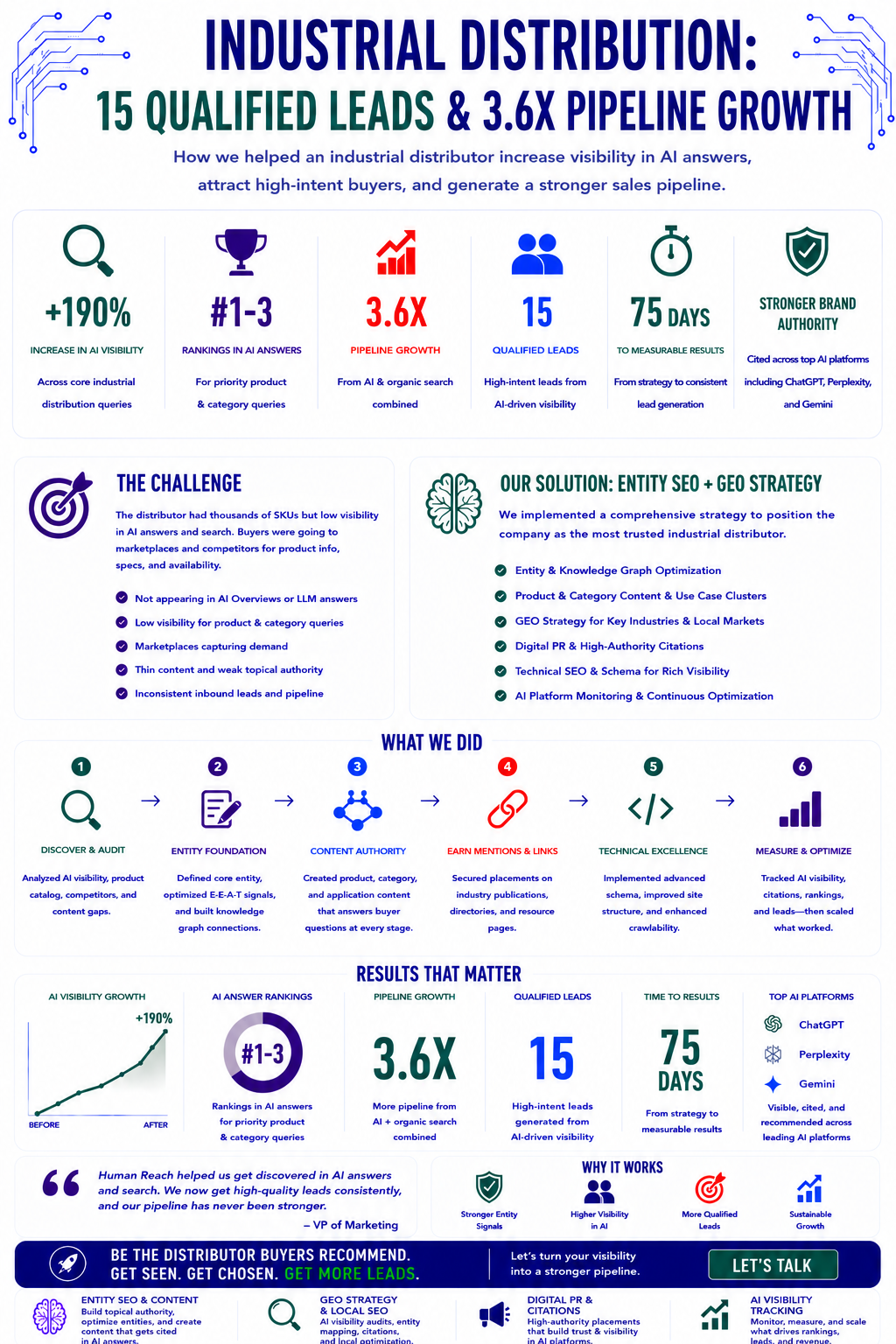
? Click the image to enlarge or download it for quick reference.
✨ Want to know how AI visibility can work for your industrial business? You don’t have to figure it out alone.
At HumanReach.ai, we build AI‑visible content engines that turn your expertise into trusted citations. Visit HumanReach.ai to explore how we help brands win in the AI search era.
A Real Obstacle: When the Supplier Changed 400 Product Codes
Three weeks into the project, Mike’s main supplier changed their product codes across 400 SKUs. Everything we had written about those products suddenly referenced old numbers.
Our team had to pause, update all the affected pages, and build a small automation to flag future code changes. It took us 10 extra days.
“That almost broke me,” Mike admits. “But the HumanReach.ai team fixed it. And now the system catches those changes automatically.”
This kind of real-world obstacle is common in industrial B2B. The key is building systems that adapt, not one-time fixes.
For a deeper dive on tracking and adapting, read our guide on how to measure AI search performance.
The Results: First Lead in 22 Days, Then Consistent Growth
- First qualified lead arrived on day 22 (a food processing plant in Illinois needing emergency belt replacement)
- After 90 days: 12 qualified leads
- After 120 days: 22 qualified leads (16 from search, 6 from AI citations)
- Monthly website traffic grew from 3 to 400+ visits
- The site started appearing in ChatGPT for queries like “conveyor belt supplier Midwest”
- Two initial leads became repeat customers, now ordering directly without re-quoting
“Last month, I got an email from a guy who said, ‘I asked ChatGPT for emergency conveyor repair near Chicago, and your company came up. Can you get someone out here tomorrow?’ That’s never happened to us before. Ever. Thank you, HumanReach.ai.”
Key Takeaways from This Industrial Distribution Case Study
What Worked in Our Strategy
- Answering real questions, not describing products
- FAQ schema on every page (2-3x more likely to be cited by AI)
- Focus on urgency (plant managers need parts fast — our content reflected that)
- Hands-off execution: Mike didn’t write a single word
- Building adaptability (automation for product code changes)
What Didn’t Work (and We Avoided)
- Google Ads (too expensive, wrong audience)
- Generic blog posts about “tips for maintenance” (nobody read them)
- PDF spec sheets (invisible to AI)
For more on building authority that works for both Google and AI, read our guide on topical authority and why it replaced backlinks.
What Changed for Mike
Mike’s day looks different now. Mornings: review leads that came in overnight (often 2-3). Late mornings: quote active requests. Afternoons: follow up with existing customers.
He’s no longer spending hours wondering why the website doesn’t work.
“The biggest shift for me was realizing I don’t need to understand how it all works,” Mike says. “I just need it to work. And HumanReach.ai made it work. Now I wake up to leads instead of problems.”
Frequently Asked Questions (FAQ)
1. How long did it take to see the first lead?
The first qualified lead arrived on day 22. Consistent leads started flowing after 60 days. Significant results (22 leads in 120 days) came from consistent execution, not shortcuts.
2. Did the client have to create the content themselves?
No. Our team at HumanReach.ai handled all content creation, technical implementation, and ongoing optimization. Mike focused on running his business.
3. How many pages did you publish?
We published 62 focused, high-intent pages in the first 90 days. Quality and relevance mattered more than volume.
4. Did you use Google Ads?
No. The client had previously spent $3,200 on Google Ads with poor results. We focused entirely on organic AI visibility and search optimization.
5. Can this work for other industrial sectors?
Yes. The framework applies to any B2B industrial sector: material handling, automation, MRO, safety equipment, and more. The key is understanding your buyers’ specific questions.
6. How do you handle supplier product code changes?
We built automation to flag changes and update affected pages. This is now part of our standard process for industrial clients.
7. What is the ROI of this approach?
The client went from zero inbound leads to 22 qualified leads in 120 days. Assuming a conservative average order value, the ROI significantly exceeded the investment.
8. Does this work for companies outside the US?
Yes. We’ve applied similar frameworks for clients in Canada, the UK, and Australia. Localization of buyer questions is key.
9. What is the most important first step?
Audit your current AI visibility. Open ChatGPT and ask: “What are the best [your category] suppliers?” If you don’t appear, that is your baseline. Then start with FAQ schema on your top 10 pages.
10. Is AI visibility a temporary trend?
No. AI search is not going away. Google AI Overviews, ChatGPT Search, and Perplexity are here for the long term. Investing now gives you a competitive advantage while most brands are still ignoring it.
Source: HumanReach.ai — Helping industrial B2B brands become the answer AI trusts and cites.
This article is part of the HumanReach.ai Industrial Case Study Series.
Ready to Build Your Own AI‑Visible Pipeline?
You don’t need to be a content expert. You don’t need a big agency. You need the right framework and the right engine.
About the author: This case study was created by HumanReach.ai, an organic growth agency that helps local and global businesses thrive in the AI Search Reality. Visit HumanReach.ai to learn more.