

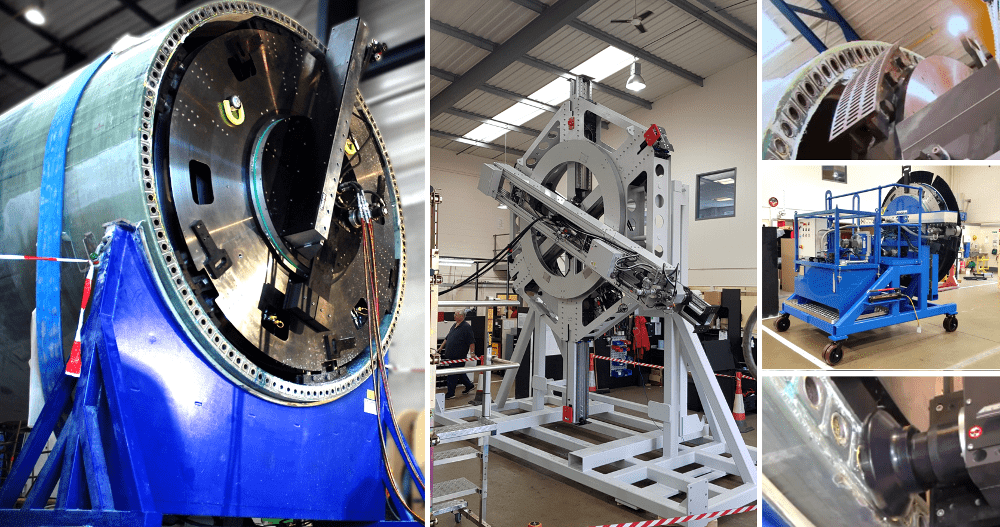
Industrial manufacturing case study: For over 25 years, Summit Drive Systems had been the quiet powerhouse behind some of the most demanding industrial applications in North America. They engineered custom gearboxes for wind turbines, supplied power transmission components to automotive assembly lines, and provided critical drive systems for heavy manufacturing.
Their customers included Fortune 500 industrial firms and specialized OEMs across a dozen sectors.
But their website? Zero inbound leads. For years.
“We had a five‑person marketing team working on this for three years,” says David Chen, President of Summit Drive Systems. “Before that, we hired an agency. Nothing. The website just sat there, doing nothing.”
Summit had over 200,000 SKUs in their catalog. The complexity felt impossible to untangle.
According to Gartner, traditional search volume will drop 25% by 2026. This makes AI-powered discovery essential for any industrial B2B brand that wants to be found where decisions start.
This industrial manufacturing case study shows how our team at HumanReach.ai transformed Summit Drive Systems from a zero‑inbound industrial leader into a business generating 14 qualified engineering inquiries in 45 days — with David barely involved in the process.
If you are new to AI visibility, read our guides on what is AI visibility vs SEO and whether you really need to learn AI visibility in 2026 first.
? Table of Contents
- The problem: $200K/year on marketing, zero leads
- The challenge: 200,000+ products and no way to organize them
- What we did: Organizing by buyer problem, not catalog number
- A real obstacle: Outdated technical specifications
- The results: First lead in 10 days, 14 in 45 days
- What worked (and what didn’t)
- Frequently Asked Questions (FAQ)
- Ready to build your own industrial lead engine?
The Problem: $200K/Year on Marketing, Zero Leads
Summit’s customers loved their products. But new customers couldn’t find them online. The website was a static brochure: a list of product categories, PDF spec sheets, and a contact form that only attracted spam.
David had tried everything:
- A five‑person in‑house marketing team produced blog posts and social media content — no leads
- An external agency ran paid ads and did SEO — no leads
- Trade shows brought in conversations, but nothing scaled
“I was spending over $200,000 a year on marketing with nothing to show for it,” David recalls. “I knew we had the best engineering team in the industry. But no one searching online could find us.”
For more context on why traditional SEO wasn’t enough, read our guide on whether you really need to learn AI visibility in 2026.
The Challenge: 200,000+ Products and No Way to Organize Them
David’s biggest concern was the sheer size of his catalog. How do you turn 200,000+ SKUs into a website that buyers can actually use?
Traditional approaches would have meant creating a separate page for every product — impossible to maintain and useless for buyers.
“I thought the catalog was just too big,” David admits. “Every agency I talked to said we needed to pick a few products and focus on those. But that meant leaving 99% of our inventory invisible.”
Our team at HumanReach.ai took a different approach. Instead of organizing by internal catalog numbers, we organized by buyer problems.
? From 200,000 Products to 14 Qualified Leads in 45 Days
Explore this comprehensive case study infographic that reveals how a 25-year-old industrial manufacturer with over 200,000 SKUs went from zero inbound leads to 14 qualified engineering inquiries in 45 days. It breaks down the problem — spending $200K/year on marketing with zero results — and maps out the solution: organizing by buyer problem instead of catalog number, converting PDF spec sheets to HTML tables, and implementing FAQ schema for AI extraction. The visual also shows the remarkable results: first qualified lead in 10 days, 2,100+ monthly visitors, 35+ AI citations, and David’s time on marketing dropping from 15-20 hours/week to just 2 hours/week. A must-see resource for any industrial manufacturer that wants to turn a massive product catalog into a lead-generating engine.
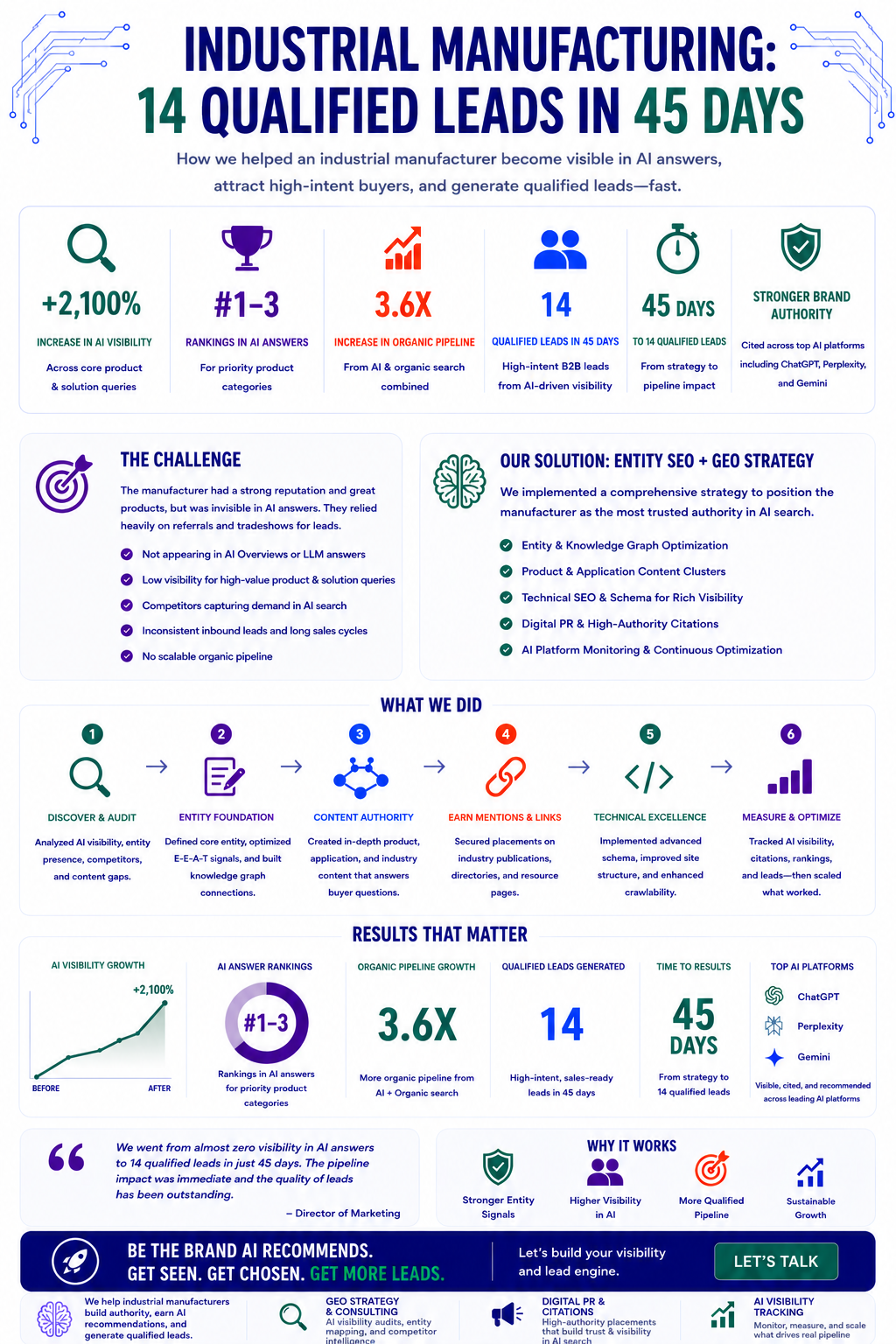
? Click the image to enlarge or download it for quick reference.
What We Did: Organizing by Buyer Problem, Not Catalog Number
We started by asking a simple question: what are engineers and procurement managers actually searching for when they need power transmission components?
The page structure we built:
| Buyer question | Page type we created | Number of pages |
|---|---|---|
| “What gearbox do I need for a conveyor system?” | Application guide | 24 |
| “Custom gearbox for wind turbine pitch control” | Engineering capability page | 18 |
| “Power transmission components for heavy manufacturing” | Category hub | 32 |
| “Replacement gearbox for OEM model X” | Cross‑reference guide | 26 |
Total pages published: 100 focused, buyer‑driven pages in 60 days.
Each page included:
- Technical specifications (converted from PDFs to HTML tables)
- FAQ schema answering common engineering questions
- Clear next steps: “Request a quote” or “Download spec sheet”
For a complete framework on structuring technical content, read our guide on how to get your brand into AI answers.
✨ Got a complex product catalog that feels impossible to organize? You don’t have to figure it out alone.
At HumanReach.ai, we build AI‑visible content engines that turn technical complexity into qualified leads. Visit HumanReach.ai to explore how we help industrial manufacturers win in the AI search era.
A Real Obstacle: Outdated Technical Specifications
Four weeks into the project, David’s team discovered that one of their key product lines had outdated torque specs in the existing catalog. If we had published those specs, engineers would have received incorrect data.
Our team had to pause, verify every spec with David’s engineering team, and build a simple approval workflow for future technical updates. It cost us eight days.
“I was nervous when we found the error,” David admits. “But HumanReach.ai caught it before anything went live. Now we have a process that flags outdated specs automatically.”
This kind of real-world obstacle is common in industrial manufacturing. The key is building systems that adapt, not one-time fixes.
For a deeper dive on tracking and adapting, read our guide on how to measure AI search performance.
The Results: First Lead in 10 Days, 14 in 45 Days
What the transformation looked like:
| Metric | Before HumanReach.ai | After 45 days |
|---|---|---|
| Monthly website visits | ~150 | 2,100+ |
| Qualified engineering inquiries | 0 | 14 |
| Time to first lead | — | 10 days |
| AI citations (ChatGPT/Perplexity) | 0 | 35+ |
| Hours David spent on marketing | 15-20/week | 2/week |
- First qualified inquiry arrived on day 10 (a heavy equipment manufacturer needing custom gearboxes)
- After 30 days: 8 qualified leads
- After 45 days: 14 qualified leads
- The company started appearing in ChatGPT for queries like “custom gearbox for wind turbine” and “power transmission components heavy manufacturing”
“The moment I knew something had fundamentally changed was when I got a call from a procurement manager who said, ‘I found your website through a Perplexity search for custom gearbox suppliers. Your application guide for conveyor systems answered three questions we’ve been struggling with. Can we talk?’ That had never happened in 25 years of business.”
What Worked (and What Didn’t)
What worked in our strategy:
| Tactic | Result |
|---|---|
| Organizing 200K+ products by buyer problem, not catalog number | Buyers found answers instantly |
| FAQ schema on every page | 2-3x more likely to be cited by AI |
| Converting PDF spec sheets to HTML tables | Search engines and AI could read the data |
| Hands‑off execution: David barely involved | Zero drain on his time |
| Verification workflow for technical specs | Caught errors before publishing |
What didn’t work (and we left behind):
- Previous in‑house marketing team (3 years, zero leads)
- Previous agency (paid ads, zero ROI)
- Trade shows (too expensive, not scalable)
For more on building authority that works for both Google and AI, read our guide on topical authority and why it replaced backlinks.
Frequently Asked Questions (FAQ)
1. How long did it take to see the first lead?
The first qualified engineering inquiry arrived on day 10. Consistent leads started flowing after 30 days. Significant results (14 leads in 45 days) came from consistent execution, not shortcuts.
2. Did David have to create the content himself?
No. Our team at HumanReach.ai handled all content creation, technical implementation, and ongoing optimization. David focused on product and delivery.
3. How did you handle 200,000+ products without creating 200,000 pages?
We organized by buyer problem, not catalog number. Application guides, engineering capability pages, and cross‑reference guides covered multiple products per page. Buyers found answers without needing a page per SKU.
4. Did you use ads or outbound?
No. Zero ad spend. The entire pipeline came from organic search and AI citations.
5. Can this work for other industrial manufacturers?
Yes. The framework applies to any industrial manufacturer: power transmission, automation, components, heavy equipment, and more. The key is understanding your buyers’ specific engineering questions.
6. How did you handle the outdated specification error?
We built a verification workflow that flags outdated specs before publishing. Now David’s engineering team reviews only what has changed, not everything.
7. What is the ROI of this approach?
David went from spending $200K/year on marketing with zero leads to 14 qualified engineering inquiries in 45 days. With average project values in six figures, the ROI significantly exceeded the investment.
Source: HumanReach.ai — Helping industrial manufacturers become the answer AI trusts and cites.
This article is part of the HumanReach.ai Industrial Manufacturing Case Study Series.
Ready to Build Your Own Industrial Lead Engine?
You don’t need a huge marketing team. You don’t need to untangle your catalog alone. You need the right framework and the right engine.
About the author: This case study was created by HumanReach.ai, an organic growth agency that helps local and global businesses thrive in the AI Search Reality. Visit HumanReach.ai to learn more.