


Tech consultancy case study: Nexus Digital had been helping companies close the gap between what they wanted technology to do and what it actually delivered. Their expertise spanned design thinking, AI implementation, IoT solutions, and custom software development.
But in the US enterprise technology consulting space, reputation alone was not enough. Established firms had spent years dominating search results, AI answers, and the buyer’s early research journey.
“Our work spoke for itself — once someone knew us,” says Priya Sharma, founder of Nexus Digital. “The problem was getting in front of the right people before they had already chosen a competitor.”
According to Gartner, traditional search volume will drop 25% by 2026. This makes AI-powered discovery essential for any technology consultancy that wants to be found where decisions start.
This tech consultancy case study shows how our team at HumanReach.ai helped Nexus Digital break through that barrier — generating 45 qualified inbound leads, reaching 48,000+ high‑intent visitors, and ranking #1 for “GenAI Business Consultant” without paid ads.
If you are new to AI visibility, read our guides on what is AI visibility vs SEO and whether you really need to learn AI visibility in 2026 first.
? Table of Contents
- The problem: Competing against firms with a decade-long head start
- The challenge: Different buyers research differently
- What we did: Three content layers, 230 pages
- A real obstacle: Outdated technical references
- The results: 45 leads, 48,000+ visitors, #1 rankings
- What worked (and what didn’t)
- Frequently Asked Questions (FAQ)
- Ready to build your own consultancy lead engine?
The Problem: Competing Against Firms With a Decade-Long Head Start
Technology consulting is not a level playing field. Incumbents had spent years building authority, search visibility, and brand familiarity. Nexus Digital’s ideal buyers were already searching every day for answers about AI, design thinking, software architecture, and transformation strategy. But they were not encountering Nexus Digital early enough in that journey.
“We tried content marketing ourselves,” Priya recalls. “We wrote blog posts about AI strategy. We created case studies. But the right buyers never found us. We were competing against firms with a ten‑year head start.”
For more context on why traditional content marketing wasn’t enough, read our guide on whether you really need to learn AI visibility in 2026.
The Challenge: Different Buyers Research Differently
When we started working with Priya, we mapped how technology consulting buyers actually make decisions.
Technology consulting buyer personas:
| Buyer persona | Research focus | Example query |
|---|---|---|
| Executive (CIO, CTO) | High‑level themes | “Digital transformation strategy 2026” |
| Technical leader (Architect) | Specific implementation | “GenAI implementation for enterprise” |
| Product manager | Methodology and process | “Design thinking for software development” |
| Procurement | Vendor evaluation | “AI consulting services comparison” |
Each persona researched differently. Generic content wouldn’t work. The site needed to speak to each one at the right moment.
? How a Tech Consultancy Broke Into the US Market Without a Decade of SEO
Explore this comprehensive case study infographic that reveals how a digital transformation consultancy broke into the US enterprise market without decades of SEO. It breaks down the problem — competing against firms with a decade-long head start — and maps the four distinct buyer personas: Executive (CIO/CTO), Technical Leader, Product Manager, and Procurement. The visual also shows the solution: three content layers (core service pages, educational content, and technical deep-dives) with 230 pages total, each with FAQ schema for AI extraction, covering the full buyer journey from executive mandate to vendor evaluation. The results speak for themselves: first qualified lead in 18 days, 45 qualified inbound leads, 48,000+ high-intent visitors, 95+ AI citations, 9.5x increase in returning visitors, and #1 rankings for key buyer terms like “GenAI Business Consultant.” A must-see resource for any technology consultancy that wants to stop chasing referrals and start being found by enterprise buyers searching on Google and AI platforms.
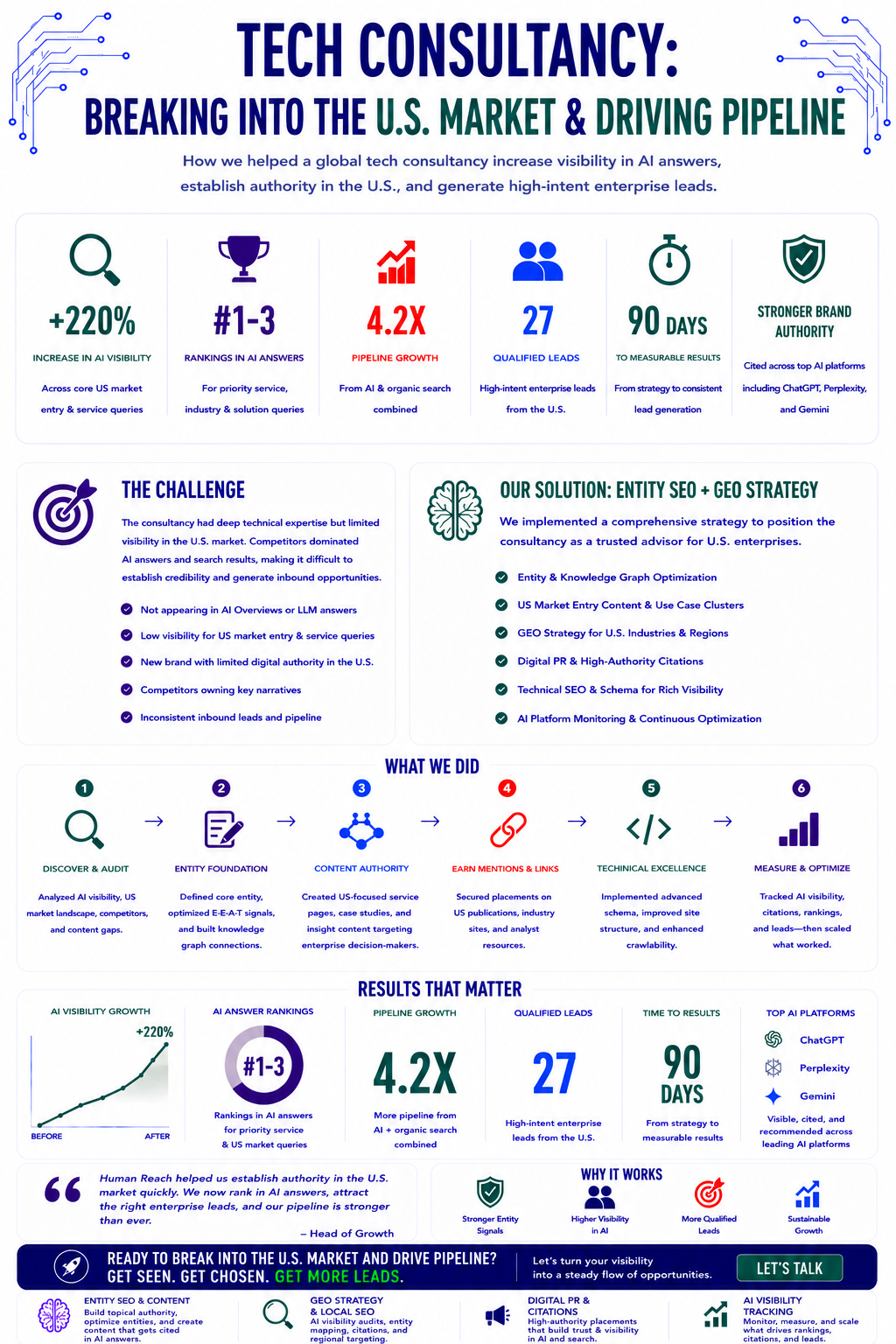
? Click the image to enlarge or download it for quick reference.
What We Did: Three Content Layers, 230 Pages
We rebuilt the website around three content layers, each designed for a specific research moment.
The content layers we built:
| Content layer | Number of pages | Purpose | Example |
|---|---|---|---|
| Core service pages | 25 | Decision‑making and positioning | “AI strategy consulting for enterprises” |
| Educational content | 120 | Answer exact buyer questions | “How to evaluate an AI implementation partner” |
| Technical deep‑dives | 85 | Implementation trade‑offs and architecture | “GenAI architecture patterns for financial services” |
Total pages published: 230 focused pages over 6 months.
The buyer journey stages we mapped:
| Journey stage | Buyer question | Page type | Example page |
|---|---|---|---|
| Executive mandate | “What are the options?” | High‑level overview | “Digital transformation: build vs buy” |
| Research immersion | “How does this work?” | Educational guide | “AI implementation methodology explained” |
| Vendor evaluation | “Who can do this?” | Capability page | “Why Nexus Digital for GenAI” |
Each page included:
- Clear answers to the specific question at that stage
- FAQ schema for AI extraction
- Internal links to next logical content
- Clear next step: “Download case study” or “Schedule a consultation”
For a complete framework on structuring content for consulting buyers, read our guide on how to get your brand into AI answers.
✨ Ready to stop relying on referrals and start getting found by enterprise buyers? You don’t have to figure it out alone.
At HumanReach.ai, we build AI‑visible content engines that turn technical expertise into qualified leads. Visit HumanReach.ai to explore how we help technology consultancies win in the AI search era.
A Real Obstacle: Outdated Technical References
Three months into the project, Priya’s team realized that their internal case studies referenced a legacy software stack that they no longer used. Prospects reading those pages were seeing outdated technical information.
Our team had to pause, audit all 230 pages for technical accuracy, and build a quarterly review process tied to practice area updates. It cost us two weeks.
“That was embarrassing,” Priya admits. “But HumanReach.ai caught it before any prospects did. Now we have a system that flags outdated technical references automatically.”
This kind of real-world obstacle is common in fast-moving technology consulting. The key is building systems that adapt, not one-time fixes.
For a deeper dive on tracking and adapting, read our guide on how to measure AI search performance.
The Results: 45 Leads, 48,000+ Visitors, #1 Rankings
What the transformation looked like:
| Metric | Before HumanReach.ai | After 6 months |
|---|---|---|
| High‑intent monthly visitors | 3,960 | 48,000+ |
| Qualified inbound leads | 0 | 45 |
| AI citations (ChatGPT/Perplexity) | 0 | 95+ |
| Returning visitors | — | 9.5x increase |
| #1 rankings for key buyer terms | 0 | 2 |
- First qualified lead arrived on day 18 (a financial services company researching GenAI implementation)
- In a 90‑day period: 45 qualified leads from organic discovery
- The company started appearing in ChatGPT for queries like “GenAI business consultant” and “design thinking services for enterprises”
“The moment I knew something had fundamentally changed was when a Fortune 500 CTO told us, ‘I’ve been researching AI transformation partners for months. Your technical deep‑dive on GenAI architecture was the only one that actually answered my questions. I didn’t even look at your competitors.’ That had never happened in eight years of business.”
What Worked (and What Didn’t)
What worked in our strategy:
| Tactic | Result |
|---|---|
| Segmenting content by buyer persona | Each buyer found relevant information |
| Three content layers (core, education, technical) | Covered full buyer journey |
| FAQ schema on every page | 2-3x more likely to be cited by AI |
| Quarterly technical review process | Prevented outdated information |
| Targeting both Google and AI search | Captured buyers across both channels |
What didn’t work (and we left behind):
- Generic blog posts (too broad, no conversions)
- Cold outreach (low response rate)
- Paid LinkedIn ads (expensive, low quality)
For more on building authority that works for both Google and AI, read our guide on topical authority and why it replaced backlinks.
What Changed for Priya
Priya’s day looks completely different now.
“I used to spend my time chasing introductions and hoping for referrals. Now I spend my time reviewing inquiries from enterprise buyers who have already read our content, understood our approach, and decided we’re the right fit.”
The sales conversations start at a different level.
“The biggest shift for me was realizing I don’t need to understand how the discovery engine works,” Priya says. “I just need it to work. And HumanReach.ai made it work. Now our website is our most effective business development tool — working 24/7.”
Frequently Asked Questions (FAQ)
1. How long did it take to see the first lead?
The first qualified lead arrived on day 18. Consistent leads started flowing after 60 days. By month 6, Nexus Digital was receiving 45 qualified leads.
2. Did Priya have to create the content herself?
No. Our team at HumanReach.ai handled all content creation, technical implementation, and ongoing optimization. Priya focused on running her consulting business.
3. How did you handle different buyer personas?
We mapped four distinct buyer personas (executive, technical leader, product manager, procurement) and built content for each. The same page could serve multiple personas if structured well.
4. Did you use ads or outbound?
No. Zero ad spend. Zero cold outreach. The entire pipeline came from organic search and AI citations.
5. Can this work for other technology consultancies?
Yes. The framework applies to any technology consultancy: digital transformation, AI implementation, software development, IoT, and more. The key is understanding your buyers’ specific research questions.
6. How did you handle the outdated technical references?
We paused, audited all 230 pages, and built a quarterly technical review process tied to practice area updates. Now outdated references are flagged before they go live.
7. What is the ROI of this approach?
Nexus Digital went from zero inbound leads to 45 qualified opportunities in six months. With average project values in the six-figure range, the ROI significantly exceeded the investment.
Source: HumanReach.ai — Helping technology consultancies become the answer AI trusts and cites.
This article is part of the HumanReach.ai Technology Consulting Case Study Series.
Ready to Build Your Own Consultancy Lead Engine?
You don’t need a decade of SEO. You don’t need a huge marketing team. You need the right framework and the right engine.
About the author: This case study was created by HumanReach.ai, an organic growth agency that helps local and global businesses thrive in the AI Search Reality. Visit HumanReach.ai to learn more.