


ChatGPT recommends your competitors, not you. You open ChatGPT. You type in your category. You watch as the AI lists your top three competitors — and your brand? Nowhere to be found.
This is not a glitch. It’s not bad luck. It’s a fundamental shift in how buyers discover solutions — and your brand is losing.
According to Gartner, traditional search volume will drop 25% by 2026. This makes AI visibility essential for any B2B brand. If you missed our analysis of the zero click search crisis, read that first — it explains why your Google rankings no longer protect you.
If you are new to AI visibility, read our guides on what is AI visibility vs SEO and whether you really need to adapt to AI search in 2026 first.
This post will show you exactly how many leads you’re losing — and what to do about it.
📑 Table of Contents
- Why ChatGPT recommends your competitors instead of you
- The 5-stage AI buyer journey (where you’re being filtered out)
- Calculate how many leads you’re losing
- Run the 15-minute ChatGPT experiment
- Why this gap exists (and why your SEO agency can’t fix it)
- How HumanReach.ai reclaims your lost leads
- Frequently Asked Questions (FAQ)
- Ready to stop losing leads to ChatGPT?
Part 1: Why ChatGPT Recommends Your Competitors Instead of You
AI models don’t have a secret list of approved brands. They’re not playing favorites. They’re pattern-matching against their training data — and your competitors have built the patterns that trigger recommendations.
Here is how ChatGPT decides who to recommend:
| Factor | Weight | Why It Matters |
|---|---|---|
| Authoritative list mentions | 41% | Being included in “best of” lists from trusted publications |
| Awards and accreditations | 18% | Third-party validation of quality/authority |
| Online reviews | 16% | Consistent positive sentiment across G2, Trustpilot, etc. |
| Content freshness | 71% of citations from 2023-2025 | Recent content signals relevance |
The uncomfortable truth: Your Google rankings don’t matter to ChatGPT. Studies have found virtually no correlation between traditional web traffic and AI citation frequency. One domain with only 8,500 visits appeared in 23,787 AI citations. Another with 15 billion visits was barely cited at all.
Traffic does not equal AI visibility. You can rank #1 on Google and be completely invisible to the 100 million weekly active ChatGPT users.
For more on why rankings no longer protect you, read our analysis of the zero click search crisis.
Part 2: The 5-Stage AI Buyer Journey (Where You’re Being Filtered Out)
Buyers don’t just ask “who’s the best?” once and call it done. They run a structured evaluation inside ChatGPT before ever contacting sales.
Stage 1: Problem Framing
Buyers start with their problem, not a vendor name.
“We’re a 60-person fintech replacing our onboarding workflow. We need SOC 2 compliance, Salesforce integration, and implementation under 60 days. What software should we consider?”
If your brand doesn’t appear in requirement-specific answers, you’re filtered out before Stage 2 begins.
Stage 2: Shortlisting
Buyers ask for a shortlist. AI returns 3-5 vendors, synthesized from review sites, comparison articles, and community content.
This is the actual competitive battleground in 2026. A vendor that ranked 8th on Google might have made a buyer’s long list in 2024. Today, absent from the AI shortlist = never considered at all.
Stage 3: Head-to-Head Comparison
Buyers compare you directly against competitors on specific criteria: security posture, implementation timeline, pricing model, integration depth.
If your differentiators aren’t structured for AI extraction, the model pulls whatever data it can find — which may come from your competitor’s comparison page.
Stage 4: Downside Research (Before Sales Contact)
This is the stage that catches most vendors off guard. Buyers specifically prompt for weaknesses:
“What are the most common implementation problems with Vendor X?”
“What do customers complain about most with Vendor Y?”
ChatGPT surfaces this from review content on G2, TrustRadius, Reddit, and public support forums. If your negative signals are louder than your positive proof in third-party sources, the AI finds them first.
Stage 5: Internal Business Case Generation
By Stage 5, buyers have a shortlist, a comparison, a risk profile, and a list of demo questions. They’re also generating the artifact their CFO needs.
The sales call is now validating a decision that’s already mostly made. Vendors with sparse citation surfaces get described vaguely. Vendors with dense, structured citation surfaces get described accurately — in the buyer’s internal business case — before your first call.
For a complete framework on getting cited at every stage, read our guide on how to get your brand into AI answers.
Part 3: Calculate How Many Leads You’re Losing
Most brands have no idea how much revenue is flowing to competitors through AI recommendations. Here is how to calculate it.
Step 1: Estimate your total addressable monthly buyers in your category. Use search volume data for your top 10 non-branded category keywords.
Step 2: Apply the AI adoption rate (51% of B2B buyers now start in AI).
Step 3: Determine your current Share of Voice in AI. Run the test in Part 4. Be honest.
Step 4: Calculate lost exposure. If competitors dominate 100% of AI recommendations for your category, all those monthly buyers are seeing competitors — not you.
Step 5: Convert to lost leads. AI-referred traffic converts at 14.2% vs Google’s 2.8%.
Step 6: Calculate revenue impact: Lost Leads × Close Rate × Average Deal Size × 12 months.
Example calculation:
- 50,000 monthly searches for “best [category]”
- 51% use AI → 25,500 monthly buyers
- You’re cited in 0% of answers
- AI conversion rate: 14.2%
- Lost leads/month: 25,500 × 0.142 = 3,621
- 20% close rate × $5,000 average deal size × 12 months = $43,452,000 annual lost revenue
This is not theoretical. This is happening right now. Your competitors are closing these deals while you’re optimizing meta descriptions.
Part 4: Run the 15-Minute ChatGPT Experiment
Before you do anything else, find out where you actually stand. Open ChatGPT (free tier is fine) and run these prompts:
- Category recommendation: “What are the best [your category] companies for [ideal customer description]?”
- Comparison: “Compare [your company] to [competitor A] and [competitor B]. What’s the difference?”
- Problem-specific: “I have [specific problem your product solves]. What should I use?”
- Pricing: “How much does [your company] charge for [specific service/product]?”
- Reputation: “Is [your company] reputable? What do people say about us?”
Interpreting your results:
| Results | Your Status |
|---|---|
| You appear in 0-1 answers | Invisible — AI does not recommend you |
| You appear in 2-3 answers but not consistently | Partial visibility — inconsistent signals |
| You appear in 4-5 answers with accurate info | Visible — AI recognizes your brand |
If you’re in the “Invisible” or “Partial” category, your competitors are winning deals you should be competing for.
For a deeper dive on tracking your visibility, read our guide on how to measure AI search performance.
📊 ChatGPT Recommends Your Competitors, Not You — How Many Leads Are You Losing?
Explore this comprehensive visual guide that reveals exactly why ChatGPT recommends your competitors instead of you. It breaks down the key factors AI uses to decide who to recommend — authoritative list mentions (41%), awards (18%), online reviews (16%), and content freshness (71% of citations from recent years). The infographic also maps out the 5-stage AI buyer journey where brands get filtered out, provides a step-by-step calculation to determine how many leads you’re losing (with a real example showing $43M+ in potential lost revenue), and gives you a 15-minute experiment to run on ChatGPT right now. A must-see resource for any B2B brand that’s invisible in AI answers.
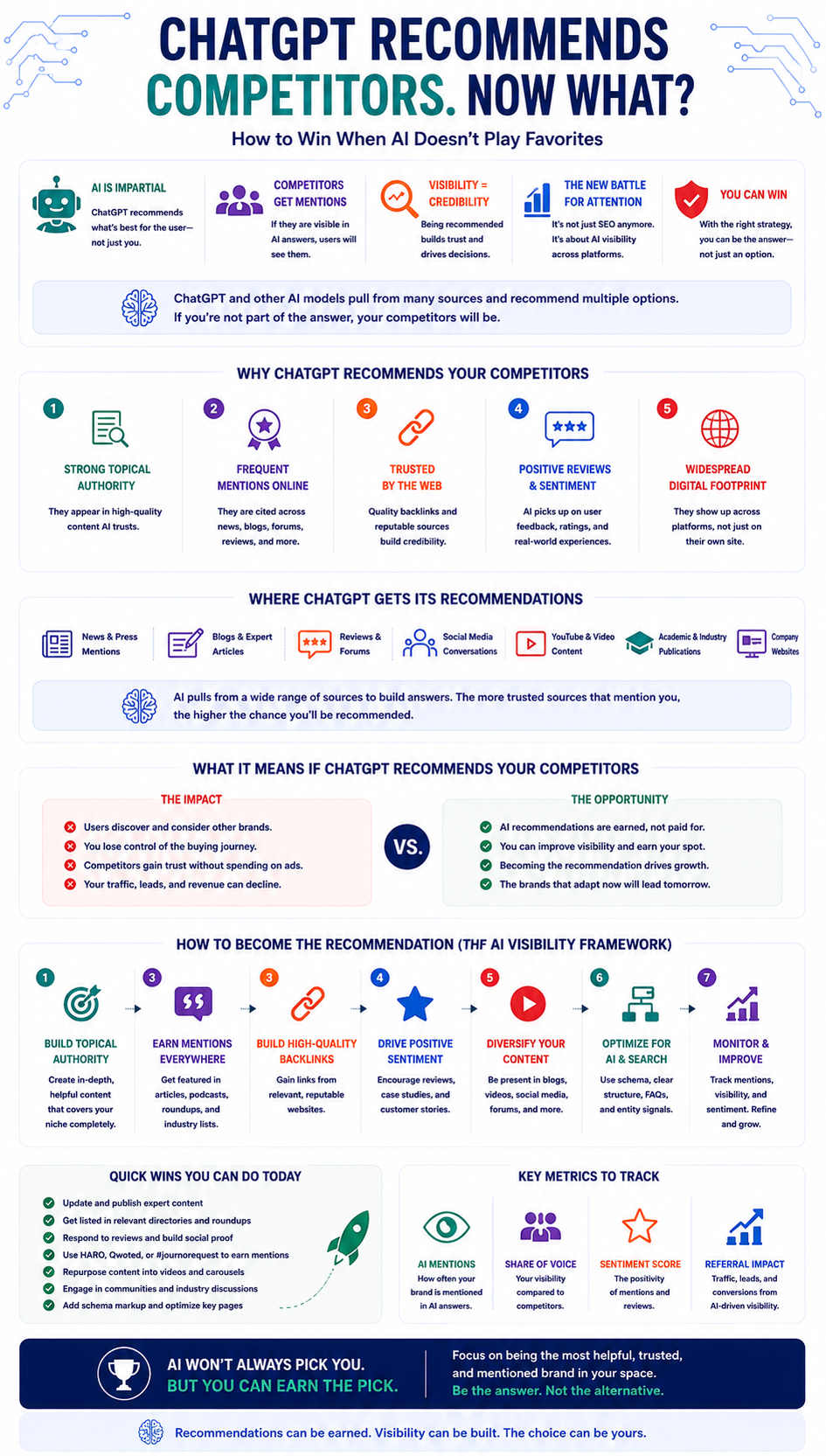
💡 Click the image to enlarge or download it for quick reference.
✨ Ready to stop losing leads to ChatGPT and start getting recommended? You don’t have to figure it out alone.
At HumanReach.ai, we build AI‑visible content engines that turn your expertise into trusted citations. Visit HumanReach.ai to explore how we help brands win in the AI search era.
Part 5: Why This Gap Exists (And Why Your SEO Agency Can’t Fix It)
The disconnect between Google rankings and AI recommendations is not random. Here is exactly why your competitors are winning:
- They built citation density, not just backlinks. AI models learn which brands matter from seeing them mentioned repeatedly across authoritative sources.
- They appear where AI looks. Reddit alone captures 46.7% of Perplexity’s top citations. Your competitors are present in these high-credibility contexts.
- They use structured data that AI can parse. GPT-4’s extraction rate jumps from 16% to 54% with proper schema.
- Their content is structured for extraction. 72.4% of posts cited in LLMs use Answer Capsules — direct 20-25 word answers after question-formatted headings.
- AI weights third-party sources more than your own site. If your homepage says you’re “the best” but no third-party source corroborates it, AI treats it as a marketing assertion.
For more on building authority that works for AI, read our guide on topical authority and why it replaced backlinks.
Part 6: How HumanReach.ai Reclaims Your Lost Leads
We don’t just tell you you’re invisible. We make you visible — and turn AI recommendations into booked demos.
| Phase | What We Do | Timeline |
|---|---|---|
| Audit | Map your current AI visibility vs top 5 competitors | Week 1 |
| Gap analysis | Identify exactly where competitors are being cited and why | Week 1 |
| Citation building | Earn mentions in “best of” lists, comparison content, and industry publications AI trusts | Weeks 2-8 |
| Entity optimization | Implement extraction-focused schema, fix positioning inconsistencies | Weeks 2-4 |
| Answer Capsules | Restructure key content for direct AI extraction | Weeks 2-6 |
| Reddit presence | Build authentic citations in subreddits where your buyers ask questions | Ongoing |
| Weekly tracking | Monitor Share of Voice growth across all major LLMs | Weekly |
What our clients typically see:
- First ChatGPT citations: Weeks 6-12
- Share of Voice improvement: 0% → 15-30% by Month 3-4
- AI-referred conversions: 10-15% of total leads by Month 4-6
- ROI positive: Month 4
For real‑world proof, read our case study on how a B2B SaaS company went from zero inbound to 30+ qualified leads per month or our industrial case study.
Frequently Asked Questions (FAQ)
1. Why does ChatGPT recommend my competitors instead of me?
ChatGPT recommends competitors because they have built citation density — mentions across authoritative sources like “best of” lists, review sites, and industry publications. AI models learn which brands matter from seeing them mentioned repeatedly across trusted sources. Your Google rankings don’t matter to ChatGPT.
2. How do I get ChatGPT to recommend my brand?
Focus on citation building, not SEO. Get mentioned in “best of” lists, comparison articles, and industry roundups. Implement FAQ schema (GPT-4’s extraction rate jumps from 16% to 54% with structured data). Write content in Answer Capsule format. Build authentic Reddit presence where your buyers ask questions. For a full framework, read our guide on how to get your brand into AI answers.
3. How many leads am I losing to ChatGPT?
Use the calculation in Part 3. As a benchmark: if your category has 50,000 monthly searches and you’re invisible in AI, you could be losing over $40M annually in potential revenue. AI-referred traffic converts at 14.2% — 5x higher than Google’s 2.8%.
4. What is the AI buyer journey?
The 5-stage AI buyer journey includes: Problem Framing, Shortlisting, Head-to-Head Comparison, Downside Research, and Internal Business Case Generation. Most brands are filtered out in Stage 1 or 2 before ever reaching a sales conversation.
5. Can my SEO agency fix this?
Probably not. Traditional SEO agencies optimize for Google rankings — which don’t correlate with AI citations. You need GEO: citation building, structured data for AI extraction, Answer Capsules, and presence where AI looks.
6. How long does it take to see results from GEO?
First ChatGPT citations typically appear in 6-12 weeks. Share of Voice improvement from 0% to 15-30% by Month 3-4. AI-referred conversions become measurable at Month 4-6. GEO is faster than SEO but still requires consistency.
7. What is the ROI of GEO?
GEO is faster (citations in weeks vs months for SEO) and AI-referred traffic converts at 5-10x higher rates than organic search.
Source: HumanReach.ai — Helping brands become the answer AI trusts and cites.
This article is part of the HumanReach.ai GEO Resource Hub.
Ready to Stop Losing Leads to ChatGPT?
Your competitors are winning deals you never knew existed. Don’t let them win another quarter.
About the author: This guide was created by HumanReach.ai, an organic growth agency that helps local and global businesses thrive in the AI Search Reality. Visit HumanReach.ai to learn more.