

Google AI search upgrade 2026 — On May 19, 2026, Google announced the most significant transformation to Search in over 25 years. This Google AI search upgrade 2026 includes AI Mode surpassing one billion monthly users, the introduction of Search agents, and Generative UI. These changes fundamentally change how brands will be discovered online.
Google AI Search Upgrade 2026: The 3 Biggest Announcements from I/O
“The goal of Search has always been simple: to help you ask anything on your mind — from quick facts to the deep, complex or hyper‑specific questions that can be hard to articulate,” wrote Elizabeth Reid, VP of Search at Google.
According to Gartner, traditional search volume is already projected to drop 25% by 2026. Google’s latest moves accelerate that shift dramatically.
This post breaks down what changed, what it means for your brand’s visibility, and how to prepare. If you are new to AI visibility, read our guides on what is AI visibility vs SEO and whether you need to adapt to AI search in 2026 first.
? Table of Contents
- The numbers: AI Mode surpasses 1 billion users
- Search agents: The 24/7 background researchers
- Generative UI: Search builds custom experiences for users
- Personal Intelligence: Search knows the user’s context
- What this means for your brand’s visibility
- How to prepare your brand for AI‑first Search
- Frequently Asked Questions (FAQ)
- Ready to build your AI‑visible brand?
The Numbers: AI Mode Surpasses 1 Billion Users
Just one year after its debut, Google’s AI Mode has surpassed one billion monthly users, with queries more than doubling every quarter since launch. Last quarter, Google saw its highest search query volume ever.
| Metric | Value |
|---|---|
| AI Mode monthly users | 1+ billion |
| Query growth rate | Doubling every quarter |
| Search query volume | All-time high |
Google is also upgrading AI Mode with Gemini 3.5 Flash as the new default model globally — the same model optimized for agents and coding.
For context on why this matters, read our guide on how to get your brand into AI answers.
Search Agents: The 24/7 Background Researchers
Google is entering the era of Search agents — AI agents that operate in the background, 24/7, intelligently reasoning across information to find exactly what users need at the right moment.
What they do:
- Monitor blogs, news sites, social posts, and real‑time data (finance, shopping, sports)
- Send intelligent, synthesized updates when changes occur
- Take action (e.g., notify when rental listings meet criteria)
Example from Google: “If you’re apartment hunting, you can brain dump all of the exact requirements you’re looking for, and your agent will continuously scan for you, notifying you when listings meet your needs.”
What this means for brands: Your content needs to be structured so that agents can extract and cite it. If your information is buried in PDFs or unstructured pages, agents will ignore it.
For more on structuring content for AI, read our guide on how to measure AI search performance.
Generative UI: Search Builds Custom Experiences for Users
Google is bringing agentic coding capabilities directly into Search using Google Antigravity and Gemini 3.5 Flash.
What it does:
- Search builds custom layouts (interactive visuals, tables, graphs, simulations) in real‑time
- Users can get custom dashboards or trackers for ongoing tasks (e.g., wedding planning, fitness tracking)
- These “mini apps” live in Search and users can return to them
Example from Google: “Say you’re looking to establish a new health and wellness routine. You can ask Search to build you a custom fitness tracker. Search will code it for you, tapping into fresh, real‑time sources including reviews, live maps and local data like the weather.”
What this means for brands: If Search is generating custom UIs from your data, your data needs to be structured, accessible, and trusted. FAQ schema, structured tables, and clear Q&A format become essential.
For more on structured data, read Schema.org FAQPage documentation.
Personal Intelligence: Search Knows the User’s Context
Google is expanding Personal Intelligence in AI Mode to nearly 200 countries and 98 languages — with no subscription required.
Users can securely connect:
- Gmail
- Google Photos
- Google Calendar (coming soon)
What this means for brands: AI Search will increasingly prioritize results that are relevant to the user’s personal context. Generic content will rank lower. Content that answers specific, situational questions will win.
What This Means for Your Brand’s Visibility
These changes fundamentally shift how brands get discovered online.
| Change | Impact on brands |
|---|---|
| AI Mode (1B+ users) | Brands must optimize for AI answers, not just links |
| Search agents (24/7 monitoring) | Content must be structured for agent extraction |
| Generative UI | Data must be trusted and structured for real‑time assembly |
| Personal Intelligence | Contextual relevance matters more than ever |
For a complete framework on adapting, read our guide on how Google and LLMs decide who is an expert.
? Google’s Biggest Search Upgrade in 25 Years — What It Means for Your Brand
Explore this comprehensive visual guide that breaks down Google’s landmark I/O 2026 announcement. It captures the three biggest changes — AI Mode surpassing 1 billion users, the introduction of 24/7 Search agents, and Generative UI that builds custom experiences in real-time. The infographic also maps out what these changes mean for brand visibility across each dimension and provides a clear action plan to prepare your brand for AI-first Search. A must-see resource for any brand that wants to stay visible as Google transforms how discovery works.
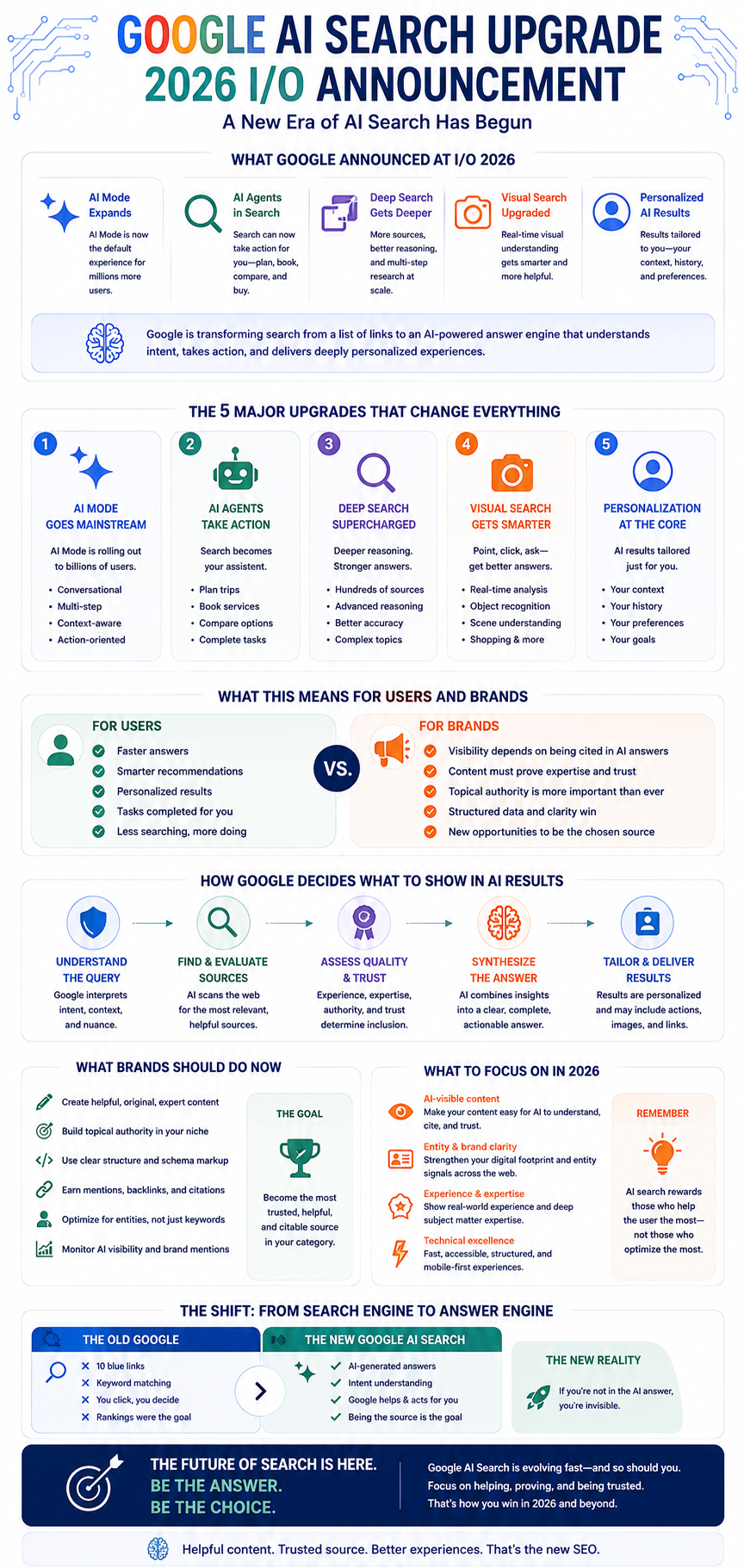
? Click the image to enlarge or download it for quick reference.
How to Prepare Your Brand for AI‑First Search
1. Structure your content for extraction
Use Q&A format (H2 = question, paragraph = answer). Add FAQ schema to every page. Agents and AI Mode prioritize structured content.
2. Optimize for specific, situational questions
Personal Intelligence means generic answers rank lower. Write content that answers “how do I solve [specific problem] in [specific context]?”
3. Make data machine‑readable
Replace PDFs and images with HTML tables and structured lists. Generative UI needs clean, accessible data.
4. Build topical authority
Agents monitor across the web. Brands that cover topics completely get cited more often. For more, read topical authority and why it replaced backlinks.
5. Monitor your AI visibility
Track where you appear in AI Mode and whether agents cite your content. For tracking methods, read how to measure AI search performance.
✨ Google just changed the rules of Search. Is your brand ready for AI‑first discovery?
At HumanReach.ai, we help brands optimize for AI Mode, Search agents, and Generative UI. Visit HumanReach.ai to explore how we build AI‑visible content engines.
Frequently Asked Questions (FAQ)
1. What is Google’s AI Mode and why does it matter?
AI Mode is Google’s AI‑powered search experience that provides direct answers instead of just links. With over 1 billion monthly users, it’s now mainstream. If your brand isn’t cited in AI Mode answers, you’re invisible to a huge and growing audience.
2. What are Search agents?
Search agents are AI agents that operate in the background 24/7, monitoring the web for specific changes or information. They synthesize updates and notify users. Your content needs to be structured so agents can extract and cite it.
3. How does Generative UI affect my brand?
Generative UI means Search can build custom layouts (tables, graphs, trackers) using your data in real‑time. If your data isn’t structured with FAQ schema and clean HTML, Generative UI won’t use it.
4. Do I need to change my SEO strategy?
Yes. Traditional SEO (keywords, backlinks, meta tags) is no longer sufficient. You need AI visibility: FAQ schema, Q&A format, conversational language, and structured data. Read our guide on what is AI visibility vs SEO.
5. How quickly do I need to adapt?
AI Mode already has 1 billion users. Search agents launch this summer. Generative UI is rolling out now. The window for early adoption is closing. Brands that adapt now will dominate AI visibility for their categories.
6. Can small brands compete with big brands in AI Search?
Yes. AI Mode and agents prioritize helpful answers, not domain authority. A small brand with well‑structured, specific content can out‑cite a large brand with generic content. Focus on answering specific questions better than anyone else.
7. What is the single most important action to take today?
Add FAQ schema to your top 10 informational pages. Pages with FAQ schema are 2‑3x more likely to be cited by AI. It takes 2 hours. Start there.
Source: HumanReach.ai — Helping brands win in the AI Search era.
Analysis based on Google I/O 2026 announcements. Read the original Google announcement here.
Ready to Build Your AI‑Visible Brand?
Google just changed the rules. Don’t wait for your competitors to adapt first.
About the author: This analysis was created by HumanReach.ai, an organic growth agency that helps local and global businesses thrive in the AI Search Reality. Visit HumanReach.ai to learn more.