


How to get your brand into ChatGPT, Gemini, and Perplexity answers? As conversational search dominance solidifies, this has become the foundational milestone for modern organic growth…
Fortunately, breaking into these generative engine indexes does not require a massive enterprise budget, months of waiting, or a deep technical background in data science.“We produce high-quality content and hold strong positions on Google. Yet, when enterprise buyers ask AI platforms for market recommendations, our competitors get cited and we are completely left out.”
This gap between traditional indexing and AI model retrieval is incredibly common, but bridging it is highly actionable. Successfully earning live AI citations comes down to a targeted five-step optimization sprint that your team can execute in less than ten hours of focused work.
With Gartner data capturing a structural 25% contraction in traditional desktop search volume, establishing a footprint inside these LLM architectures is a critical defensive measure. If you are still auditing the commercial stakes of this transition, our analysis on evaluating corporate readiness for generative search engines outlines exactly what is at risk.
At HumanReach.ai, we specialize in converting digitally invisible brands into trusted, primary sources for large language models. The framework below outlines the precise 30-day deployment strategy we use to help B2B brands secure active mentions across Perplexity and OpenAI’s ecosystem within weeks. For a high-level technical breakdown before diving into execution, review our baseline primer on how AI visibility mechanics differ from traditional SEO architectures.
? Table of Contents
- The 5-Step Execution Path
- Why Isn’t My Brand in AI Answers Yet?
- The 30-Day Blueprint (Weeks 1-4)
- Frequently Asked Questions (FAQ)
- The Bottom Line
The 5-Step Execution Path
Earning inclusion in conversational engine answers requires structured adjustments to your content delivery. Here is the operational overview:
| Step | Action | Time to see results |
|---|---|---|
| 1 | Audit current model share of voice | 1 hour |
| 2 | Deploy customized FAQ schema to core landing pages | 2 days |
| 3 | Seed high-authority answers on community platforms (Reddit/Quora) | 1 week |
| 4 | Restructure informational assets into clean Q&A format | 2 weeks |
| 5 | Establish weekly citation tracking frameworks | 4 weeks |
Most organizations remain invisible to large language models simply because they apply outdated ranking tactics. Once you begin establishing presence inside these neural networks, implementing a system to accurately monitor generative search metrics will keep your strategy aligned.
Why Isn’t My Brand in AI Answers Yet?
Diagnosing your brand’s absence from AI summaries is straightforward once you step out of a traditional web-crawling mindset. Our ongoing data audits at HumanReach.ai highlight three systematic bottlenecks that prevent corporate websites from being chosen as primary sources.
Reason 1 — LLMs don’t crawl like classic search engines
Traditional bots catalog indices based on link volume and keyword maps. Generative models like ChatGPT and Perplexity are highly selective filters that heavily prioritize:
- Verified community spaces (Reddit accounts for roughly 47% of Perplexity’s citation database)
- Strictly formatted, machine-readable structured markup
- Highly current data clusters refreshed within the trailing 30-90 days
- Clear, authoritative conversational statements over dense marketing jargon
Reason 2 — Your authority signals are isolated
Restricting your thought leadership to an isolated company blog drastically limits its visibility. AI models value cross-platform validation. To build momentum, your brand must have an active footprint on external authoritative hubs including specialized subreddits, target Quora communities, and executive LinkedIn networks.
Reason 3 — Content architecture lacks semantic clarity
Large language models rely heavily on clear query-to-answer matching. If your resources are hidden behind vast walls of prose without distinct structural signposts, the models cannot reliably parse out the answer. Implementing explicit structures outlined by the official Schema.org data guidelines resolves this translation issue immediately.
? How to Get Your Brand into ChatGPT, Gemini & Perplexity — 30-Day Framework
Explore this comprehensive visual guide that reveals the exact 30-day framework to get your brand cited by ChatGPT, Gemini, and Perplexity. It breaks down why LLMs don’t crawl like Google, where you need to be present, and how to structure your content for AI extraction. The infographic maps out the complete 4-week action plan — from auditing your current AI visibility and implementing FAQ schema, to building Reddit and Quora presence, optimizing content in Q&A format, and monitoring citations weekly. A must-see resource for any brand that wants to appear in AI answers without spending months or a huge budget.
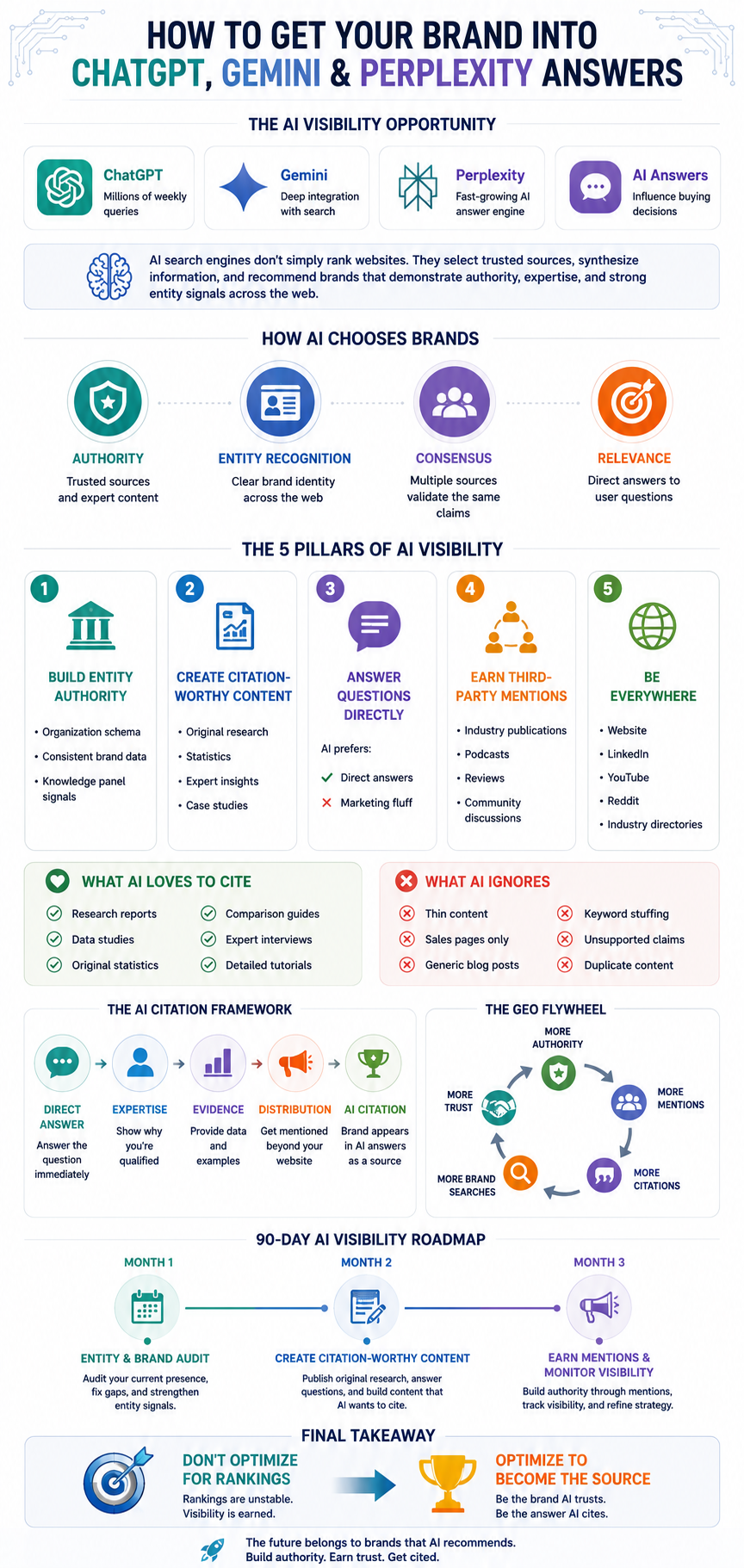
? Click the image to enlarge or download it for quick reference.
The 30-Day Blueprint (Weeks 1-4)
This systematic, 4-week framework mirrors the exact workflow we execute at HumanReach.ai to elevate corporate visibility within conversational environments.
Week 1 — Audit and Structural Markup
Days 1-2: Establish Your Data Baseline
Query the primary conversational models using core discovery prompts:
- ChatGPT: “What are the leading options for [your industry category]?”
- Perplexity: “Provide an objective profile of [your brand name]”
- Gemini: “How do I resolve [your target customer’s main operational bottleneck]?”
Log every baseline omission, link citation, or brand mention across platforms.
Days 3-5: Deploy Advanced Schema
Integrate dedicated, high-intent FAQ schema across your top ten service or content pages. Focus on real-world client queries rather than internal marketing copy. According to Google’s technical guidelines, pages featuring structured schema maintain a massive advantage in programmatic retrieval.
Week 1 Outcome: baseline metrics are documented and your data layer is accessible to AI scrapers.
Week 2 — Community Forum Integration
Days 8-10: Identify AI-Source Threads
Isolate industry-specific subreddits and query paths containing active discussions. Prioritize threads showing consistent community engagement, as these serve as direct citation feeder paths for tools like Perplexity.
Days 11-14: Provide Objective Solutions
Contribute five comprehensive answers per week. Avoid direct promotional copy. Instead, provide immediate value:
- Lead with a concise, direct thesis statement
- Utilize structured bulleted lists for immediate scannability
- Reference your brand or case studies objectively only where directly relevant
Week 2 Outcome: Your expertise is indexed inside key community repositories that feed real-time AI summaries.
Week 3 — Structural Optimization
Days 15-18: Re-architect Core Content Assets
Select three foundational informational articles and reformat them into direct, semantic question-and-answer pairs.
- Legacy Structure (Inefficient for AI): “Content marketing represents an integrated enterprise initiative designed to curate and manage highly authoritative editorial assets to engage a specific commercial audience.”
- Optimized Structure (Excellent for AI):
“H2: What is the primary objective of content marketing?”
“Content marketing is an operational strategy centered on creating clear, authoritative resources to successfully acquire and retain a targeted business audience.”
Days 19-21: Synchronize the Data Layer
Align your physical page headings with matching backend FAQ or HowTo schema properties to create an unassailable data signal.
Week 3 Outcome: Your main informational pages are perfectly structured for seamless LLM data extraction.
Week 4 — Analytics and Strategic Iteration
Days 22-28: Run Recurring Discovery Audits
Re-evaluate the exact baseline prompts established in Week 1. Log all newly emerged live citations. For a comprehensive tracking setup, reference our deployment blueprint on building an internal generative engine dashboard.
Week 4 Outcome: Clear attribution data showing exactly where your share of voice has scaled across conversational models.
✨ Transitioning your organic footprint to the AI search era doesn’t have to be a blind experiment.
At HumanReach.ai, we engineer tailored generative optimization strategies that anchor your brand inside the neural networks enterprise buyers rely on. Explore our solutions at HumanReach.ai.
Frequently Asked Questions (FAQ)
1. How do I get my brand into ChatGPT answers without paying for ads?
Securing organic real estate requires a focus on machine-readable optimization rather than media spend. Prioritize clean FAQ schema configurations, maintain an active presence inside heavily cited forums like Reddit, and present your web text in a natural Q&A syntax. Because these channels are largely ignored by standard teams, they offer the highest return on investment.
2. How long does it take to see my brand in AI answers?
Operational timelines show that Perplexity citations can register in as little as 3-4 weeks due to their aggressive real-time indexing models. ChatGPT integrations generally stabilize within 4-6 weeks, while complex Google AI Overviews listings can require 6-8 weeks, depending on existing domain authority. Tangible lifts in branded search metrics usually emerge within the 60-to-90-day window.
3. Does my brand need to be on Reddit to get cited?
While not strictly mandatory, omitting community platforms leaves significant visibility on the table. Verified data indexes show that community conversations represent up to 47% of modern informational citations. Contributing authoritative, completely non-promotional solutions to niche community threads ensures your insights populate the primary LLM dataset hubs.
4. What is the #1 fastest way to get cited by ChatGPT?
Deploying structured FAQ schema remains the single fastest technical adjustment. Transforming raw paragraphs into cleanly indexed questions makes your content significantly easier for LLMs to safely extract and attribute, often doubling citation probability within your immediate niche.
5. How do I check if my brand is already in AI answers?
Run regular diagnostic searches across ChatGPT, Perplexity, and Gemini. Use varied category, brand, and problem-centric prompts to chart where your brand appears organically. Documenting these interactions every week creates a reliable performance baseline.
6. Do I need to be on all AI platforms (ChatGPT, Gemini, Perplexity)?
Your optimization foundational work scales across platforms naturally, even though their index sources differ slightly. While Perplexity relies heavily on recent public discussions and ChatGPT rewards structured site documentation, focusing on an integrated strategy of schema deployment and community visibility covers the clear majority of LLM discovery routes.
7. What if my brand is in a competitive niche?
High-competition environments are uniquely advantageous because the vast majority of legacy competitors are still focusing entirely on old keyword rankings. By pivoting your resources toward semantic data structures, you can secure valuable AI citations long before traditional market leaders adapt to the shift.
8. Can small brands beat big brands in AI answers?
Absolutely. LLM selection frameworks prioritize precise topical accuracy, context, and structural clean formatting over historic domain size or massive link profiles. A agile brand implementing pristine data schemas can routinely out-cite larger legacy enterprises.
9. How do I measure if my AI visibility strategy is working?
Monitor your performance across three clear indicators: active citation presence within target model prompts, direct increases in branded search queries inside Google Search Console, and upward trends in direct or branded entry conversions. For full execution metrics, review our strategic analysis on measuring B2B generative engine attribution.
10. What is the single biggest mistake brands make with AI visibility?
The most costly error is taking a passive approach. Treating conversational engine footprint as a long-term future consideration allows competing brands to occupy and dominate the core datasets. Dedicating even minimal time to schema integration provides a massive competitive advantage.
The Bottom Line
Succeeding in the era of generative discovery comes down to a concise, structured 30-day framework:
| Week | Action | Estimated Investment |
|---|---|---|
| 1 | Run initial discovery audits & deploy core site schema structures | 2-3 Hours |
| 2 | Seed high-intent, authoritative forum solutions | 2 Hours |
| 3 | Re-architect foundational informative pages into structured Q&A | 3-4 Hours |
| 4 | Monitor conversational footprint and optimize dataset connections | 30 Min / Week |
Total Execution Commitment: ~10 total hours distributed across the month.
Organic visibility has evolved past simple link networks. The brands winning this market shift are those restructuring their digital footprints for machine trust. Taking just fifteen minutes to initiate your first discovery audit is all it takes to begin.
To further explore foundational mechanics, read our complete guide comparing AI optimization versus classic SEO architectures, or review our operational blueprint on building internal performance dashboards.
Source: HumanReach.ai — Pioneering AI Visibility frameworks for forward-thinking brands.
This insight article is an official release within the HumanReach.ai Generative Optimization Resource Network.
Ready to Build Your Own AI‑Visible Pipeline?
You don’t need to be a content expert. You don’t need a big agency. You need the right framework and the right engine.
About the author: This guide was created by HumanReach.ai, an organic growth agency that helps local and global businesses thrive in the AI Search Reality. Visit HumanReach.ai to learn more.