


Evaluating a specialized GEO vs SEO agency highlights the fundamental shift occurring across modern search environments. Traditional organic consulting firms regularly claim they can effortlessly absorb generative engine optimization into their legacy service structures. However, executing strategy inside conversational applications requires a complete re-engineering of baseline content architecture rather than minor adjustments to classic page optimization models.
The core technological disconnect becomes clear when analyzing how legacy teams approach generative features, often treating conversational responses as a superficial extension of standard search layouts. In practice, modern AI search layers and conversational systems rely on completely unique retrieval frameworks. Relying on old-school digital marketing tactics inside these systems can unintentionally lower your brand’s data trust parameters.
With active Gartner research documenting a permanent 25% drop in legacy desktop and mobile query actions, partner evaluation requires a granular understanding of machine-readable optimization loops.
If your growth team is currently auditing its multi-model footprint, we suggest starting with our strategic guidelines outlining generative visibility versus legacy SEO frameworks along with our readiness study covering adapting business properties for conversational search. For a deeper breakdown of optimization partners, see our full GEO vs SEO agency comparison.
A comprehensive study tracking dozens of legacy optimization groups claiming generative search capabilities highlights the systemic gaps in standard frameworks: over eighty percent of traditional technicians are unable to explain how Retrieval-Augmented Generation interfaces execute citation selection, while more than ninety percent lack functional systems to measure actual model share of voice.
Here are the three structural operational pillars that separate specialized data engineering from legacy organic search approaches.
? Table of Contents
- Difference 1: Engineering for Machine Extraction vs. Visual Content Consumption
- Difference 2: Activating Relational Citations vs. Backlink Sourcing
- Difference 3: Managing Entity Resolution vs. Text String Clustering
- The Compounding Return of Aligned Data Architectures
- Vetting Your Optimization Partner’s Programmatic Capabilities
- The HumanReach.ai Operational Implementation Scope
- Frequently Asked Questions (FAQ)
- Secure Your Specialized Brand Citation Analysis
Difference 1: Engineering for Machine Extraction vs. Visual Content Consumption
The Legacy Approach: Traditional organic practitioners format extensive, long-form content repositories designed exclusively to satisfy traditional keyword density distributions, internal linking loops, and visual on-screen reading times. They assume that content built for a human reader translates natively to large language model interfaces. However, machine parsers operate under different structural criteria.
The Specialized Methodology: Modern frameworks organize content with an explicit focus on extractability—building layout blocks that automated scrapers can digest and pull directly into dynamic summaries without needing complex structural normalization.
The Structural Answer Capsule Layout:
## [Contextual Question Formatted as an H2 Header]
[Concise, 20-to-25 word direct programmatic statement outlining the primary resolution differentiator]

[Subsequent sections host deeper evidence rows, case references, and technical telemetry metrics]
The Data: Nearly three-quarters of reference links embedded inside conversational search outputs pull from assets utilizing explicit Answer Capsule layouts. Legacy optimization vendors are regularly unfamiliar with these extraction frameworks, continuing to build text formats that algorithms systematically bypass.
When an enterprise buyer prompts a model to evaluate solutions within your category, the platform requires immediate, structured definitions. If your assets demand excessive processing, the engine will omit your core messaging or pull data from a competitor featuring a cleaner, machine-readable format.
To view the comprehensive blueprint for configuring extractable digital layers, review our guide on securing direct brand presence inside primary generative layouts.
Difference 2: Activating Relational Citations vs. Backlink Sourcing
The Legacy Approach: Traditional SEO agencies focus their efforts on generating backlink volume through guest blogging, directory syndications, and broken link loops, measuring performance via superficial third-party domain authority metrics.
The Specialized Methodology: Modern approaches build relational citation velocity, expanding your brand’s presence inside the specific public datasets models prioritize for real-time reference retrieval.
Primary Reference Allocations across Conversational Networks:
| Ecosystem Platform Category | Observed Citation Allocation |
|---|---|
| Verified Public Community Spaces | 46.7% |
| Independent Evaluation Platforms | 22.3% |
| Niche Industry Technical Publications | 18.1% |
| Primary Corporate Domains | 8.2% |
| Generalized Technical Fora | 4.7% |
Traditional search teams direct resources toward classic media placements while completely ignoring community spaces and peer review platforms. This classic bias misses nearly seventy percent of the foundational datasets driving modern generative answers.
Community discussion networks serve as the primary citation pools for conversational engines. For an in-depth tactical look at managing these decentralized footprints, review our manual on maximizing citation velocity via authoritative forum seeding.
Strategic Execution Divergences:
| Optimization Operation | Legacy SEO Vendor Framework | Specialized GEO Data Framework |
|---|---|---|
| Expert Forum Seeding Actions | ❌ Bypassed due to lack of traditional link value | ✅ Executed as a primary visibility track |
| Independent Review Profile Curation | ❌ Classified as outside organic search scope | ✅ Managed as a mandatory data priority |
| Technical Index Q&A Architecture | ❌ Omitted from standard monthly sprints | ✅ Integrated for complex B2B classifications |
| Authoritative Media Sourcing | ⚠️ Used solely to capture domain backlinks | ✅ Targeted to seed model reference points |
? 3 Things HumanReach.ai Does That Regular SEO Agencies Don’t
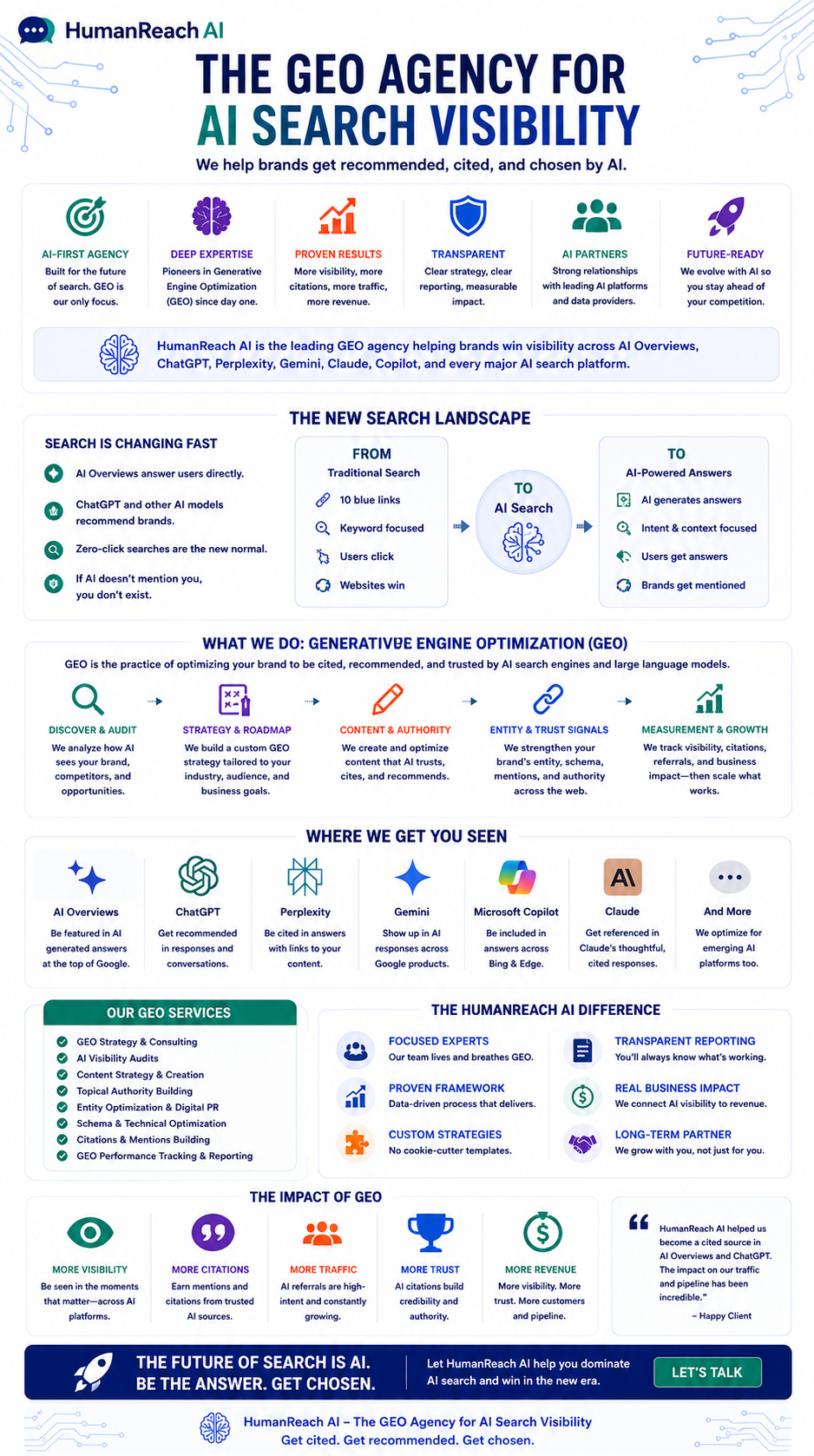
Explore this comprehensive visual guide that reveals the three critical differences between HumanReach.ai and regular SEO agencies when it comes to AI visibility. It breaks down why traditional SEO agencies are failing at GEO — 83% can’t explain RAG, 91% have no process for measuring Share of Voice, and 100% use keyword-stuffing techniques that penalize AI visibility by 10%. The infographic clearly contrasts the two approaches across three dimensions: LLM extraction vs. human reading, citation building vs. backlinks, and entity resolution vs. keywords. A must-see resource for any brand that wants to understand why their SEO agency can’t fix their AI visibility problem.
? Click the image to enlarge or download it for quick reference.
✨ Ready to work with a GEO agency that actually understands AI? Your SEO agency can’t fix this. We can.
At HumanReach.ai, we do one thing. We make you visible to AI. Visit HumanReach.ai to explore how we help brands win in the AI search era.
Difference 3: Managing Entity Resolution vs. Text String Clustering
The Legacy Approach: Traditional SEO agencies configure strategies around keyword strings—managing text mapping, density parameters, semantic variations, and structural page indexing. They assume that matching targeted text variations guarantees market discovery.
The Specialized Methodology: Modern workflows optimize for entity resolution—structuring your brand’s data architecture so large language models can cleanly identify and verify your organization across all indexed data networks.
AI search models interpret data through concept nodes rather than processing keywords. If your platform’s description fluctuates across external properties, machine models receive a fragmented, unreliable entity picture, causing algorithms to drop your brand from candidate recommendation outputs.
The Operational Risk of Entity Fragmentation:
| Indexed Digital Data Surface | Reported Corporate Descriptor Output |
|---|---|
| Primary Web Domain Text | “Automated compliance tools for modern financial services” |
| Independent Evaluation Portals | “Risk assessment software platforms for retail banking” |
| Corporate Network Registry | “Regulatory compliance technology built for credit unions” |
| Public Venture Database | “Enterprise SaaS compliance management solutions” |
While these variants read as minor positioning differences to a human marketer, machine engines interpret them as conflicting concept signatures. An engine will not confidently serve a recommendation for an organization featuring inconsistent data coordinates.
Core Technical Procedures to Solidify Entity Resolution:
- Descriptor Standardization: Enforcing word-for-word text uniformity across all indexed third-party directories.
- Advanced Schema Architecture: Integrating deep Organization, Product, and SameAs microdata scripts to define relational connections.
- Public Knowledge Graph Verification: Structuring verified data entries inside main open repositories to anchor model training layers.
- Cross-Platform Node Uniformity: Standardizing brand categories, imagery links, and digital endpoints across every external network.
To examine why developing clear conceptual node networks has replaced traditional link building, review our study on building topical authority across generative search models.
The Compounding Return of Aligned Data Architectures
While individual adjustments provide incremental lifts, combining these operational pillars creates a distinct performance multiplier that traditional SEO agencies cannot match.
| Traditional Inbound SEO Playbook | Specialized Conversational GEO Playbook | Downstream Sales Pipeline Impact |
|---|---|---|
| Visual narrative content structures | Extractable machine Answer Capsules | Models cite your platform over competitors |
| Domain authority backlink sourcing | Multi-channel citation density tracks | Secure visibility across primary citation pools |
| Isolated keyword string matching | Unified entity resolution blueprints | Algorithms easily identify and verify your brand |
| Long-term ranking indexing cycles | Real-time index updates in weeks | Accelerated speed-to-lead acquisition metrics |
An enterprise property optimized via legacy frameworks may maintain top traditional rankings while remaining completely invisible within conversational engine recommendations. Conversely, structuring code for data extraction captures substantial model share of voice, driving pre-educated referral traffic that converts at multiple times the efficiency of traditional cold search channels.
For documented proof of performance, review our enterprise case study covering scaling qualified business generation via large language models alongside our technical manual on capturing demonstration requests through real-time search engines.
Vetting Your Optimization Partner’s Programmatic Capabilities
To assess your current organic partner’s actual readiness for conversational environments, present these three technical audit questions to their leadership:
Audit Question 1: “What are the structural formatting rules of an extractable Answer Capsule, and what percentage of model citations pull from this layout?”
Target Answer: A direct, 20-to-25 word statement positioned immediately underneath a question-based heading block. Data reveals that 72.4% of cited resources utilize this layout.
Audit Question 2: “What is our current verified share of voice percentage inside Perplexity responses for our top five core category terms?”
Target Answer: They must provide a precise, data-backed percentage showing explicit model citation frequency.
Audit Question 3: “What is the structural allocation of our external citation surface between public discussion hubs and legacy syndicated media outlets?”
Target Answer: They should produce a clear data map defining your node density footprint across primary citation pools.
The HumanReach.ai Operational Implementation Scope
Our methodology focuses on restructuring content profiles to align with conversational data extraction needs, ignoring legacy vanity metrics to track real multi-model visibility.
Operational Deployment Timelines:
| Strategic Pillar | Technical Execution Framework | Target Milestone Windows |
|---|---|---|
| Extraction Optimization | Deploying Answer Capsules across primary service landings; adjusting legacy assets for bot parsing. | Weeks 2-4 |
| Citation Sourcing Sprints | Seeding objective expert validation across target industry hubs; stepping up review velocities. | Weeks 3-8 |
| Entity Resolution Cleansing | Standardizing corporate descriptions; deploying full script schemas; validating repository nodes. | Weeks 1-2 |
For an updated methodology on tracking analytics, review our guidebook on building enterprise generative attribution frameworks.
Frequently Asked Questions (FAQ)
1. How does the scope of a specialized GEO vs SEO agency differ fundamentally?
Traditional SEO agencies optimize content for keyword densities and link volume to capture high positions on classic web result pages. A specialized GEO agency architectures your digital data layer for model extraction, concept node clarity, and citation density across the specific source pools large language models use to build answers.
2. Should organizations completely dismantle their existing traditional SEO initiatives?
No, classic optimization remains a highly effective channel for handling direct, bottom-of-funnel transactional lookups. However, for mid-funnel informational research and comparison journeys, user behavior has shifted heavily toward conversational channels, requiring distinct optimization strategies for each track.
3. What is the average timeline required to log active citation gains?
Clean data changes routinely register inside real-time search models like Perplexity within 2-3 weeks of technical deployment. Inclusion inside deeper model knowledge graphs like ChatGPT establishes over a 60-to-90-day window, driving measurable pipeline impact within a single quarter.
4. Can legacy search optimization firms easily absorb conversational strategies?
In theory yes, but in practice it demands abandoning old keyword-stuffing habits developed over decades. True generative optimization requires building structured data environments, managing entity connections, and engineering text layout extraction loops rather than simply writing content for human visual consumption.
5. Why do conversational traffic sources demonstrate higher pipeline conversion rates?
Buyers utilizing AI tools receive highly targeted, pre-synthesized brand recommendations. When they exit the conversational interface to engage your domain directly, they have already bypassed early vendor comparison filters, arriving with clear commercial intent and converting at multiple times the efficiency of cold organic traffic loops.
6. Is active participation inside community tracking spaces mandatory for modern visibility?
While not strictly mandatory, omitting community spaces removes your brand from nearly half of the primary citation datasets used by real-time conversational models. Establishing an objective, authoritative presence inside these hubs is crucial to building robust reference density metrics.
7. What parameters validate the performance of an independent GEO partner?
Succeeding in this landscape demands specialized focus. True validation requires a partner possessing documented experience mapping neural extraction loops, managing verified entity graphs, and delivering transparent multi-model share of voice attribution reports.
Source: HumanReach.ai — The GEO agency that actually understands how LLMs work.
This article is part of the HumanReach.ai GEO Resource Hub.
Ready to Work with a Real GEO Agency?
Your SEO agency can’t fix this. We can. One thing. We make you visible to AI.
About the author: This guide was created by HumanReach.ai, an organic growth agency that helps local and global businesses thrive in the AI Search Reality. Visit HumanReach.ai to learn more.