


Adapting to the rise of zero-click search has become the single most urgent priority for enterprise marketing teams in 2026. You wake up, check your analytics channels, and notice that organic web traffic pipelines are contracting at double-digit rates year-over-year. Traditional agency partners continue to claim that core keyword rankings are holding steady, yet execution teams are left scrambling as legacy revenue loops fail to connect.
This structural misalignment points to an underlying marketplace shift: roughly 60% of mainstream discovery journeys now resolve entirely within the interface of origin, completely bypassing third-party sites. Enterprise users pose intricate questions, generative engines synthesize accurate technical summaries directly on-screen, and the session closes. Your technical assets successfully trained the engine’s model, but your digital property received zero baseline traffic attribution.
With ongoing Gartner data documenting a permanent 25% drop in classic desktop query activity, this trajectory represents a permanent shift in customer discovery. This is not a standard algorithmic re-indexing phase; it is an intentional architecture update that has fundamentally dissolved the direct traffic funnels that powered customer acquisition strategies for decades.
If your organization is currently adapting to this shift, we suggest starting with our baseline technical deep-dives on semantic visibility vs. legacy SEO along with our commercial readiness analysis regarding adapting to corporate conversational search parameters. For an operational implementation plan, review our comprehensive 30-day GEO blueprint. To assess whether your digital properties are structurally affected, reference our checklist covering uncovering programmatic visibility drops.
Without targeted structural changes, your specialized knowledge-base posts, market case studies, and informational landing assets function purely as uncompensated training fuel for major LLMs—completely isolated from the target prospects you intended to capture.
Here is the underlying architecture of this transition, why legacy capture mechanics have stalled, and how to configure a modern pipeline designed specifically for an ecosystem driven by real-time citations.
Evaluating the Metric Shift: The Hard Data
Evaluating conversational interfaces requires studying user behavior within native environments. Review the benchmark engagement data below:
| Search Query Category | Zero-Click Engine Resolution Rate |
|---|---|
| Global Query Average across Engines | 60%+ |
| Informational Journeys (“how to resolve,” “technical definition”) | 75-85% |
| Commercial Research (“best software choices,” “platform comparison”) | 45-55% |
| Direct Transactional Queries (“enterprise tier pricing,” “schedule demo”) | 25-35% |
Programmatic Performance Impacts During Live AI Summaries:
| Performance Metric | Standard Results Layout | Active AI Response Box Layout |
|---|---|---|
| Click-Through Rate for Top Organic Rank | ~27-30% | ~11% |
| Combined Clicks Across Remaining Organic Layout | ~35-40% | ~8% |
| Direct Interaction Lifts via AI Inline Links | N/A | ~1% |
For an engineering perspective on why standard keyword position reports fail to safeguard your downstream demand pipeline, read our detailed look at the generative engine traffic crisis.
? 60% of Searches End Without a Click — Your Funnel Is Destroyed
Explore this comprehensive visual guide that reveals the devastating reality of zero-click search in 2026. It breaks down the brutal numbers — 60%+ zero-click rates overall, 75-85% for informational queries, and CTR for #1 results dropping from 30% to just 11% when AI Overviews appear. The infographic explains how AI Overviews have decoupled rankings from traffic, why your SEO agency’s “rankings are holding” report is misleading, and maps out the new funnel that replaces the broken one — from AI citations to branded search to direct conversion. A must-see resource for any brand that wants to understand what’s happening and how to rebuild their funnel for the AI era.
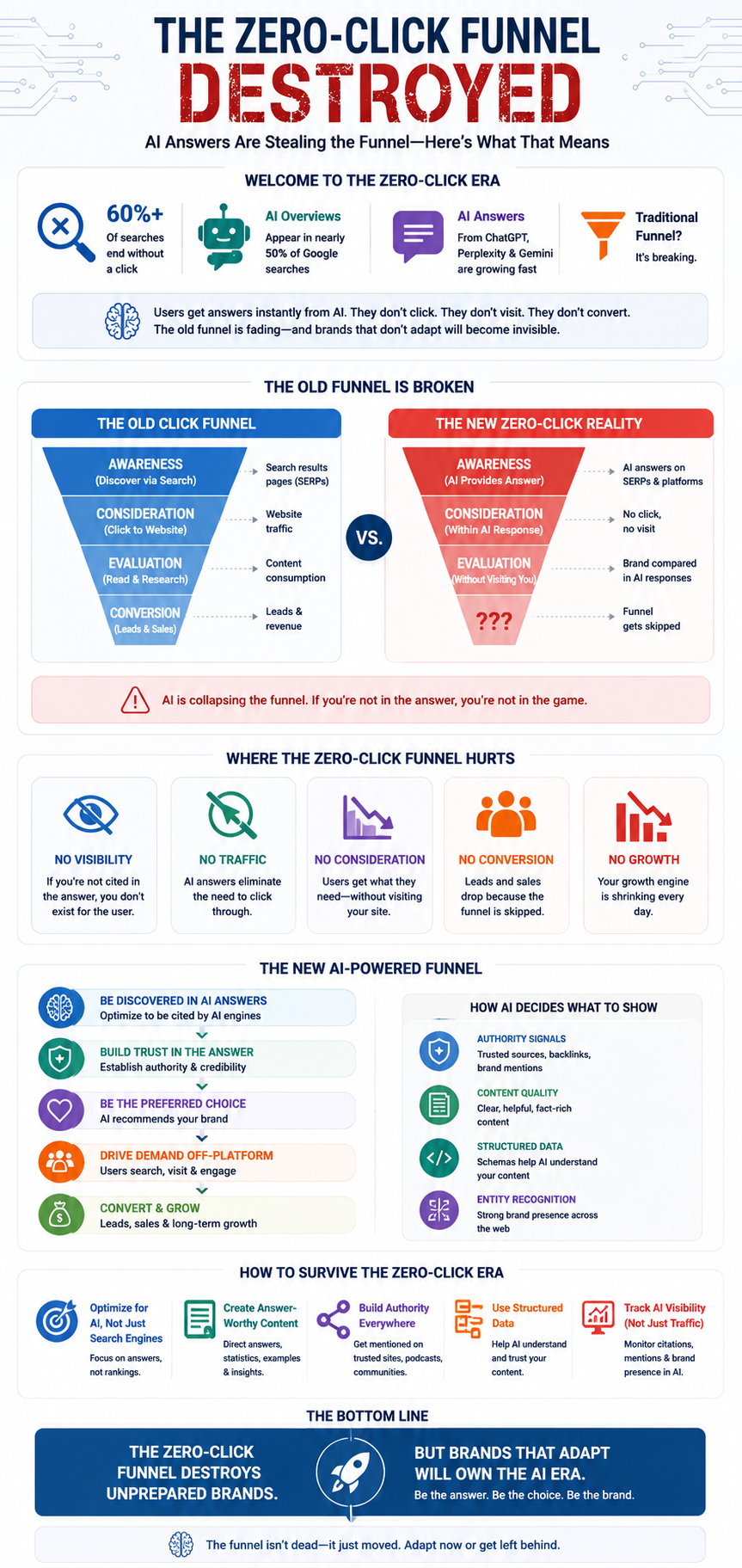
? Click the image to enlarge or download it for quick reference.
Why the Legacy Inbound Pipeline Stalled
The standard content framework sustained enterprise pipeline volume for over two decades. The loop was linear: establish index authority for informational variations, harvest the high click-through volume, nurture that pool of users with middle-of-funnel validation assets, and drive final brand pipeline conversions.
The Current Reality: Conversational interfaces extract text strings and answer top-of-funnel questions natively. Users absorb the solution within the prompt framework, eliminating the intent to leave the application interface. Without standard click pathways, conventional site metrics drop, leaving subsequent retargeting steps broken from the outset.
Because informational assets are digested within the platform layer, your downstream product documentation and deep features pages are obscured from general visibility. This structural disruption requires clear, proactive data adjustments.
Why “Holding Steady” Is a Misleading Reporting Metric
Standard reporting mechanisms often focus on position performance, presenting clean charts highlighting static top positions. Concurrently, real-world customer acquisition from organic search loops displays steep declines.
This variance occurs because keyword metrics measure technical position while pipeline volume requires real engagement. Active AI layouts decouple these parameters entirely:
| Ecosystem Phase | Reported Rank | Average CTR | Attributed Traffic Clicks (Per 10k Volume) |
|---|---|---|---|
| Traditional Desktop SERP Framework | 1 | 30% | 3,000 inbound clicks |
| Generative Interface Layout Placement | 1 | 11% | 1,100 inbound clicks |
Your technical code position remains completely unchanged, yet the resulting inbound buyer volume falls by over 60%. Treating static rankings as proof of pipeline health masks a systemic contraction in performance.
For an updated operational guide to tracking metrics that dictate pipeline value, review our breakdown on architecting enterprise generative attribution reporting.
The Modern Conversion Journey: Search 2.0
Adapting to zero-click resolution requires shifting focus from absolute referral traffic to cross-model brand density. When access pathways adapt, the inbound loop must pivot toward programmatic validation.
The Operational Framework for Conversational Demands:
- Phase 1: Generative Model Citation — Your platform assets are crawled, validated, and embedded as a verified citation source by tools like ChatGPT, Claude, and Perplexity.
- Phase 2: Multi-Model Footprint — Targeted buyers encounter your brand consistently across independent AI research queries. Repeated citations establish authority entirely within the platform interface.
- Phase 3: High-Intent Direct Discovery — Educated buyers exit the conversational environment and query your organization explicitly by name, bypassing general competitive comparisons.
- Phase 4: Targeted Conversions — Buyers access your digital domain with clear commercial intent, converting at multi-fold efficiency compared to cold organic traffic channels.
The core strategic goal shifts: your value is driven by persistent engine validation rather than direct informational clicks. This is why branded search lifts serve as the leading indicator for modern GEO return on investment.
For real-world performance verification, read our latest B2B case study on scaling enterprise conversion volume via conversational search engines.
The Economic Reality of Zero-Click Gaps
Measuring the direct pipeline value lost to zero-click resolution provides clear strategic context.
Standard Pipeline Analysis:
- Baseline Monthly Organic Inbound Volume: 10,000 sessions
- Average Zero-Click Resolution Footprint: 60%
- Diverted Traffic Opportunity: 6,000 missing sessions
- Baseline Site Conversion Performance: 3%
- Diverted Monthly Opportunities: 180 enterprise leads
- Average Contract Close Efficiency: 20% | Target Contract Values: $5,000
- Estimated Pipeline Deviation: 180 × 0.2 × $5,000 = $180,000 in monthly enterprise value
This baseline calculation highlights real buyer volume currently captured within conversational engine interfaces rather than your standard sales pipeline. Quantifying the gap between your present visibility metrics and your potential generative search share of voice defines the cost of strategic inaction.
Safeguarding Your Intellectual Property
The primary challenge of conversational search optimization centers on value asymmetry. Large language models leverage your specialized web assets to answer queries natively while retaining the user within their ecosystem.
To capture value in this environment, your brand must transition from an isolated publisher into an unassailable data entity. By establishing definitive structural links across the knowledge graphs that power LLM synthesis, you ensure that models must cite your brand, transforming your content from anonymous training material into an authoritative recommendation source.
For a step-by-step framework covering implementation protocols, read our operational deep-dive on optimizing corporate content assets for direct AI model synthesis.
Industry Disruption Variances
Evolving user habits impact digital spaces across different operational scales:
High Exposure (75-85% Zero-Click Resolution): Standard B2B software directories, informational education platforms, health knowledge networks, personal finance portals, and digital publishers.
Moderate Exposure (45-60% Zero-Click Resolution): Mid-market e-commerce research, generalized corporate consulting services, and regional business directories.
Low Exposure (25-35% Zero-Click Resolution): Direct transactional checkout interfaces, highly complex enterprise software configurations, and specialized high-consideration commercial partnerships.
Architecting Your 2026 Optimization Sprint
Sprint Phase 1: Structural Extraction Readiness (Weeks 1-4)
Deploy custom microdata structures to elevate content extraction rates from 16% to 54%. Re-architect key pages into high-clarity Answer Capsules to maximize inclusion in real-time answers. Standardize entity nodes and refresh data loops older than 13 weeks.
Sprint Phase 2: Citation Footprint Expansion (Weeks 4-12)
Establish expert footprints inside heavily crawled communities like Reddit, which drives up to 46.7% of Perplexity’s reference points. Enhance reviews on verified third-party portals and secure references in core vertical publications. For tactical execution guidelines, review our analysis on maximizing citation distribution via authoritative platform loops.
Sprint Phase 3: Dynamic Attribution Analysis (Ongoing)
Track weekly variations across branded query trends, direct traffic volume, multi-model share of voice, and direct conversational entry points.
Sprint Phase 4: Downstream Sales Alignment (Ongoing)
Integrate multi-channel attribution checks into discovery loops, optimize sales messaging for highly informed buyers, and build explicit comparison content to streamline model retrieval.
✨ Ready to rebuild your conversion pipeline for the AI search era? You don’t have to navigate this transition alone.
At HumanReach.ai, we construct optimization frameworks designed to capture value from citations, not just raw link clicks. Partner with HumanReach.ai today.
How HumanReach.ai Modifies Your Inbound Performance
Our methodology focuses on restructuring your content architecture to match modern discovery frameworks, ensuring consistent visibility as user habits adapt.
Operational Milestone Timelines:
- Weeks 2-4: Verification of initial source citations across Perplexity indexes.
- Weeks 4-8: Measurable growth within baseline branded query volume (+5-15%).
- Weeks 6-12: Structural indexing and active reference inclusion within ChatGPT threads.
- Month 3: Upward trending direct-to-domain entry metrics (+10-20%).
- Months 3-4: Documented customer generation sourced explicitly from conversational references.
- Months 4-6: Balanced inbound pipelines featuring 10-30% direct conversational search attribution.
Frequently Asked Questions (FAQ)
1. Is SEO dead in 2026?
No, search optimization is adapting rather than disappearing. While a 60% zero-click baseline presents clear traffic challenges for informational queries, standard search engines remain highly effective channels for direct transactional queries. Succeeding today requires blending classic visibility practices with generative engine optimization (GEO) to capture buyers throughout the discovery cycle.
2. How do I measure if my funnel is broken?
Analyze three primary data points: a persistent 10-30% downward trajectory in standard organic informational traffic, flat or declining branded search query trends within your reporting logs, and a complete absence of mentions across target conversational models. Negative trends across all three confirm your inbound funnel requires structural updates.
3. How long does it take to rebuild the funnel?
Initial citation presence across real-time indexers like Perplexity typically establishes within 2-4 weeks. Lifts in branded discovery queries develop over 4-8 weeks, while structural citations inside ChatGPT take 6-12 weeks. Fully realized conversational source lead loops settle into consistent performance over 3-6 months.
4. What is the most important metric in the new funnel?
Branded search lift represents your primary leading metric. When target buyers encounter your platform within conversational answers, they regularly move to direct discovery loops to assess your business. This growth in explicit search volume serves as clear validation before final sales conversions arrive.
5. Do I need to stop creating top-of-funnel content?
No, but the content architecture must adapt. Narrative long-form prose should be replaced with concise, hyper-focused Answer Capsules. Structuring direct, 20-25 word answers immediately underneath distinct, question-based subheadings matches the formatting required for maximum model extraction.
6. How is Perplexity different from ChatGPT for funnel rebuilding?
Perplexity treats real-time web execution and index refreshes within a 2-5 day window, while passing transparent referral parameters to web property dashboards. ChatGPT operates across structured knowledge-graph releases, making Perplexity your best indicator for immediate optimization tracking.
7. What is the ROI of rebuilding the funnel?
Transitioning from zero conversational baseline visibility to a sustained 30% multi-model share of voice can reclaim significant enterprise pipeline value. Based on our market models, optimized organizations routinely achieve complete return on investment within 3-4 months of active deployment.
Source: HumanReach.ai — Helping brands rebuild their funnels for the AI era.
This article is part of the HumanReach.ai GEO Resource Hub.
Ready to Rebuild Your Funnel for the AI Era?
With 60% of searches resolving without an external click, your old traffic frameworks must adapt. Let’s engineer your new acquisition engine.
About the author: This guide was created by HumanReach.ai, an organic growth agency that helps local and global businesses thrive in the AI Search Reality. Visit HumanReach.ai to learn more.